George : English Fine and Decorative Arts
George Presents

Original Presentation Script
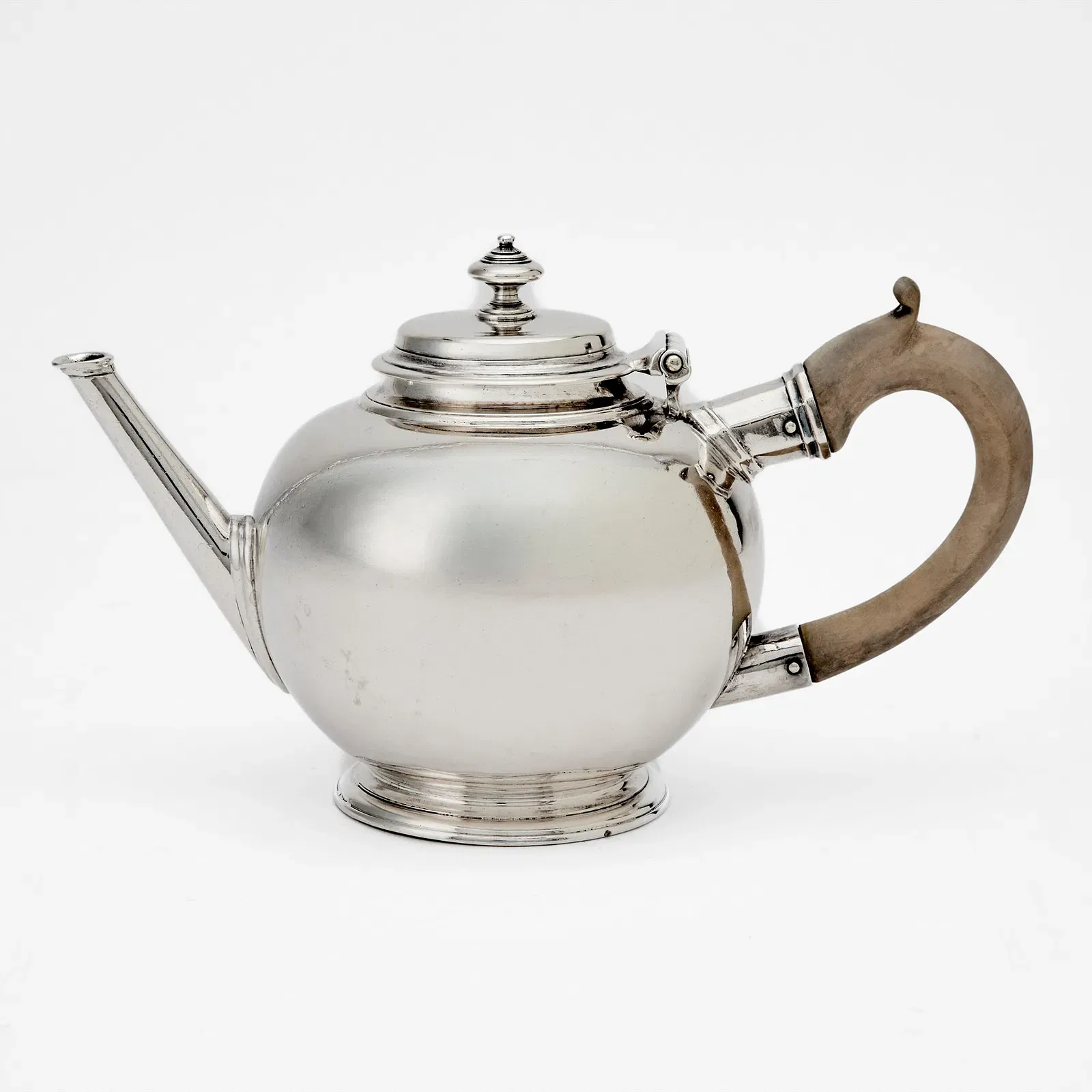
Here we have a handsome English George III period silver teapot, the sort of object that turns the daily ritual of tea into a minor act of ceremony. Its rounded body, elegant tapering spout, and domed lid with urn finial are beautifully restrained—Georgian design at its most civilized. The form points comfortably to the late 18th century, when English silver workshops were producing refined domestic wares for an increasingly tea-loving society. The carved wood handle is not just decorative; it is practical, keeping the hand cool while the pot does its duty. Construction details matter here. The hinged lid, molded foot, and underside struck hallmarks all suggest a genuinely period piece rather than a modern pastiche. Just as important, the surface has the right sort of honest life: light scratching, mellow patina, and no suspiciously glassy finish. Condition appears quite good for a teapot of this age. There is visible wear and minor rubbing, and the handle shows age and use. That is normal—indeed reassuring—on a working silver vessel more than two centuries old. I do not see obvious red-flag fakery in the photos. My authenticity score would sit around 85 out of 100, with caution only because the hallmarks are not fully legible in the provided close-up. As an auction estimate, I’d place it conservatively at $500 to $1,200 if fully authentic and period, versus roughly $150 to $350 if it proved later or substantially altered. A quietly distinguished survivor of Georgian table culture... Charles here, signing off: Let the Mink have a Think!
Used for this report's TTS and avatar presentation.
Item Report
English George III Period Silver Teapot with Wood Handle
By: Likely English maker; specific maker not fully legible from provided photos
Style: George III Period silver
Origin: England
Materials: Silver, likely sterling silver, with carved wood handle
Age: circa 1780-1800
Condition: Very Good (age-appropriate surface wear, light scratches, minor handle wear, not professionally inspected in hand)
Value: Auction estimate: if authentic period example, approximately $500-$1,200; if later reproduction or heavily altered piece, approximately $150-$350.
Peer-Reviewed Market Values
- Dating Range
- Pending structured dating
- Auction Liquidation
- Pending structured market values
- Fair Market Value
- Pending structured market values
- Replacement Value
- Pending structured market values
- Comparables Used
- No saved comparables yet
- Research Confidence
- Insufficient Data
Peer review completed, but this run did not return structured market value ranges.
Maker's Marks / Writing: Underside shows English hallmarks including lion passant and maker's mark that appears to read 'BK'; other assay/date marks are present but not fully legible from the provided image.
Date: 2026-05-06 01:06:47.499006
Description:
A late 18th-century English silver teapot of rounded globular form with straight tapering spout, domed hinged lid with urn finial, molded foot, and heat-resistant carved wood handle. The restrained profile and bright-cut simplicity are characteristic of George III silver. Visible underside hallmarks support English origin and period authenticity.
Curator Questions
Curated by Jade
Assessment:
This appears to be a genuine English George III period silver teapot rather than a later decorative reproduction. The overall form, hinged lid construction, wooden handle, and underside hallmarks are all consistent with late 18th-century English tea wares. The body shows honest wear, light scratching, and age-appropriate surface patina rather than an overly bright modern finish. The handle appears old and possibly original, though it may have seen refinishing or replacement at some point; such maintenance is common and does not by itself negate period authenticity. Because only one hallmark image is supplied and the marks are not fully crisp, the dating should remain slightly conservative.
Individual Images:
- whole teapot side view
- whole teapot three-quarter view
- detail of wood handle
- underside of teapot hallmarks
Provenance:
No provenance documentation provided in the images.
Condition:
Very Good (age-appropriate surface wear, light scratches, minor handle wear, not professionally inspected in hand)
Identification Score: 95%
The object's function and type are very clear: a Georgian English silver teapot. The form, hinged lid, wooden handle, and English-style hallmarks make the identification highly secure, though the exact maker and assay date letter cannot be fully confirmed from the photo alone.
Authenticity Score: 85%
The strongest evidence for authenticity is the period-appropriate form, the practical insulated wood handle, the wear patterns, and the underside hallmarks that appear genuinely struck rather than decorative pseudo-marks. Some caution remains because the hallmark details are not fully legible and no interior, lid marks, or close assay-letter view is provided. On balance, it reads as an authentic late 18th-century English silver teapot.
Image Memory Note
None None
Keywords
English, George III, period silver teapot, sterling silver, Georgian tea service, wood handle, hinged lid, hallmarked silver
Peer Review Summary
Peer Review
Key Visible Evidence
The teapot's globular form, tapering spout, domed hinged lid with urn finial, and curved wooden handle are consistent with late 18th to early 19th-century English silver tea wares (Image 1). Underside hallmarks (Image 4) clearly display a lion passant, a crowned leopard's head, a duty head (King George III), and a date letter appearing as a Roman lowercase 'h'. The maker's mark is visible as 'IB' or 'TB' in a rectangular punch (Image 4).
Market and Source Support
Metal Standard Trace: The presence of the lion passant, crowned leopard head, and duty head confirms the object as English sterling silver, with no silverplate indicators visible. Dating Lookup Trace: The observed date letter is a Roman lowercase 'h'. Candidates from the table are 1743, 1783, 1823, 1903. The presence of a crowned leopard head indicates pre-1822, eliminating 1823 and 1903. The presence of a duty head indicates 1784-1890. The combined rule (Crowned leopard head AND Duty/sovereign head) mandates a date between 1784 and 1822. None of the Roman lowercase 'h' candidates (1743, 1783) fall within this 1784-1822 range, creating an unresolved conflict within the provided dating guidance. The year 1783 is the closest but falls just outside the derived range.
Needs Verification
["The report's reading of the maker's mark as 'BK' is contradicted by visible evidence, which appears to be 'IB' or 'TB' (Image 4).", "The report's dating of 'circa 1780-1800' is plausible stylistically, but the precise date cannot be definitively confirmed from the hallmarks using the provided RAG due to a conflict between the date letter 'h' and the combined presence of the crowned leopard head and duty head.", "The claim of 'bright-cut simplicity' in the description is not clearly supported by the provided images.", "A clearer, higher-resolution image of the maker's mark would be needed for definitive identification of the maker."]
Audit Conclusion
The report's claims regarding English origin, sterling silver material, and general George III period style are partly supported by visible evidence and hallmark analysis. However, the specific dating is plausible but unproven from the supplied hallmark evidence due to an internal conflict in the dating rules. The maker's mark reading in the report is contradicted by the visible evidence. Audit posture: Partly supported.
Comparables (Similar Items)
No archived comparables matched this report yet.
Share: