Behold the Victorian Revival Brass and Wood Sundial Compass — a charming artifact of modern craftsmanship that takes inspiration from the scientific instruments of a bygone era. This piece, while outwardly resonant with Victorian scientific aesthetics, serves primarily as an ornamental delight for collectors and enthusiasts alike. Resting elegantly on four turned wooden legs, it combines the allure of polished brass and timeless wood, an ensemble that is both classic and contemporary. Yet, its tale is not one of ancient mariners or seasoned explorers, but rather one of clever design and modern production. Predominantly found in the late 20th and early 21st century marketplace, these devices were created to spark curiosity and admiration rather than to serve functional purposes in navigation or surveying. Their lineage can often be traced to prolific workshops in England or India, where craftsmanship meets nostalgia. In this instance, the materials — brass, glass, and wood — are masterfully assembled with machine precision, yielding a product that shines with newness and lacks the historical wear of a true antiquity. The sundial's brilliant engravings and the compass's spotless glass face underscore its excellent condition, unmarred by time's passage. No maker's mark or inscription reveals the hand behind its assembly, allowing it to stand as both an anonymous work of art and an evocative representation of a more wistful age. Yet, despite its aesthetic pleasures, the compass does not claim authenticity. Rated at a mere 20% for historical fidelity, it is unmistakably a modern reproduction. In the realm of decorative collectibles, its appraised value at auction stands between $20 to $50 — a modest price for a piece that casts the spell of Victorian elegance without its provenance. As an emblem of historical aspiration, it reminds us of the enchantment that the past continues to hold, even when conjured anew.
Used for this report's TTS and avatar presentation.
Item Report
Victorian Revival Brass and Wood Sundial Compass
By:Unknown (likely a modern manufacturer, often unmarked or marked only with decorative motifs)
Origin:England or India (typical origins of such reproductions)
Materials:Brass, glass, wood
Age:Late 20th to early 21st century
Condition:Excellent (minimal wear, appears unused, no significant flaws)
Value:$20 - $50 (auction estimate for decorative/reproduction instruments of this type)
Maker's Marks / Writing:No visible maker's marks or inscriptions on the accessible surfaces.
Date:2025-07-07 04:12:15.380902
Description:
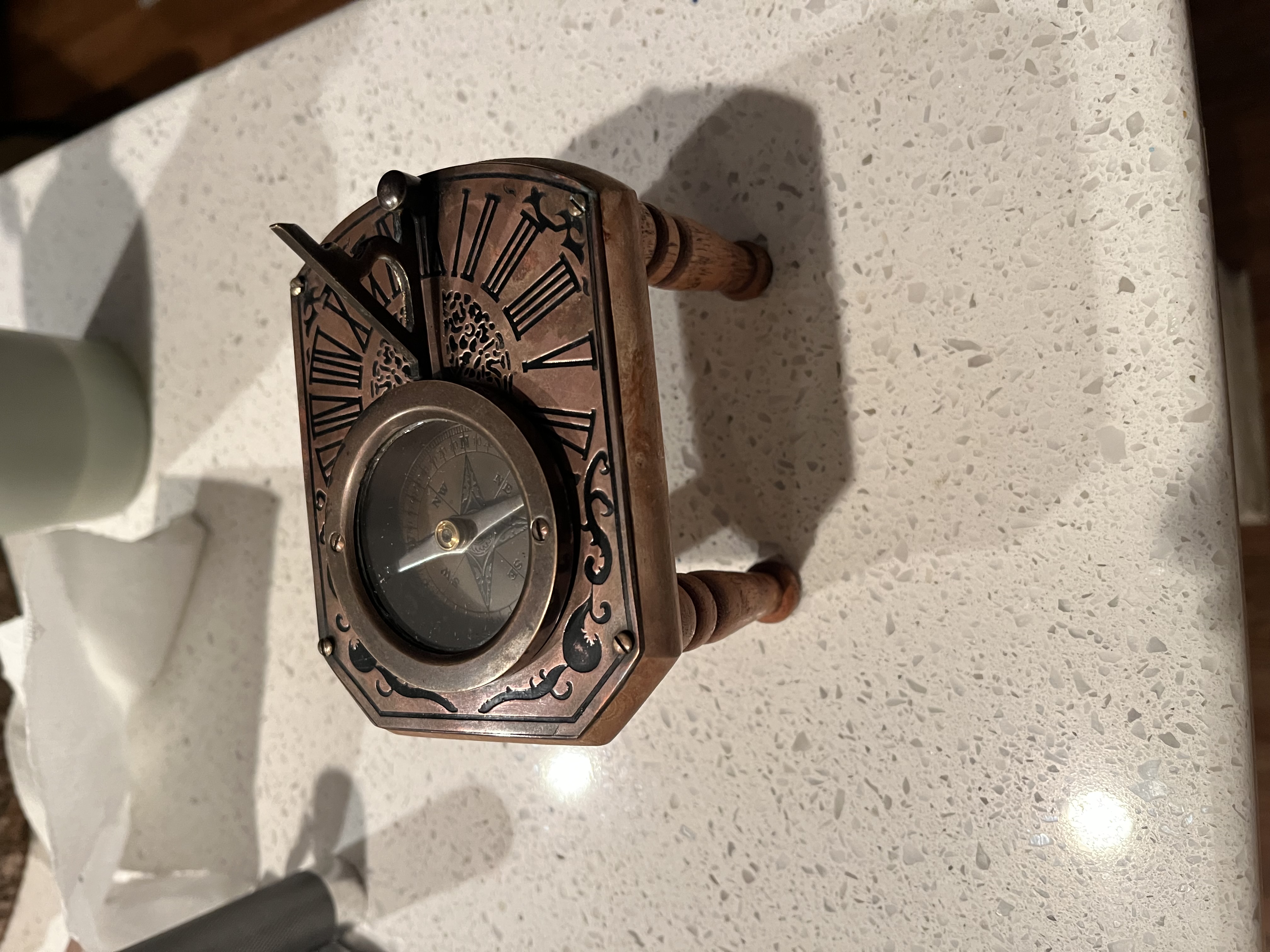
This is a small, table-mounted sundial compass, featuring a combination of a magnetic compass set within a brass casing and an engraved sundial face with Roman numerals and a folding gnomon. The base includes four turned wooden legs, giving the object an elevated and decorative form. The brass top is ornately decorated, manufactured to evoke the style of 19th-century Victorian scientific instruments. This item is a decorative reproduction, commonly made for the gift, novelty, or collector market, rather than a genuine 19th-century navigational or surveyor's instrument.
Curator Questions
Curated by Jade
Assessment:
This is a decorative reproduction inspired by Victorian-era sundial compasses, commonly produced in the late 20th and early 21st centuries, primarily for the collector and novelty markets. While attractively made and evocative of historical scientific instruments, it lacks the patina, build quality, and hand-finishing of true antique examples. Its value is primarily decorative.
Individual Images:
The provided image shows detailing of the brass sundial face
compass housing
and folding gnomon; the wooden legs are turned and polished but show no wear or signs of age. No makers mark is visible on top or sides. No damage or patina typical of true antiques.
Provenance:
No provenance documentation provided.
Condition:
Excellent (minimal wear, appears unused, no significant flaws)
Identification Score: 95%
The combination of features — ornate brasswork, engraved Roman numerals, folding gnomon, and turned wooden legs — clearly identifies this as a reproduction Victorian-inspired sundial compass rather than an antique original. Its pristine condition, machine manufacturing marks, and style are typical for modern gift shop pieces.
Authenticity Score: 20%
A word about fakes... The market for antique scientific instruments is saturated with reproductions like this. The construction, gloss, and absence of genuine wear all point to a modern decorative item rather than an authentic 19th-century piece. While functional in principle, it is not museum-quality or period-authentic.
Image Memory Note
The object is a small reproduction sundial compass featuring a brass plate with engraved Roman numerals and floral scrollwork, a central compass under glass, and a folding gnomon for sundial function. Four turned wood legs are attached to the base. The surface is pristine; there are no visible scratches, dents, or discoloration. No visible maker's marks, serial numbers, or inscriptions on any surface. The compass rose is marked with cardinal directions (N, S, E, W). The needle is silver in color and the central screw is brass. The gnomon is latched upright and points to the Roman numeral dial. Decorative, not functional as a precise instrument.


Share: