Premium upgrade: Monique delivers your appraisal as a guided podium narration with synced visuals and voiceover.
Output is a narrated, animated slideshow with video intro and outro, sandwiching the autoplay voiceover sequence in actual video.
Early 19th Century Portrait Miniature of a Gentleman
LANGUAGE UNLOCK
Glossary Roundup
Original Presentation Script
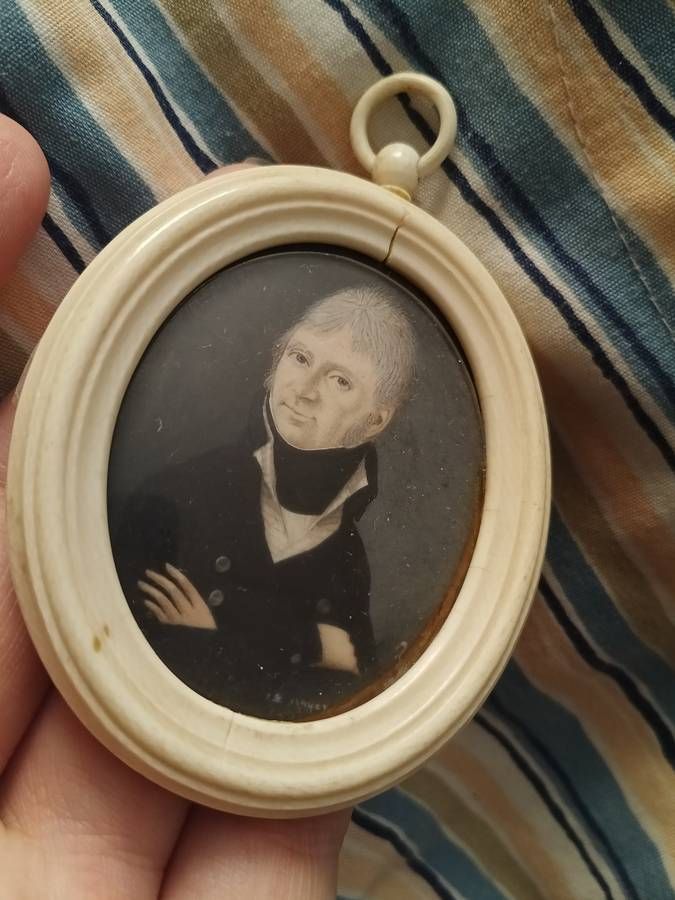
Take a look at this captivating glimpse into the past. This is an early 19th-century portrait miniature of a gentleman. Before the invention of photography, these small, intimate portraits were the primary way to carry the likeness of a loved one. Based on the gentleman's attire—specifically the high collar and voluminous white cravat—we can confidently date this piece to the Empire or Regency period, roughly between 1800 and 1820. The portrait is delicately painted, likely watercolor on a thin wafer of ivory, which was the standard technique of the era to give the skin a luminous, lifelike quality. It is housed in an oval frame that also appears to be crafted from ivory or bone. You can clearly see distinct vertical cracks at the top and bottom of the frame; while this is technically damage, it is also a very common sign of natural aging and shrinkage in these organic materials, which actually supports its antique status. If you look closely at the lower right edge of the painting, there is a faint signature that appears to read 'Isabey', pointing towards the famous French miniaturist Jean-Baptiste Isabey. However, Isabey's work was highly sought after and frequently copied by followers. Without in-hand authentication, we must be conservative and say it 'bears the signature'. Assuming it is a period piece in the manner of Isabey, a fair auction estimate would be between $200 and $400. It remains a wonderful, personal piece of history.
Used for this report's TTS and avatar presentation.
Item Report
Early 19th Century Portrait Miniature of a Gentleman
By:Bears signature 'Isabey' (possibly manner of Jean-Baptiste Isabey)
Style:Portrait Miniature / Empire Period
Origin:France (likely)
Materials:Likely watercolor on ivory, in a likely ivory or bone frame with glass cover
Age:circa 1800-1820
Condition:Good (frame has visible vertical cracks at top and bottom; painting appears intact under glass)
Value:$200 - $400
Peer-Reviewed Market Values
Dating Range
Pending structured dating
Auction Liquidation
Pending structured market values
Fair Market Value
Pending structured market values
Replacement Value
Pending structured market values
Comparables Used
No saved comparables yet
Research Confidence
Insufficient Data
Peer review completed, but this run did not return structured market value ranges.
Maker's Marks / Writing:Faint signature at lower right, appears to read 'Isabey'
Date:2026-11-07 15:09:35.535234
Description:
A small, oval portrait miniature depicting a gentleman in early 19th-century attire, featuring a dark coat and white cravat. The painting, likely watercolor on ivory, is housed in an oval frame that appears to be made of ivory or bone, complete with a carved suspension loop. The piece bears a faint signature at the lower right edge.
Curator Questions
Curated by Jade
Assessment:
This is a charming portrait miniature typical of the early 19th century. The subject's attire suggests a date around 1800-1820. While it bears a signature that appears to read 'Isabey' (a famous French miniaturist), the market contains many period copies and follower pieces. The frame shows significant age-related cracking, typical of antique ivory or bone. In-hand inspection by a specialist would be required to confirm the signature and exact materials, hence the conservative estimate.
Individual Images:
whole miniature in hand
detail of portrait and signature
Provenance:
N/A
Condition:
Good (frame has visible vertical cracks at top and bottom; painting appears intact under glass)
Identification Score: 90%
The item is clearly identifiable as a portrait miniature from the early 19th century based on the subject's clothing, the format, and the materials used.
Authenticity Score: 75%
The piece appears to be a genuine early 19th-century miniature, supported by the style, materials, and natural aging (cracks in the frame). However, the signature cannot be authenticated from photos alone and may be apocryphal or indicate a follower rather than the master himself.
Image Memory Note
None
None
Keywords
portrait miniature, watercolor on ivory, early 19th century, Empire period, Regency, gentleman, Isabey, antique frame
The report was edited after initial Artmink draft. Original AI draft preserved in Artmink audit history.
Fair Market Value
Pending structured market values
Replacement Value
Pending structured market values
Archived Matches
No archive matches yet
Research Confidence
Insufficient Data
Research Findings
Key Visible Evidence
Images 1 and 2 show a portrait miniature of a gentleman in early 19th-century dress, bearing a prominent, light-colored signature reading 'Isabey' across the dark coat. The painting execution appears somewhat flat, lacking the fine stippling and subtle modeling typical of high-quality period miniatures. The piece is housed in a thick, rounded, turned bone or ivory frame with an integral carved suspension loop, which exhibits straight vertical stress cracks at the top and bottom.
Market and Source Support
Jean-Baptiste Isabey (1767–1855) was a leading French miniaturist known for exceptional technical refinement and typically discreet signatures. Reference and auction records document a prolific late 19th- and early 20th-century industry producing decorative miniature portraits that copied earlier styles and frequently bore apocryphal signatures of famous masters like Isabey. These later retrospective pieces were routinely housed in thick, turned bone or 'piano key' ivory frames with integral carved loops, matching the exact profile and construction of the subject frame.
Needs Verification
- Magnified inspection of the portrait surface to determine if it is entirely hand-painted or a hand-colored printed base.
- Examination of the frame material under magnification (e.g., checking for Schreger lines or Haversian canals) to definitively distinguish between ivory, bone, or early celluloid.
- Inspection of the reverse of the miniature and any backing materials, which often confirm late 19th- or 20th-century assembly.
Advisory Conclusion
The report's dating of the object to 1800-1820 is contradicted by the object's physical characteristics. While the sitter's attire reflects the Empire/Regency period, the flat painting execution, prominent apocryphal signature, and specific thick turned-bone frame style strongly indicate this is a late 19th- or early 20th-century decorative copy. The claim that it is a genuine period piece is unsupported by the supplied images.
Google Search Evidence
Google Search was enabled, but Gemini returned no grounding queries or source records for this review.


Share: