Portuguese Baroque Style Walnut Caned High-Back Side Chairs (Pair)
LANGUAGE UNLOCK
Glossary Roundup
Original Presentation Script
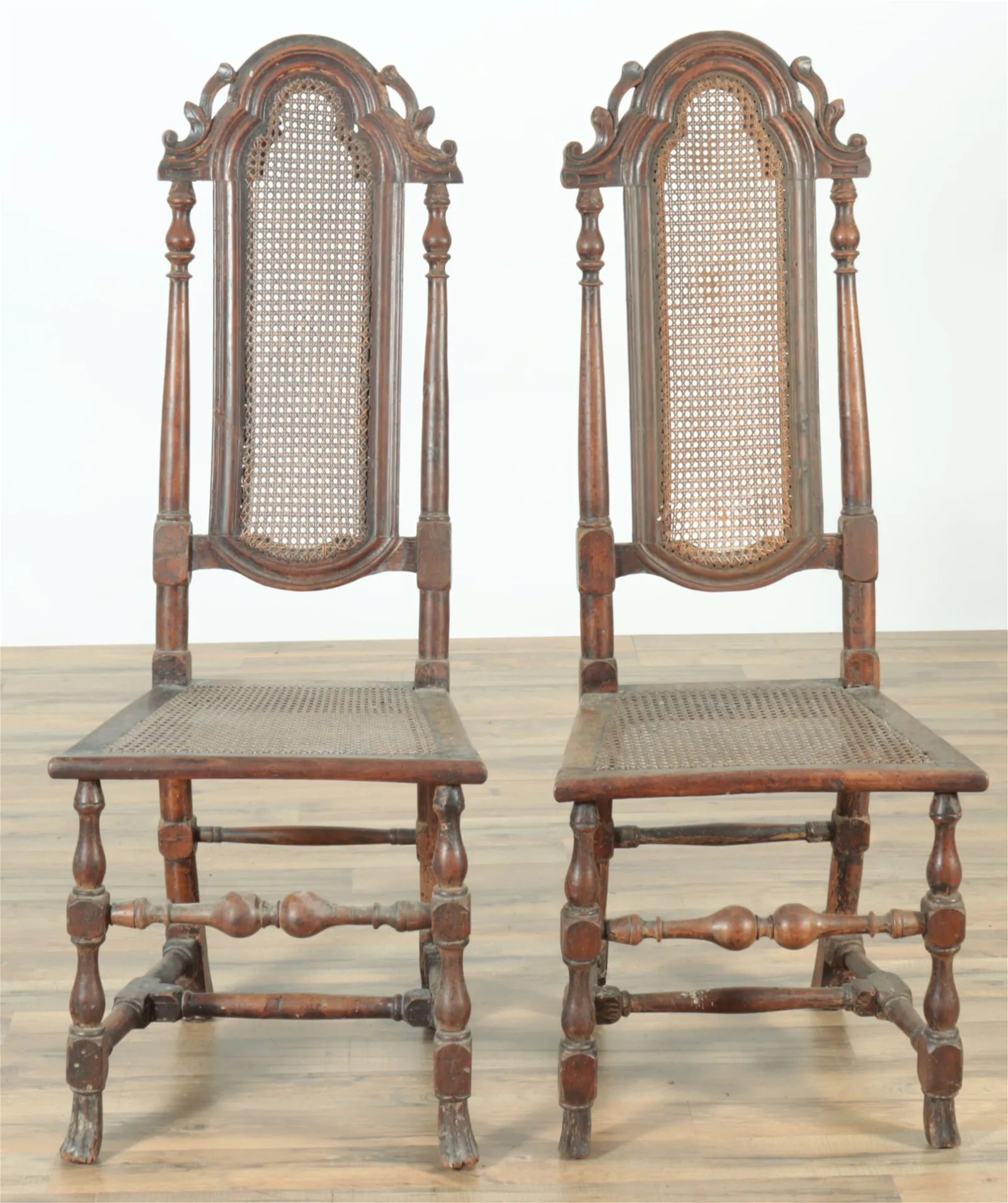
Let’s meet this stately pair: Portuguese Baroque Style Walnut Caned High-Back Side Chairs. Tall, ceremonial backs capped by ear-like scrolls and a narrow caned panel announce their Iberian bravura; the seats are caned as well, perched over block-and-baluster legs and that wonderfully swollen front stretcher.
These silhouettes echo late 17th–early 18th century Lisbon taste—what collectors often call João V Baroque—when cane and turning married courtly teatricality. They were status chairs in their day; today they read as richly historical and eminently decorative.
The materials tell the story: dark-stained walnut (possibly chestnut) with pegged joinery, and uniform rattan caning. The turnings are regular and nearly symmetrical, suggesting machine assistance typical of c.1880–1910 revival work rather than hand-wrought 1700 craftsmanship.
Condition is honest: worn finish, scattered wormholes, frayed back caning, and old stretcher repairs. These signs of life support age—but likely 19th/early 20th century age—while keeping them usable.
Authenticity? As period c.1700, only 30% likelihood; as revival pieces, 100%. A word about fakes.. Iberian Baroque chairs are widely reproduced, and fresh cane with crisp, perfectly even turnings is the usual giveaway. At auction, expect $400–800 for the pair—a handsome slice of Baroque drama without the 300-year price tag.
Used for this report's TTS and avatar presentation.
Item Report
Portuguese Baroque Style Walnut Caned High-Back Side Chairs (Pair)
Age:Circa 1880–1910 (revival of late 17th–early 18th century forms)
Condition:Fair to Good (worn finish, losses and fray to cane, old repairs to stretchers, scattered wormholes; structurally serviceable but used)
Value:$400–800 (pair, auction)
Maker's Marks / Writing:No maker’s marks observed.
Date:2025-11-02 16:09:38.918990
Description:
A matched pair of tall, caned side chairs with arched ‘broken’ pediment crests and narrow oval caned backs, block-and-baluster turned legs, and H-stretchers with pronounced bulbous central turning. Seats are also caned; surfaces show old, dark patina with scattered worming and wear.
Curator Questions
Curated by Jade
Assessment:
These read as Iberian ‘João V’/late Baroque forms—tall caned backs with ear-like crest scrolls and heavy turned stretchers—yet execution suggests a 19th–early 20th century revival rather than period c.1700. Uniform machine caning, comparatively regular turning, and general construction point to later manufacture, while the patina and scattered worming feel honest. A decorative, authentic-to-period-style pair rather than period originals. A word about fakes.. Portuguese and Spanish Baroque chairs are heavily reproduced; crisp surfaces, perfect symmetry, and new cane often signal later copies. When in doubt, treat as style pieces unless joinery and surface history firmly prove period.
Individual Images:
none
Provenance:
Not provided.
Condition:
Fair to Good (worn finish, losses and fray to cane, old repairs to stretchers, scattered wormholes; structurally serviceable but used)
Identification Score: 85%
Crest with broken-arch ‘ears,’ narrow oval caned back, block-and-baluster legs, and bulbous front stretcher are diagnostic of Portuguese Baroque chairs; caned seats confirm the type. Confident in category though exact workshop unknown.
Authenticity Score: 30%
Likely a late 19th/early 20th century revival pair: the caning appears uniform and probably replaced, turnings are regular and near-symmetrical, and construction lacks the asymmetry and wear patterns expected on c.1700 Iberian chairs. A word about fakes.. this category is rife with modern copies; without tool marks, irregular handwork, and centuries-deep oxidation, one should not assume period.
Image Memory Note
None
None
Keywords
Portuguese Baroque style, caned chairs, high-back side chairs, walnut, Iberian furniture, 19th century revival, Portugal
The report was edited after initial Artmink draft. Original AI draft preserved in Artmink audit history.

Share: