English William and Mary Period Walnut High-Back Caned Chairs
LANGUAGE UNLOCK
Glossary Roundup
Original Presentation Script
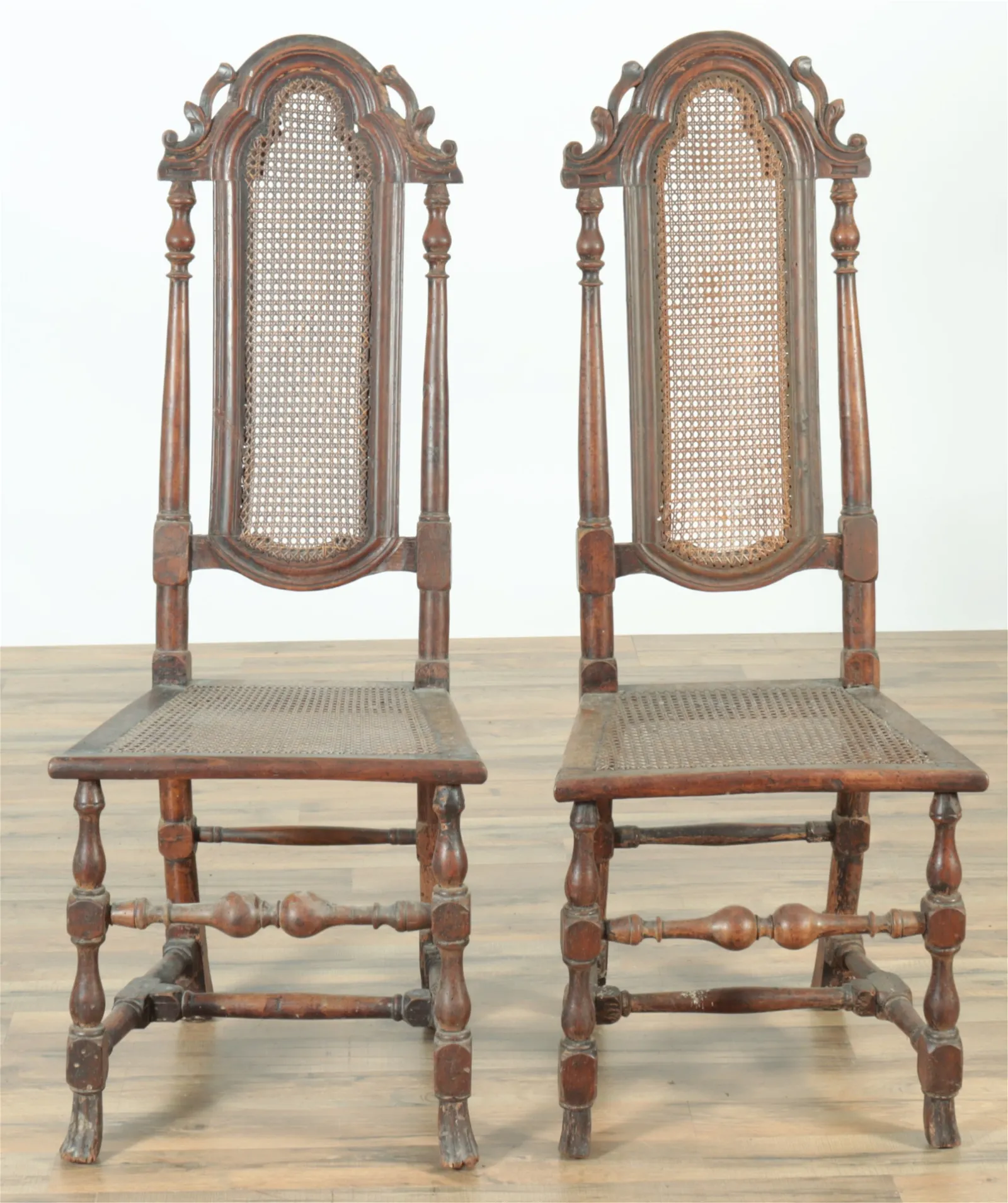
Prepare to be transported to an era steeped in regal grace, as we explore this matched pair of English William and Mary period walnut high-back caned chairs. With their tall, commanding silhouettes, these chairs exemplify the transition between the robust styles of the past and the burgeoning elegance of the early Baroque period.
Crafted circa 1690 to 1710, these chairs hail from a time when England was infusing its furniture design with the Baroque influences emanating from the continent. During the reign of William and Mary, furniture not only served functional needs but was also a statement of burgeoning societal status and artistry. The resultant styles continue to captivate collectors and historians alike.
Fashioned from rich walnut wood and complemented by intricately hand-woven cane — a technique that surged in popularity in the late 17th century — these chairs are a testament to the craftsmanship of the era. The highlighted barley twist stretchers and the exquisitely turned legs nod to meticulous handiwork that eschews the mechanized production we often take for granted today.
With the passage of time, these chairs have witnessed and endured the wear typical of genuine antiquities. Surface abrasions on frames, darkened edges, and minute losses to the caning speak volumes of their journey through centuries. Signs of old repairs, particularly to the stretchers, are evidence of their cared-for existence, though replacements keep authenticity from reaching its pinnacle.
Rated at a 75% authenticity score, these chairs are likely period pieces gracefully restored, rather than modern reproductions. Such history resonates deeply with collectors who appreciate the narrative etched by age. The estimated auction value of $1,200 to $2,500 for the pair underscores their desirability despite restorative interventions. So, dear Friend, in these chairs we find an alluring whisper of the past, still steadfast in their elegant presence.
Used for this report's TTS and avatar presentation.
Item Report
English William and Mary Period Walnut High-Back Caned Chairs
By:Unknown
Style:William and Mary / Early Baroque
Origin:England
Materials:Walnut wood, hand-woven cane
Age:Circa 1690–1710
Condition:Good (surface wear, minor losses, old repairs to stretchers, age-appropriate patina, caning intact with minor breaks)
Value:$1,200 – $2,500 (pair, at auction)
Maker's Marks / Writing:No visible maker’s mark or inscription.
Date:2025-07-05 17:22:58.585541
Description:
This is a matched pair of high-back side chairs dating from the William and Mary period (late 17th century - early 18th century). The chairs are constructed from walnut with characteristic barley twist stretchers and turned legs. The backs and seats are caned, a technique popularized during this era. The arched crest rails, shaped with carved scrolled finials and upright supports, are typical of English furniture from the William and Mary period. Visible wear, minor repairs, and the patina suggest age-appropriate use. These chairs exemplify the blend of Baroque ornamentation and sturdy craftsmanship typical of the period.
Curator Questions
Curated by Jade
Assessment:
A good, decorative, and authentic-looking pair of late 17th century English caned chairs in the William and Mary tradition. The wear and patina are consistent with genuine period examples. Some repairs and possible replaced stretcher elements but overall showing strong period style and appeal.
Individual Images:
whole item
Provenance:
No provenance documentation provided.
Condition:
Good (surface wear, minor losses, old repairs to stretchers, age-appropriate patina, caning intact with minor breaks)
Identification Score: 95%
The distinctive tall, caned backs, walnut frame, crest rail shape, and turned legs with barley twist stretchers are strong indicators of William and Mary English origin, and are well-documented in furniture reference works.
Authenticity Score: 75%
There are convincing signs of age such as surface wear, patina, minute losses to the caning, and older repairs, especially to the stretchers. However, replaced or reworked elements (common in chairs of this period) keep the score below 100%. Given the prevalence of reproduction William and Mary chairs, caution is warranted; nevertheless, these appear more likely to be period chairs with some 19th- or early 20th-century restorations than modern fakes.
Image Memory Note
Pair of tall walnut side chairs with shaped and arched crest rails, caned backrests and seats. Each has bulbous turned and slightly splayed front legs, barley twist stretchers at the front, and box stretchers at the sides. There is visible wear throughout: abrasions and darkening on frame edges and legs, minor splits in the walnut, some area repairs (especially to front stretchers), and discoloration and minor breaks to the cane. No visible maker’s marks or inscriptions are noted. Classical scrolled crest rail tops with carved ear motifs. The caned panels are worn but largely intact.
Keywords
William and Mary, high-back chairs, English furniture, walnut, caned seat, caned back, Baroque, 17th century, antique, England
The report was edited after initial Artmink draft. Original AI draft preserved in Artmink audit history.

Share: