Guangxu Style Famille-Rose Porcelain Covered Bowl with Bajixiang Decoration光绪款粉彩八吉祥纹盖碗
LANGUAGE UNLOCK
Glossary Roundup
Original Presentation Script
Let’s take a close look at this "Guangxu Style Famille-Rose Porcelain Covered Bowl with Bajixiang Decoration"—a compact but highly ceremonial object. With its steep walls and domed lid, it’s the sort of covered bowl that could serve tea or sweet broth, wrapped in layers of auspicious symbolism.
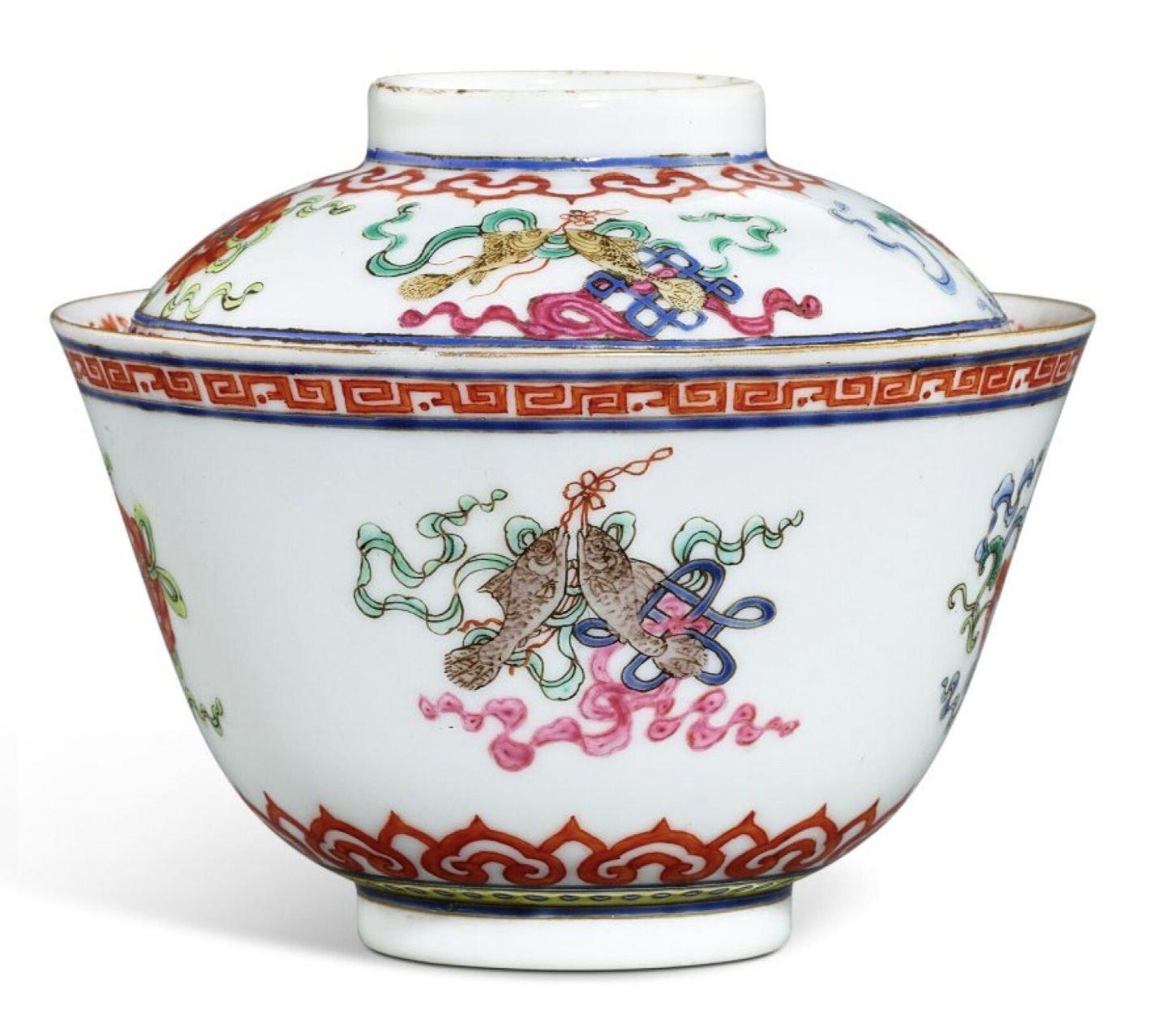
The design speaks late Qing: the Eight Buddhist Emblems spiral around the surface, interwoven with scholar’s vessels and lotus blossoms. Over the foot and rim, iron-red ruyi and key-fret borders lock the whole scheme into a tight, rhythmic frame. Inside the lid, a four-character iron-red inscription calmly announces: "Da Qing Guangxu nian zhi"—made in the Guangxu era.
Porcelain body and overglaze famille-rose enamels point straight to Jingdezhen. The potting is thin and regular, the palette bright but slightly soft at the edges—hallmarks of late-19th to early-20th-century work rather than crisp modern factory ware.
Condition is very good: light rim wear, a few firing specks, but no dramatic chips or hairlines visible. Enough age to reassure, not enough damage to alarm.
On authenticity, I’d place this around 68 out of 100: likely late Guangxu to early Republic in date, but not demonstrably a palace-commissioned piece. In today’s market, that translates to roughly $400 to $800 at auction—respectable for its charm, symbolism, and honest craftsmanship, even if it won’t fund your retirement.
Used for this report's TTS and avatar presentation.
Item Report
Guangxu Style Famille-Rose Porcelain Covered Bowl with Bajixiang Decoration
Materials:High-fired porcelain with overglaze famille-rose (fencai) enamels and iron-red reign mark
Age:Likely late 19th to early 20th century, circa 1880–1910, with possibility of slightly later Republican-period manufacture
Condition:Very good (minor wear and small firing imperfections; no obvious cracks or major chips visible)
Value:$400–$800 at auction (assuming no hidden damage and as a quality Guangxu-style piece rather than a guaranteed imperial-period bowl)
Maker's Marks / Writing:Iron-red four-character reign mark on cover interior: 大清光緒年製 (Da Qing Guangxu nian zhi, ‘Made in the Guangxu years of the Great Qing’).
Date:2025-12-06 00:52:50.138709
Description:
Small fine porcelain covered bowl, steep-sided with domed cover and short foot, decorated in famille-rose enamels with the Eight Buddhist Emblems (bajixiang) and auspicious vessels amid multicolored ruyi-form ribbons. The rim and shoulder carry iron-red key-fret borders and a band of ruyi-heads above the foot. The cover interior shows a four-character iron-red mark reading ‘Da Qing Guangxu nian zhi’ within a ruyi medallion.
一件小型瓷盖碗,胎质细腻,斜壁直收,配高隆盖,圈足较矮。通体以粉彩描绘八吉祥及博古花卉纹,器身与盖面上可见宝瓶、宝轮、双鱼等纹饰,缠以多色飘带。口沿与肩部饰铁红回纹带,足墙上方一周红彩如意头边饰。盖内心以铁红书“大清光绪年制”四字款,外围绘连绵如意云头纹。
Curator Questions
Curated by Jade
Assessment:
This is a well-painted Guangxu-marked covered bowl executed in the late Qing imperial style, featuring classic famille-rose rendering of the Eight Buddhist Emblems and auspicious vessels. The enamels are bright yet slightly flat, and the potting and glaze appear quite clean and regular, suggesting late Guangxu to early Republic production rather than a high-status palace commission. The iron-red four-character ‘Da Qing Guangxu nian zhi’ mark is neatly written but somewhat stiff and standardised compared with palace wares, another sign of commercial or later workshop origin. A word about fakes.. in the field of Guangxu-marked famille-rose wares, modern reproductions are widespread, but here the wear around the rim, the moderate firing grit, and the handling of the decorative motifs are consistent with late-19th/early-20th-century output. Collectors value such bowls for their iconography and decorative appeal more than rarity. As a solid Guangxu-style piece, it would likely realise a mid-hundreds price at auction, with higher values reserved for documented imperial-commission wares. Jade Discernment Protocol.
此件为一只光绪款粉彩盖碗,整体以晚清官窑风格绘制八吉祥及博古纹,画工细腻规整。彩料鲜艳而略显平面,胎釉洁白匀净,器形端正,均显示应为光绪晚期至民国初年景德镇窑场的制品,而非宫廷特供的高等级官窑器。盖内铁红书“大清光绪年制”四字款,书写工整却略显板正,没有一等宫廷器上那种灵动写意感,亦指向民用或后期作坊的属性。A word about fakes.. 在光绪款粉彩瓷领域,现代仿品极多,但本品口沿有自然使用磨损,釉面有轻微窑粘与老气,纹饰设色与线条亦符合十九世纪末至二十世纪初的绘画习惯,因此判断为该时期真品而非当代仿作。此类器物以题材吉祥、陈设效果好而受藏家欢迎,更具装饰与文化意味而非极端稀有性。作为一件保存良好的光绪风格作品,在拍卖中多在数百美元区间成交;真正宫廷档次并具可靠传承者,价格则会远高于此。Jade Discernment Protocol。
Individual Images:
none
Provenance:
Not provided.
Condition:
Very good (minor wear and small firing imperfections; no obvious cracks or major chips visible)
Identification Score: 93%
Form, decoration, enameling palette, and the Guangxu reign mark clearly identify this as a Guangxu-marked famille-rose covered bowl with Bajixiang motifs; comparable examples are well documented.
根据器形(斜壁盖碗)、粉彩色系、八吉祥题材及盖内“大清光绪年制”四字款等特征,可较为确定为光绪款粉彩八吉祥盖碗,与已知晚清器物有众多对比实例,故识别置信度较高。
Authenticity Score: 68%
The bowl and enamels show convincing late-Qing to early-Republic age and wear, but the neat, slightly standardized mark and very clean potting leave some possibility it is a later high-quality reproduction; thus authenticity to the Guangxu period is plausible but not guaranteed.
胎釉与彩绘呈现出晚清至民国初期的自然老化痕迹,使用磨损与窑烧细节可信;然而落款工整略板、器物整体较为洁净标准,仍不排除稍后高仿的可能,因此将其定为大致光绪时期风格真品的可能性较大,但并非百分之百确认,故真实性评分略为保守。

Share: