Generalist : Art, Antiques and Collectibles
Generalist Presents

Original Presentation Script
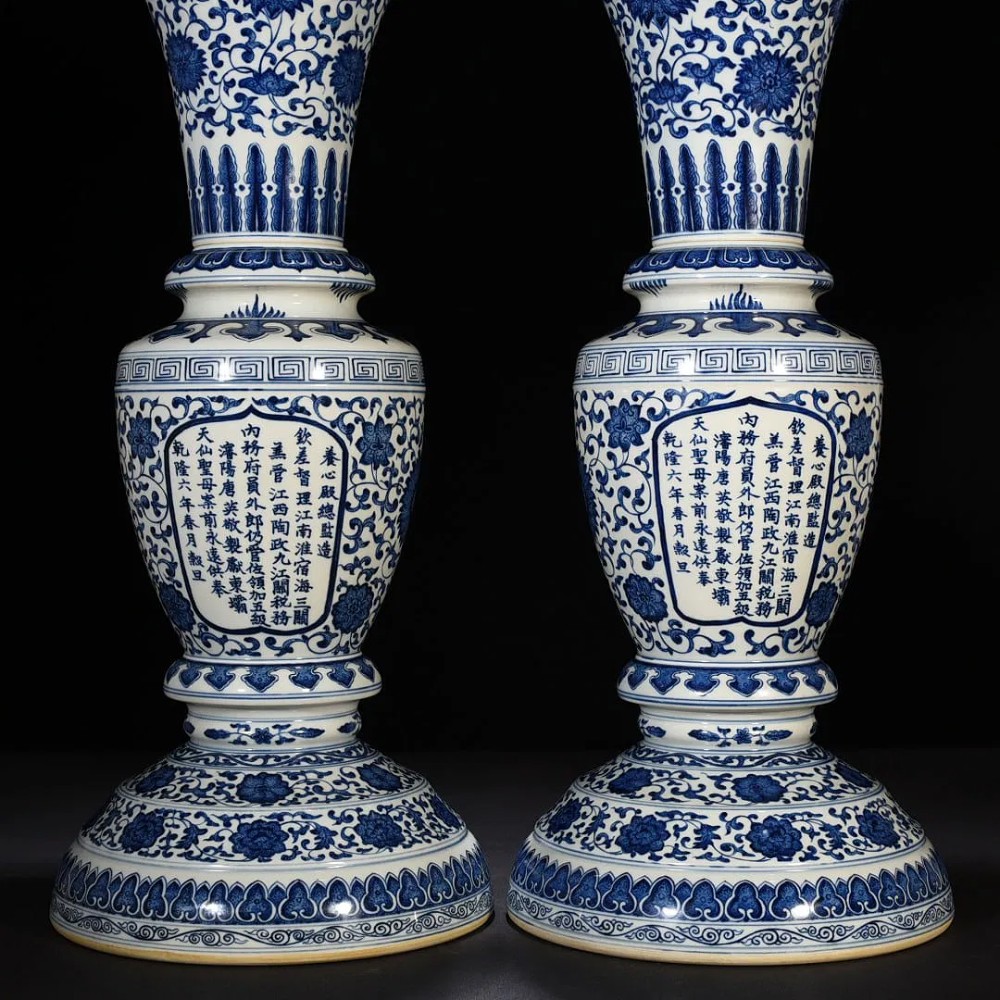
Here we have a dramatic pair of Chinese blue and white baluster floor vases, boldly potted with trumpet necks and commanding presence. At first glance, they radiate imperial ambition. The inscriptions date them to the sixth year of the Qianlong Emperor — an era synonymous with technical perfection in porcelain. True Qianlong imperial pieces of this scale were court commissions, produced in Jingdezhen for palaces and temples, and today rank among the most valuable ceramics in the world. The decoration here is densely composed: scrolling lotus, formalized floral roundels, crisp key-fret borders, and carefully framed calligraphy panels. The cobalt is bright and even, the lines confident, the symmetry exact — almost too exact. Condition tells an important story. These surfaces are glossy and pristine, without the softening, kiln variation, foot wear, or subtle glaze pooling one expects from an 18th-century monumental vessel. The inscription itself — boldly dated — raises another red flag. Imperial reign marks and specific dates on grand pieces are among the most commonly copied features in the Chinese art market. A word about copies.. In Chinese blue-and-white porcelain, reproductions vastly outnumber genuine Qing imperial works. Even sophisticated modern examples can be visually impressive yet historically recent. Authenticity score: 15%. If these were truly Qianlong period, they could exceed $200,000 at auction. As modern decorative reproductions, a realistic auction estimate is $2,000 to $5,000 for the pair. Magnificent in presence — but imperial in spirit more than in age.
Used for this report's TTS and avatar presentation.
Item Report
Chinese Qing Dynasty Qianlong Style Blue and White Porcelain Baluster Floor Vases (Pair)
清乾隆款青花瓷高颈瓶一对(仿古风格)
By: Unknown
Style: Qianlong Style (Reproduction)
Origin: China
Materials: Porcelain with underglaze cobalt blue decoration
Age: Late 20th to early 21st century
Condition: Excellent (no visible wear, likely modern, not officially graded)
Value: If authentic 18th c. Qianlong Period: $200,000–$400,000 at auction; as a modern reproduction: $2,000–$5,000 at auction for the pair.
Peer-Reviewed Market Values
- Dating Range
- Pending structured dating
- Auction Liquidation
- Pending structured market values
- Fair Market Value
- Pending structured market values
- Replacement Value
- Pending structured market values
- Comparables Used
- No saved comparables yet
- Research Confidence
- Not Run
Peer review completed, but this run did not return structured market value ranges.
Maker's Marks / Writing: Lengthy inscription referencing Qianlong sixth year (乾隆六年春月) within cartouche panels.
Date: 2026-03-21 16:04:27.039383
Description:
A monumental pair of blue and white porcelain floor vases of baluster form with flared trumpet necks, densely decorated in underglaze cobalt blue with scrolling lotus, floral roundels, lappet borders, key-fret bands, and large cartouches containing lengthy Chinese inscriptions dated to the sixth year of Qianlong. 一对大型青花瓷高颈瓶,撇口长颈,鼓腹圈足。通体以釉下青花绘缠枝莲、团花纹、如意瓣纹及回纹边饰,腹部开光内书长篇楷书铭文,款识为乾隆六年纪年。
Curator Questions
Curated by Jade
Assessment:
These vases closely imitate 18th-century Qianlong imperial blue-and-white ceremonial vessels. However, the highly uniform cobalt tone, glossy surface, lack of age-related wear, and the ambitious dated inscription strongly suggest a modern decorative reproduction rather than an 18th-century imperial work. 此对花瓶仿效十八世纪乾隆朝御窑青花重器风格,但青花发色过于均匀,釉面光亮缺乏自然老化痕迹,加之带有具体乾隆六年纪年的长篇铭文,综合判断更可能为现代仿古装饰性作品,而非清代乾隆时期真品。
Individual Images:
- whole vase pair front view
- detail of inscription cartouche
- whole vase pair alternate view
- detail of lower body decoration
- upper half showing flared rims
- reverse of vase pair
Provenance:
None provided.
Condition:
Excellent (no visible wear, likely modern, not officially graded)
Identification Score: 95%
Form, decorative program, and Qianlong-dated inscription clearly identify these as Qianlong-style blue and white baluster vases. 器形、装饰布局及乾隆纪年铭文均明确显示其为乾隆风格青花高颈瓶。
Authenticity Score: 15%
The pristine condition, mechanical precision of decoration, bright even cobalt, and overt dated inscription are major red flags. Genuine Qianlong imperial pieces of this scale are extremely rare and show natural patina and kiln variation absent here. 器物保存过于完美,绘工规整近乎机械化,青花发色均一鲜亮,加之带有具体纪年长铭文,均为重要疑点。真正乾隆御窑如此体量之重器极为罕见,且应有自然岁月痕迹与窑变差异,此处未见。
Image Memory Note
None None
Keywords
Chinese porcelain, blue and white, Qianlong style, baluster vase, floor vase, Qing dynasty style, underglaze cobalt, China 中国瓷器, 青花, 乾隆风格, 高颈瓶, 落地花瓶, 清代风格, 釉下青花, 中国
Peer Review Summary
Peer Review
Key Visible Evidence
The subject items are a pair of monumental blue and white baluster vases with flared trumpet necks, as seen in Images 1, 3, and 6. The decoration is densely applied in underglaze cobalt blue, featuring scrolling lotus, floral roundels, lappet borders, and key-fret bands. Prominently displayed on the body of each vase are large cartouches containing lengthy Chinese inscriptions (Image 2). The inscription on Image 2 clearly reads '乾隆六年春月' (Qianlong 6th Year, Spring Month). Visually, the cobalt blue is remarkably uniform and bright, lacking the subtle variations, pooling, or 'heaping and piling' effects often associated with genuine 18th-century imperial porcelain. The glaze is consistently glossy and pristine across all surfaces, with no visible signs of age-related wear, scratching, or degradation. The foot rim (Image 4) is clean and evenly finished, showing no significant wear, grit, or firing imperfections typical of older pieces. The overall execution of the decoration appears highly precise and almost mechanical in its regularity, contributing to a modern aesthetic rather than an antique one.
Market and Source Support
The inscription '乾隆六年春月' translates to 'Qianlong 6th Year (1741), Spring Month'. This refers to the 6th year of the Qianlong Emperor's reign (1736-1795). However, as per established connoisseurship and the provided RAG guidance on Chinese reign marks, the presence of a reign mark or dated inscription does not automatically confirm period authenticity, especially for highly copied imperial styles. The visual characteristics of the vases, such as the uniform cobalt, pristine glaze, and lack of age-related wear, are inconsistent with genuine 18th-century Qianlong imperial porcelain. Instead, these features are hallmarks of modern decorative reproductions. The market comparables found, including similar large blue and white baluster vases explicitly dated to the 20th century from reputable auction houses (Bonhams, Doyle New York, Sotheby's, Christie's), consistently realize prices in the range of $2,500 to $5,000 for a pair. This strongly supports the report's valuation for the subject items as modern reproductions.
Needs Verification
While the report's conclusion regarding the modern dating of the vases is well-supported by visible evidence, a more definitive assessment of the inscription's execution could be made with macro photography of the characters. This would allow for a closer examination of brushwork, the depth and texture of the cobalt, and whether the decoration is hand-painted or potentially a transfer print, which would further confirm modern manufacturing techniques. Additionally, UV light examination of the glaze could reveal any repairs or inconsistencies not visible under normal light. A detailed examination of the interior of the vases and the unglazed foot rim for specific modern factory marks or unique potting characteristics would also provide further corroborating evidence.
Audit Conclusion
The report's assessment that these Chinese blue and white baluster vases are modern decorative reproductions, despite bearing a Qianlong 6th year inscription, is strongly supported by the visible evidence and grounded market comparables. The pristine condition, highly uniform cobalt blue, glossy glaze, and absence of age-related wear are all consistent with late 20th to early 21st-century manufacture. The inscription, while clearly legible as 'Qianlong 6th Year, Spring Month' (1741), is correctly identified by the report as an apocryphal mark, commonly found on later decorative pieces. The valuation range provided for a modern reproduction is well-aligned with current auction results for similar items. The report accurately identifies the discrepancy between the claimed inscription date and the object's likely period of manufacture.
Comparables (Similar Items)
No archived comparables matched this report yet.
Share: