Premium upgrade: George delivers your appraisal as a guided podium narration with synced visuals and voiceover.
Output is a narrated, animated slideshow with video intro and outro, sandwiching the autoplay voiceover sequence in actual video.
American Classical Period Mahogany Fold-Top Card Table
LANGUAGE UNLOCK
Glossary Roundup
Original Presentation Script
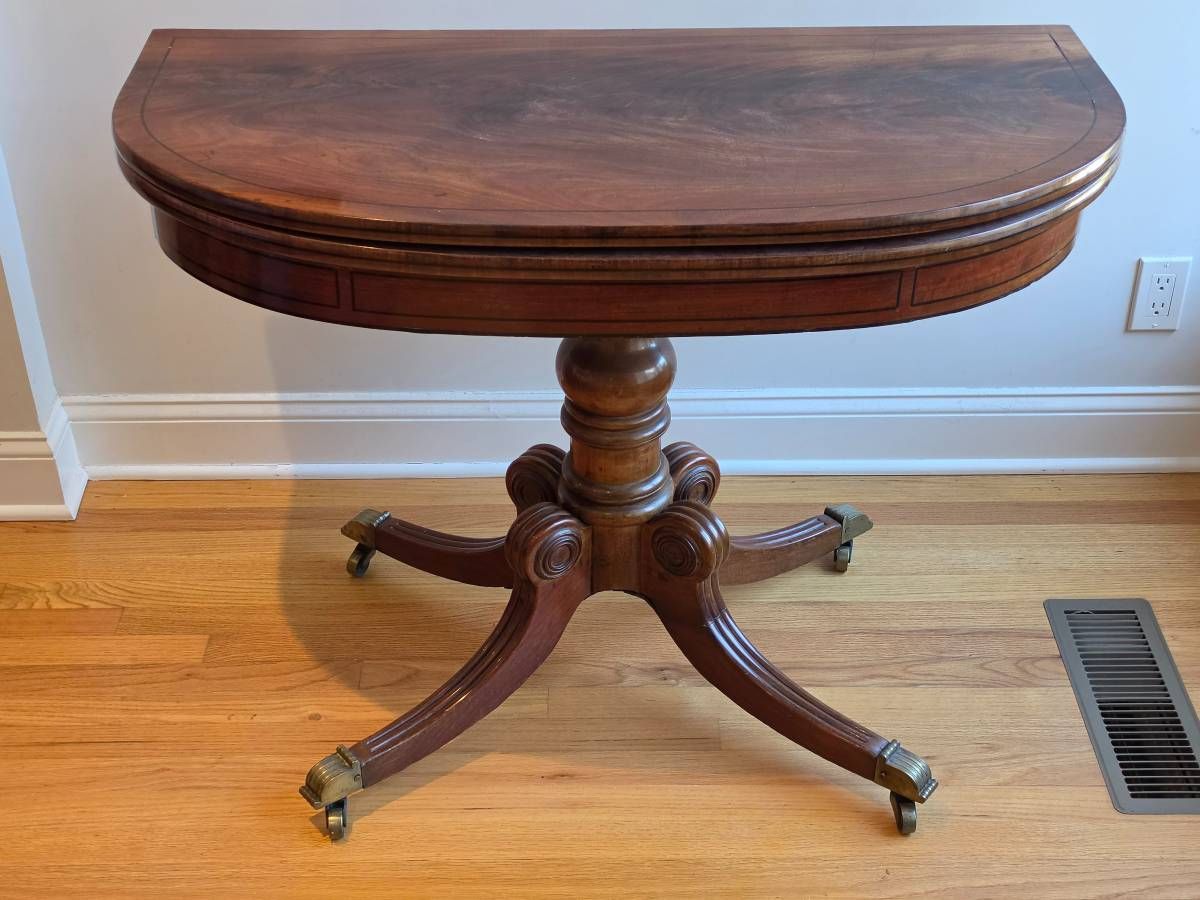
Here we have a striking American Classical Period mahogany fold-top card table. In the early 19th century, these tables were essential pieces of parlor furniture, serving as elegant consoles against the wall when closed, and swiveling open to provide a surface for evening card games. Dating to circa 1815 to 1830, this piece embodies the robust elegance of the American Classical style, heavily influenced by French Empire and English Regency designs. The craftsmanship is evident in the stunning flame mahogany veneers on the top, bordered by delicate string inlay. The table is supported by a stout, turned central pedestal that branches into four sweeping, molded legs. Notice the carved volutes at the knees and the classic brass paw caps with casters at the feet—these are hallmark features of the period. The table appears to be in very good condition; the high gloss suggests it has been sympathetically refinished at some point to revive the spectacular grain of the mahogany. Based on its stylistic coherence and visible construction details, it presents as an authentic period piece. At auction, a fine example like this would carry a conservative estimate of $600 to $900. It's a beautiful, functional slice of early American domestic life.
Used for this report's TTS and avatar presentation.
Item Report
American Classical Period Mahogany Fold-Top Card Table
By:Unknown
Style:American Classical
Origin:United States
Materials:Mahogany, mahogany veneer, brass
Age:circa 1815-1830
Condition:Very Good (appears refinished, minor wear consistent with age)
Value:Authentic: $600 - $900. Later Reproduction: $150 - $300.
Peer-Reviewed Market Values
Dating Range
Pending structured dating
Auction Liquidation
Pending structured market values
Fair Market Value
Pending structured market values
Replacement Value
Pending structured market values
Comparables Used
No saved comparables yet
Research Confidence
Insufficient Data
Peer review completed, but this run did not return structured market value ranges.
Maker's Marks / Writing:None visible
Date:2026-11-07 18:04:24.710736
Description:
An American Classical period mahogany fold-top card table, circa 1820. The table features a hinged, swiveling top with highly figured flame mahogany veneer and string inlay, opening to a circular playing surface. It rests on a turned central pedestal supported by four sweeping, molded legs terminating in brass paw caps and casters. The knees are accented with carved volutes.
Curator Questions
Curated by Jade
Assessment:
A handsome and well-proportioned example of American Classical furniture, featuring excellent mahogany veneers and characteristic brass hardware. The piece appears to be in very good condition, likely having seen some restoration or refinishing over its life to maintain its appearance.
Individual Images:
whole table closed front view
whole table open top view
Provenance:
None provided
Condition:
Very Good (appears refinished, minor wear consistent with age)
Identification Score: 95%
The form, materials, and stylistic details are textbook examples of American Classical furniture from the early 19th century.
Authenticity Score: 85%
While the piece shows all the correct signs of period manufacture, a definitive authentication of the secondary woods and construction techniques would require an in-person inspection. The finish appears somewhat refreshed.
Image Memory Note
None
None
Keywords
American Classical, Empire, mahogany, card table, fold-top, antique furniture, 19th century, brass paw feet, United States
The report was edited after initial Artmink draft. Original AI draft preserved in Artmink audit history.
Fair Market Value
Pending structured market values
Replacement Value
Pending structured market values
Archived Matches
No archive matches yet
Research Confidence
Insufficient Data
Research Findings
Key Visible Evidence
Images 1 and 2 display a fold-top card table featuring a turned central pedestal and four sweeping saber legs terminating in brass paw caps with casters. The primary surfaces exhibit highly figured flame mahogany veneers bordered by string inlay, and the knees are accented with carved volutes. The exceptionally high-gloss, uniform surface visible on the open top in Image 2 strongly supports the report's conclusion that the table has been sympathetically refinished.
Market and Source Support
Reference literature and institutional collections of American Classical furniture confirm that the combination of a pedestal base, carved knee volutes, and brass paw feet was a standard vocabulary for cabinetmakers in New York, Boston, and Philadelphia between 1815 and 1840. Furthermore, auction and dealer records for American Empire card tables frequently feature polished flame mahogany interior surfaces rather than baize, aligning with the presentation of this piece. The report's dating of circa 1815-1830 is stylistically accurate for this robust form.
Needs Verification
['In-person examination of the secondary woods (e.g., white pine vs. tulip poplar) and internal joinery is required to pinpoint a specific regional origin or maker.', 'Inspection of the underside, hinge mortises, and the pedestal-to-base joinery would be necessary to assess the full extent of any structural restorations beneath the newer finish.']
Advisory Conclusion
The report is fully supported by the provided images and grounded research. The identification, dating, and stylistic analysis of this American Classical card table are accurate, and the condition notes regarding its refinished state are visually sound.
Google Search Evidence
Queries: American Empire mahogany card table carved volutes knees; "American Classical" mahogany fold-top card table pedestal base brass paw feet


Share: