Premium upgrade: Jade delivers your appraisal as a guided podium narration with synced visuals and voiceover.
Output is a narrated, animated slideshow with video intro and outro, sandwiching the autoplay voiceover sequence in actual video.
Chinese Kangxi Period Famille Verte Porcelain Bowl with Yongqing Tang Hall Mark中国康熙时期五彩瓷碗,永清堂款
LANGUAGE UNLOCK
Glossary Roundup
Original Presentation Script
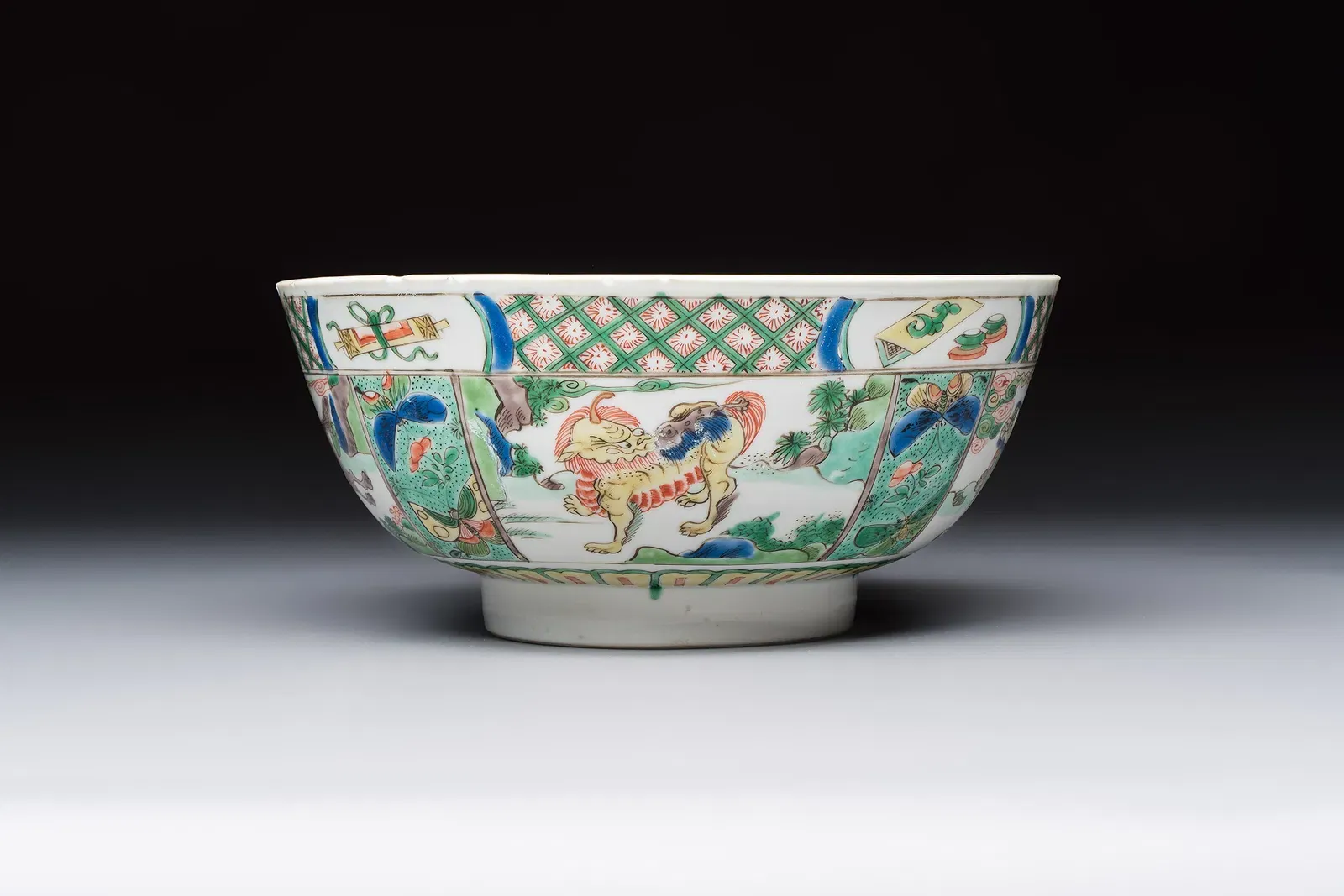
Here we have a rather spirited Chinese Kangxi Period famille verte porcelain bowl with a Yongqing Tang hall mark—a vessel that clearly enjoys a bit of theatrical company. Around the exterior, animals stride, leap, and pose inside painted landscape panels, while the rim is dressed with scholarly objects and a lively green diaper border. It is a bowl with personality.
The age estimate is circa 1700–1720, within the Kangxi reign of the Qing dynasty, when Jingdezhen kilns perfected the brilliant wucai-derived palette Europeans later called famille verte. The mark on the base reads 永清堂, Yongqing Tang—“Hall of Eternal Clarity” or “Hall of Eternal Purity.” Importantly, this is not an imperial reign mark, but a private hall or studio mark, the kind often seen on refined Kangxi porcelains.
In terms of craftsmanship, note the high foot ring, recessed glazed base, double blue circle, and hand-painted underglaze-blue characters. The exterior enamels—copper green, iron red, yellow, aubergine, black, and blue—are laid out in crisp but lively panels, and the rim shows slight irregularity consistent with hand potting rather than modern mechanical perfection.
Condition is good to very good: there is visible rim fritting and small chips, plus light enamel wear. These are not fatal flaws; in fact, they support an object with real age and use.
My authenticity score is 78%. A close macro examination of foot paste and enamel oxidation would be ideal, but the evidence strongly favors Kangxi-period manufacture. Conservative auction estimate: $4,000 to $8,000—quite a charming bowl, and with a little menagerie marching around its sides.
Used for this report's TTS and avatar presentation.
Item Report
Chinese Kangxi Period Famille Verte Porcelain Bowl with Yongqing Tang Hall Mark
中国康熙时期五彩瓷碗,永清堂款
By:Unknown Jingdezhen kiln decorator; Yongqing Tang hall mark
Style:Kangxi Period famille verte / wucai porcelain
Origin:China
Materials:Porcelain with transparent glaze, underglaze cobalt-blue mark, and overglaze famille verte enamels including copper-green, iron-red, yellow, aubergine, black and blue
Age:Circa 1700–1720, Kangxi period, Qing dynasty
Condition:Good to Very Good (visible rim fritting/chips and light enamel wear; not professionally condition-reported)
Value:Conservative auction estimate if authentic Kangxi period: USD $4,000–$8,000. If later Qing/Republic revival or decorative copy: approximately USD $500–$1,200.
Maker's Marks / Writing:Underglaze-blue three-character hall mark: 永清堂, Yongqing Tang, translated as “Hall of Eternal Clarity/Purity.” It is a private hall/studio mark rather than an imperial reign mark. A small old paper collector or inventory label is also visible on the underside, but the writing is only partly legible from the photographs.
Date:2026-06-20 14:22:26.786869
Description:
A large Chinese porcelain bowl decorated in the Kangxi famille verte palette, with overglaze green, iron-red, yellow, aubergine, black and blue enamels. The exterior is divided into lively vertical panels showing mythical and real animals in landscape settings, alternating with butterfly-and-floral reserves; the rim has auspicious scholarly objects and a green diaper-pattern border. The interior is comparatively restrained, with a central iron-red peony spray. The base bears a three-character underglaze-blue hall mark reading Yongqing Tang, 永清堂, meaning approximately “Hall of Eternal Clarity/Purity,” enclosed by a double blue circle. This is a private hall or studio mark, not an imperial reign mark.
这是一件大型中国瓷碗,采用康熙时期典型的五彩/famille verte 釉上彩装饰,见绿彩、矾红、黄彩、茄紫、黑彩及蓝彩。外壁以竖向开光分隔,绘神兽与动物山水场景,并间以蝴蝶花卉纹饰;口沿饰文房清供、吉祥器物及绿色锦地纹。内壁较为素雅,碗心绘矾红牡丹一枝。底部青花书三字堂名款“永清堂”,外以双圈围绕,意为“永恒清明/清净之堂”。此为私人堂名款或斋堂款,并非帝王年号款。
Curator Questions
Curated by Jade
Assessment:
The bowl presents strongly as a Kangxi-period famille verte piece rather than a modern decorative copy. The palette, panel layout, auspicious-object border, animal subjects, and the Yongqing Tang hall mark are all consistent with high-quality Jingdezhen porcelain of the late Kangxi era. The slightly uneven rim, visible rim fritting, foot wear, old collector label, and fluid underglaze-blue hall mark support age. The available photographs do not provide a true macro view of the foot paste or enamel oxidation halo, so the attribution should remain cautiously stated, but the visual evidence is favorable.
此碗整体呈现出康熙时期五彩瓷的特征,而非现代装饰复制品。其设色、开光布局、口沿吉祥器物纹、动物题材以及“永清堂”堂名款,均与清康熙晚期景德镇较高等级瓷器相符。口沿略不规整、可见细小磕釉与飞皮,足部磨耗、旧藏标签以及流畅的青花堂名款,都支持其年代感。现有照片尚缺少足胎与彩料氧化晕光的超近距离细节,因此仍应保持审慎表述,但从可见证据看,断为康熙时期的可能性较高。
Individual Images:
front bowl with lion panel
side bowl with qilin panel
side bowl with deer panel
side bowl with horse panel
interior bowl peony
underside bowl Yongqing Tang mark
Provenance:
No formal provenance documents provided. The underside shows an old collector/inventory label, suggesting prior collection history, but its details are not fully readable and remain unverified from the images.
Condition:
Good to Very Good (visible rim fritting/chips and light enamel wear; not professionally condition-reported)
Identification Score: 92%
The form, famille verte enamel palette, animal-and-panel decoration, interior peony, and three-character Yongqing Tang mark make the object identifiable with high confidence as a Chinese Kangxi-style famille verte porcelain bowl.
器形、五彩设色、动物开光纹饰、内心牡丹以及三字“永清堂”款,使其可高度确定为中国康熙体系的五彩瓷碗。
Authenticity Score: 78%
The mark, painting style, palette, old rim fritting, and general surface wear support Kangxi-period manufacture. The score is not higher because the photographs lack close macro details of the unglazed foot paste, enamel oxidation, and glaze surface needed for a firmer museum-level confirmation.
款识、绘画风格、彩料组合、口沿旧磕与整体磨耗均支持康熙时期制作。评分未更高,是因为照片缺少未施釉足胎、彩料氧化及釉面状态的微距细节,尚不足以作博物馆级别的绝对确认。
Image Memory Note
None
None
Keywords
Chinese porcelain, China, Kangxi period, Qing dynasty, famille verte, wucai, Yongqing Tang, hall mark, Jingdezhen, porcelain bowl, animal panels, peony, auspicious objects
中国瓷器,中国,康熙时期,清代,五彩,康熙五彩,永清堂,堂名款,景德镇,瓷碗,动物开光,牡丹,吉祥器物
The report was edited after initial Artmink draft. Original AI draft preserved in Artmink audit history.

Share: