Sienna : African and Oceanic Art
Sienna Presents

Original Presentation Script
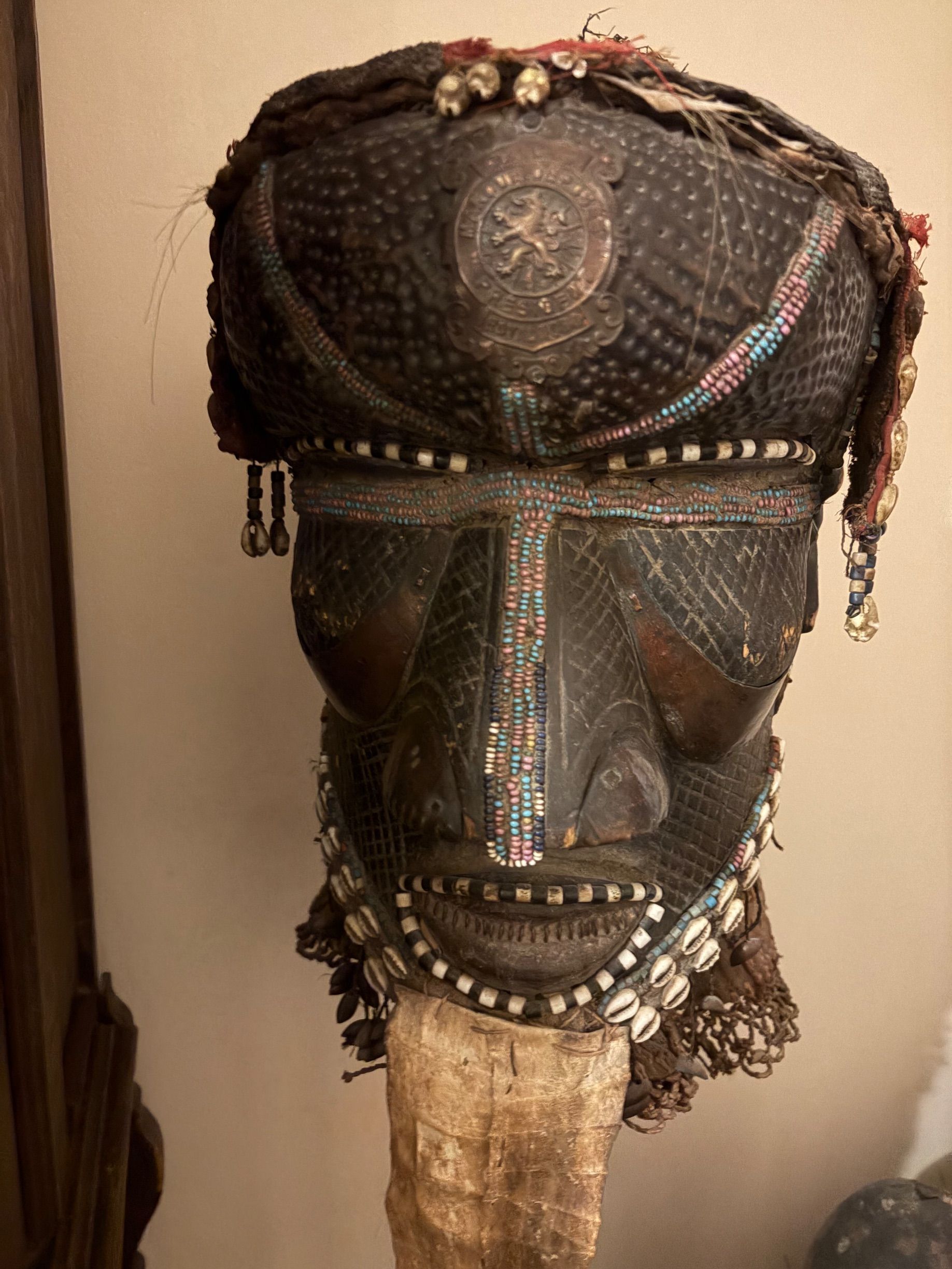
Here we have a striking West African helmet mask in the Dan- or Bassa-related orbit, a form made to transform the wearer into a social and spiritual presence rather than merely decorate a wall. The long face, heavy eyelids, shell borders, and beadwork all speak the language of masquerade. At first glance, it looks promising: the wood shows real handling wear, the cloth is frayed and tired in the right way, and the interior has the rubbed, dusty look one hopes to see in something with some age. These are encouraging signs, and they suggest that at least part of the object is not fresh workshop output. But then comes the plot twist: that metal badge on the forehead, with French wording and a heraldic lion, is not ethnographically at home here. It reads as a later addition—possibly colonial-era salvage, tourist-market embellishment, or a decorative intervention made after the mask’s original life. So the craftsmanship may indeed rest on an older carved core, but the ensemble as we see it now is probably composite. That matters, because collectors pay much more for masks that remain coherent, traditional, and field-collected. My authenticity score is 32%. Not because the whole thing is new, but because the object appears altered. Conservatively, I’d place auction value around $800 to $2,000 if accepted as a period African mask, but only $150 to $400 if regarded as a decorative composite or reproduction. A compelling face, certainly—just one with a slightly suspicious biography.
Used for this report's TTS and avatar presentation.
Item Report
West African Dan- or Bassa-Style Wood Janus Helmet Mask with Cowrie and Bead Ornament
By: Unknown tribal maker
Style: West African tribal art, Dan/Bassa style ceremonial mask
Origin: Liberia or Sierra Leone region, West Africa
Materials: carved hardwood, pigment, glass trade beads, cowrie shells, textile, fiber, hide or skin, metal badge
Age: Probably mid-20th century, circa 1940-1970; with some later added elements
Condition: Good (visible age, wear, fraying textiles, losses, later additions, condition consistent with use)
Value: Auction estimate if an authentic period African mask: $800-$2,000. If primarily a later decorative or composite reproduction: $150-$400.
Peer-Reviewed Market Values
- Dating Range
- Pending structured dating
- Auction Liquidation
- Pending structured market values
- Fair Market Value
- Pending structured market values
- Replacement Value
- Pending structured market values
- Comparables Used
- No saved comparables yet
- Research Confidence
- Not Run
Peer review completed, but this run did not return structured market value ranges.
Maker's Marks / Writing: Applied metal badge inscribed: 'EXCELSIOR', 'MARQUE DEPOSEE', 'PRESIDENT', and likely 'BOYALNOR' or similar; not a native maker's mark and probably later-added hardware.
Date: 2026-03-21 14:22:38.659478
Description:
A carved wooden African helmet mask or headdress form with elongated face, heavy lidded eyes, projecting nose, beaded linear ornament, cowrie shell trim, and layered cloth/fiber attachments. The overall form suggests a Liberian or Sierra Leone region masquerade object, likely inspired by Dan, Bassa, or related mask traditions. The applied metal badge reading 'EXCELSIOR MARQUE DEPOSEE PRESIDENT BOYALNOR' appears non-native and likely a later decorative addition.
Curator Questions
Curated by Jade
Assessment:
This appears to be a West African helmet-mask type object with convincing age in the wood and textile elements, but it should be treated cautiously as a composite piece. The carved face, surface wear, internal handling abrasion, encrusted dust, beadwork, shell ornament, and worn cloth all support some age and use. However, the applied European-style badge is a major anomaly and almost certainly not original to the traditional object; it reads as a later embellishment, perhaps added for the tourist market, colonial-era reuse, or subsequent decorative enhancement. The mask may incorporate an older carved core with later attachments and repairs. A word about copies.. African masks are heavily reproduced, altered, and 'improved' for the decorative market, especially pieces with dramatic shell and bead ornament, so one must assume reproduction or composite construction until proven otherwise.
Individual Images:
- front mask view
- side view of mask
- detail of metal badge
- interior of mask
Provenance:
No provenance documentation shown in the images.
Condition:
Good (visible age, wear, fraying textiles, losses, later additions, condition consistent with use)
Identification Score: 78%
The form, materials, facial type, and textile/cowrie embellishment strongly indicate a West African masquerade mask or helmet mask, probably from the Liberia/Sierra Leone region. Confidence is reduced because only a few views are provided and the exact ethnic attribution is uncertain.
Authenticity Score: 32%
The carved wood and worn organic materials show genuine age, but the conspicuous metal badge with French wording is a significant red flag and suggests later alteration or assembly. I would not call this fully traditional and untouched. It may be a period decorative composite built around an older mask, but absent field-collected provenance, the safest conclusion is low-to-moderate authenticity confidence.
Image Memory Note
None None
Keywords
West African mask, Dan style, Bassa style, helmet mask, Liberia, Sierra Leone, carved wood mask, cowrie shells, beadwork, tribal art, ceremonial headdress, composite mask
Peer Review Summary
Peer Review
Key Visible Evidence
The subject item is clearly a single-faced helmet mask, as depicted in Images 1 and 2, directly contradicting the 'Janus Helmet Mask' claim in the report's title. The metal badge on the forehead (Image 3) is clearly inscribed 'CYCLES MARQUE DEPOSEE PRESIDENT ROYAL NORD' with a heraldic lion, which differs from the report's transcription of 'EXCELSIOR' and 'BOYALNOR'. The carved wood, beadwork, cowrie shells, and textile elements are consistent with West African tribal art (Images 1, 2). The interior of the mask (Image 4) shows significant wear, abrasion, and dust, supporting the report's assessment of age and use for the wooden core and organic materials. The overall condition, including fraying textiles and surface wear, is consistent with the report's description.
Market and Source Support
Comparables found from reputable auction houses (LiveAuctioneers, Bonhams) confirm the general stylistic attribution to Dan or Bassa helmet masks with similar elongated facial features and decorative elements. Independent web research confirms 'Cycles President Royal Nord' as a historical European bicycle brand, reinforcing the report's conclusion that the metal badge is a non-native, later addition to the mask.
Needs Verification
The report's title incorrectly identifies the mask as 'Janus,' which is contradicted by all provided images. This requires correction. While the stylistic attribution to Dan or Bassa is plausible, a more precise ethnic attribution could benefit from detailed comparative analysis of specific carving traditions or documented field provenance. The presence of 'hide or skin' as a material, while plausible, cannot be definitively confirmed from the provided images and would require closer physical inspection or microscopic analysis. The precise dating of the carved wooden core could be further investigated with scientific methods such as C14 dating, though this is often impractical for such objects.
Audit Conclusion
The report accurately identifies the object as a West African helmet mask with genuine age in its core components, and correctly flags the metal badge as a non-native, later addition. However, the report's title contains a factual error by describing the mask as 'Janus' when it is clearly single-faced. Additionally, the transcription of the metal badge's inscription is inaccurate. The report's assessment of the object as a composite piece with an older carved core and later embellishments is well-supported by both visible evidence and grounded sources. The wide value range provided appropriately reflects the inherent uncertainty introduced by the composite nature and later alterations.
Comparables (Similar Items)
No archived comparables matched this report yet.
Share: