
Thomas : Americana and Folk Art
Thomas Presents

Original Presentation Script
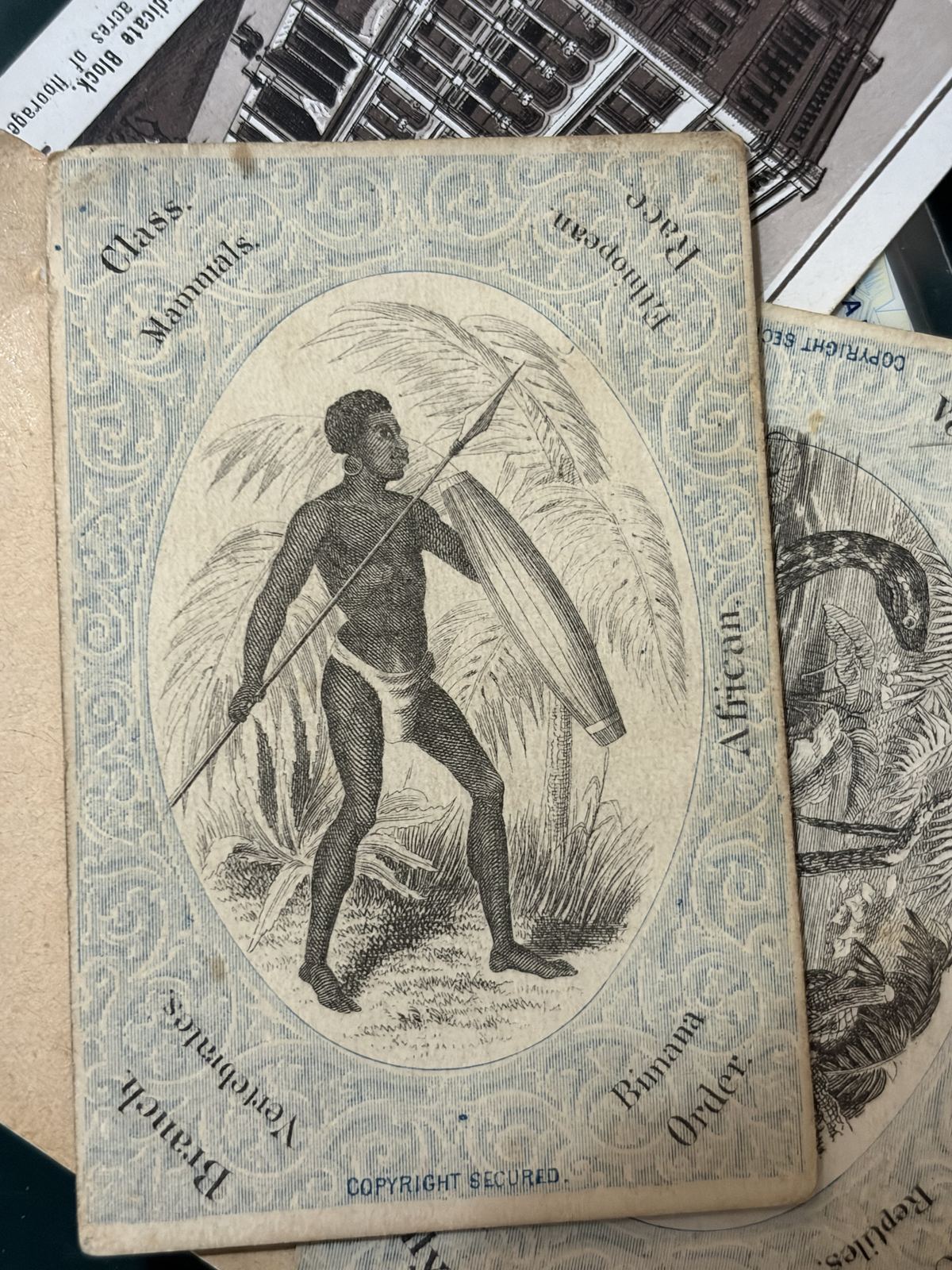
Here we have a wonderfully eccentric trio of Victorian natural history trade cards dating to circa 1870–1900 — the sort of paper ephemera that survives more by luck than by design. Each combines a decorative chromolithographic border with a stark black-and-white vignette: an African figure labeled within a zoological framework, an anaconda, and a beetle, all surrounded by taxonomic headings such as Class, Order, and Family. The layout, typography, and printed "COPYRIGHT SECURED" notation are characteristic of late 19th-century American commercial printing. During this period, publishers frequently blended education, curiosity, and advertising into pocket-sized visual lessons. The inclusion of human racial categories within zoological taxonomy reflects the scientific conventions and social attitudes of the Victorian era. Condition is good for items of this type. The cards show even age toning, minor edge wear, and scattered staining consistent with authentic antique paper. A handwritten name, "F.A. Holmes," appears on the reverse of one example, adding a small but tangible trace of personal history. Market value for common Victorian trade cards is generally modest. Comparable single cards often sell in the $5–$20 range, placing this three-card group at an estimated $20–$35 at auction. While not rare, they remain charming survivals of 19th-century print culture — miniature cabinets of curiosity in card form.
Used for this report's TTS and avatar presentation.
Item Report
Victorian Chromolithograph Natural History Trade Cards (Group of Three)
维多利亚时期自然历史彩色石印广告卡(三张一组)
Merge Reports: Yes (reconciled). Approval remains manual.
By: Unknown publisher; marked "COPYRIGHT SECURED"
Style: Victorian chromolithograph trade card / natural history educational card
Origin: United States
Materials: Printed paper/card stock with chromolithographic color borders and black ink text
Age: circa 1870–1900
Condition: Good (overall toning, minor edge wear, scattered stains; not professionally graded)
Value: Estimated auction value for the group: $20–$35 USD total
Peer-Reviewed Market Values
- Dating Range
- Pending structured dating
- Auction Liquidation
- Pending structured market values
- Fair Market Value
- Pending structured market values
- Replacement Value
- Pending structured market values
- Comparables Used
- 1 comparable
- Research Confidence
- Insufficient Data
Peer review completed, but this run did not return structured market value ranges.
Maker's Marks / Writing: Printed "COPYRIGHT SECURED" on each card; taxonomic labels including Class, Order, Family, Mammalia, Reptiles, Arthropoda, Vertebrates, Insects; handwritten "F.A. Holmes" on reverse of one card
Date: 2026-05-10 15:43:39.683672
Description:
A group of three late 19th-century American chromolithograph trade or educational cards featuring decorative color borders surrounding black-and-white natural history vignettes. Subjects include a figure labeled "Africa," an anaconda, and a beetle. Each card is framed with printed taxonomic classifications such as "Class," "Order," "Family," and related zoological categories (including Mammalia, Reptiles, Arthropoda, Vertebrates, and Insects). One card classifies the African figure under "Class: Mammals," "Race: Ethiopean," "Branch: Vertebrates," and "Order: Bimana," an obsolete 19th-century scientific term used to distinguish humans as "two-handed" mammals. The inclusion of human racial categories within zoological classification reflects the scientific and social biases of the Victorian era. Such imagery and terminology are consistent with late 19th-century natural history pedagogy and commercial ephemera. Each card bears the printed notation "COPYRIGHT SECURED," indicating formal commercial publication. A handwritten ownership inscription, "F.A. Holmes," appears on the reverse of one card. 三张一组的19世纪晚期美国彩色石印广告或教育卡片,采用彩色装饰边框,中央为黑白自然历史图像。题材包括标注为“Africa”的人物、一条蟒蛇(anaconda)以及一只甲虫。卡片边框印有“Class(纲)”、“Order(目)”、“Family(科)”等分类信息,并涉及Mammalia(哺乳纲)、Reptiles(爬行纲)、Arthropoda(节肢动物门)、Vertebrates(脊椎动物)和Insects(昆虫纲)等术语。其中一张将非洲人物归类为“Class: Mammals”、“Race: Ethiopean”、“Branch: Vertebrates”、“Order: Bimana”。“Bimana”为19世纪已废止的分类术语,用以将人类作为“两手类”哺乳动物与其他灵长类区分。 将人类种族纳入动物学分类体系,反映了维多利亚时期的科学与社会偏见。这类图像与术语符合19世纪晚期自然历史教育及商业印刷品的特征。每张卡片均印有“COPYRIGHT SECURED”字样,表明其为正式商业出版物。其中一张背面可见手写署名“F.A. Holmes”。
Curator Questions
Curated by Jade
Assessment:
An appealing and historically evocative group of three Victorian natural history trade cards dating to circa 1870–1900. The chromolithographic borders, period typography, and printed "COPYRIGHT SECURED" notation are consistent with late 19th-century American commercial ephemera. Condition is good for paper items of this age, with toning, minor edge wear, and scattered staining. While modest in market value, the cards are collectible examples of educational and advertising print culture from the Victorian era. 一组三张具有历史意义的维多利亚时期自然历史广告卡,约制作于1870–1900年。彩色石印边框、当时期字体风格以及“COPYRIGHT SECURED”字样均符合19世纪晚期美国商业印刷品特征。整体保存状况对该类纸质藏品而言属良好,存在自然氧化、轻微边缘磨损及少量污渍。市场价值相对不高,但作为维多利亚时期教育与广告印刷文化的实例,具有一定收藏意义。
Individual Images:
- front African figure card
- front anaconda card
- back of card with F.A. Holmes inscription
- front beetle card
Provenance:
No formal provenance documented; one card bears handwritten name "F.A. Holmes" on reverse.
Condition:
Good (overall toning, minor edge wear, scattered stains; not professionally graded)
Identification Score: 92%
The format, chromolithographic borders, taxonomic layout, typography, and printed "COPYRIGHT SECURED" mark are all strongly consistent with American Victorian trade or educational cards produced between 1870 and 1900. While the exact publisher or series is not identified, the object type and period attribution are well supported. 卡片的版式、彩色石印边框、分类学布局、字体风格以及“COPYRIGHT SECURED”印记均与1870–1900年间美国维多利亚时期广告或教育卡片高度一致。尽管具体出版商或系列尚未确认,但其类别与年代判断具有较高可靠性。
Authenticity Score: 80%
Visible age toning, edge wear, minor staining, and period printing characteristics support authenticity as late 19th-century paper ephemera. The paper stock and ink appearance are consistent with chromolithographic trade cards of the era. Without publisher identification, absolute certainty is not possible, but no obvious indicators of modern reproduction are present. 可见自然氧化、边缘磨损、轻微污渍以及符合时代特征的印刷效果,均支持其为19世纪晚期纸质印刷品。纸张与油墨特征与当时期彩色石印广告卡一致。虽未确认具体出版商,无法达到绝对确定,但未发现明显现代复制迹象。
Image Memory Note
Three similarly styled Victorian natural history trade cards with chromolithograph borders and taxonomic labels. 三张风格一致的维多利亚时期自然历史广告卡,带彩色石印边框与分类标签。
Keywords
Victorian, trade card, chromolithograph, natural history, educational card, paper ephemera, 19th century, zoological classification, Americana 维多利亚时期, 广告卡, 彩色石印, 自然历史, 教育卡片, 纸质藏品, 19世纪, 动物分类, 美国古董
Peer Review Summary
Peer Review
Key Visible Evidence
The provided images (Images 1-4) clearly show three Victorian-era trade cards featuring natural history vignettes and classification labels, consistent in design and printing style. Each card includes a 'COPYRIGHT SECURED' mark, indicating commercial publication. The cards exhibit age-appropriate toning, minor edge wear, and some staining, supporting the reported 'good' condition. A handwritten inscription 'F.A. Holmes' is visible on the reverse of one card (Image 3).
Market and Source Support
Independent research confirms that chromolithographic trade cards with educational or advertising themes were prevalent in the United States during the late 19th century, specifically from the 1870s to around 1900. The classification system and the inclusion of human 'races' within zoological categories are consistent with scientific and social biases of that period. Comparables for individual Victorian trade cards range from approximately $5 to $20, with sets of multiple cards selling for slightly higher, but generally not exceeding $20-30 for a small group of common examples.
Needs Verification
['The exact publisher or series name is not visible in the provided images, which would aid in more precise dating and market positioning.', "The specific product or company these cards were intended to advertise, if any, is not apparent, suggesting they might be 'stock cards' or purely educational.", "Further research into similar 'natural history classification' trade card sets could refine the valuation, as the current comparables are a mix of general trade cards and one similar educational set."]
Audit Conclusion
The report's identification of the items as Victorian chromolithograph natural history trade cards from circa 1870-1900 is well-supported by visible evidence and grounded historical sources. The condition assessment is also accurate. However, the reported auction value range of $40-$125 for the group of three appears somewhat optimistic when compared to recent market activity for similar items, which suggests a more conservative estimate is warranted for auction liquidation. The historical context provided regarding the content is accurate and relevant.
Comparables (Similar Items)
No archived comparables matched this report yet.
Share: