George : English Fine and Decorative Arts
George Presents

Original Presentation Script
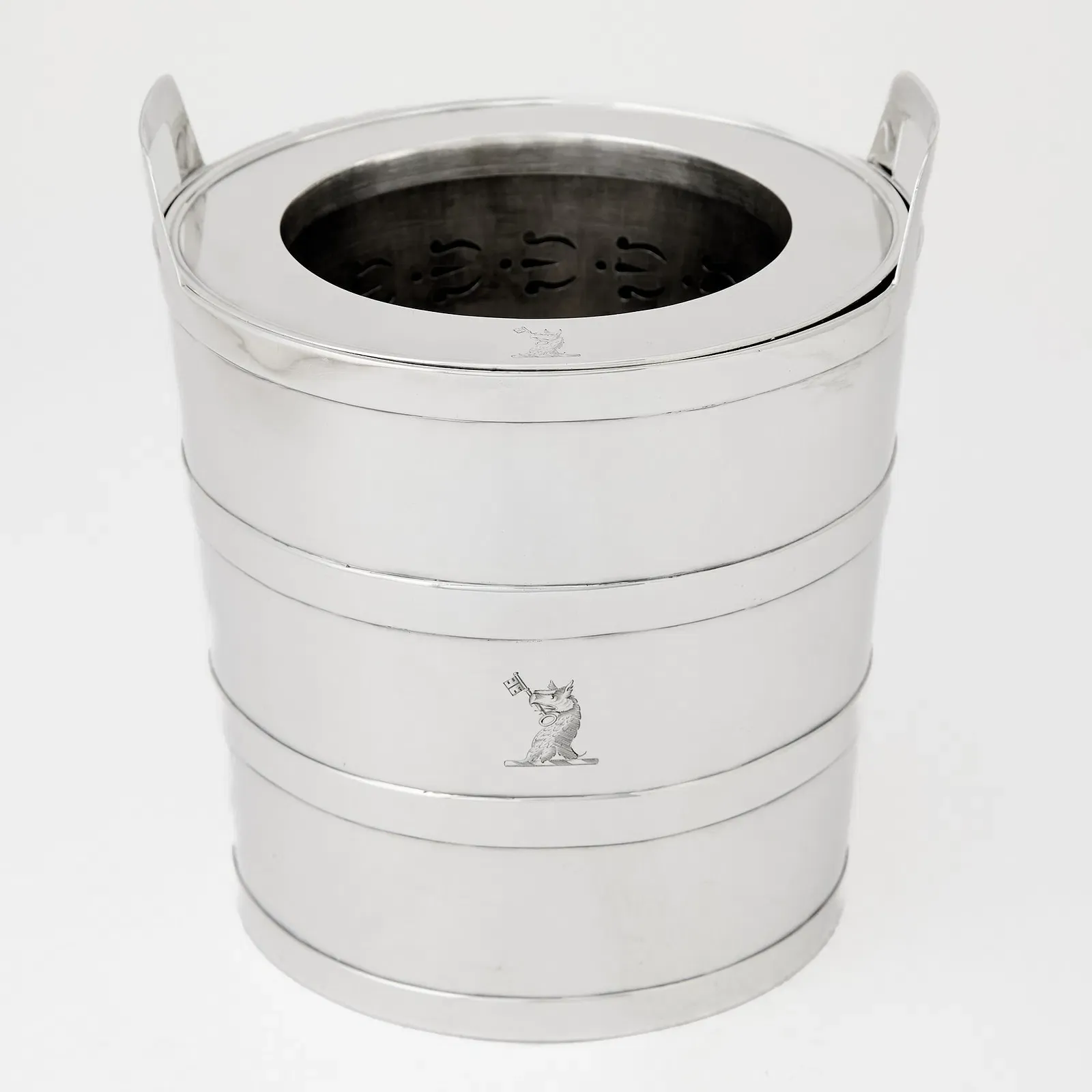
Here we have a handsome Victorian London sterling silver biscuit warmer — one of those specialized pieces of tableware that speaks quietly but eloquently of 19th-century dining ritual. Its cylindrical form, upright handles, and removable pierced liner are all hallmarks of practical elegance. Upon further review of the hallmarks, the earlier attribution to the 17th century has been corrected. The presence of a duty mark with the monarch's head, together with the uncrowned Leopard's Head of London and the date letter "C," securely places the piece in the Victorian era. Depending on the precise cycle of the "C" punch, it was assayed in London in either 1838-39, 1858-59, or 1878-79. The engraved crest — a boar holding a key — adds a note of armorial distinction, suggesting it was commissioned for a particular family or household. The workmanship appears sound, the liner properly fitted, and the hallmarks correctly configured. Light surface wear is entirely consistent with age and careful use. As Victorian sterling hollowware, it occupies a solid and collectible category of English silver. Value will ultimately depend on weight, confirmed maker attribution, and the appeal of the engraved crest, but it stands as a genuine and attractive example of London-assayed silver from Queen Victoria's reign.
Used for this report's TTS and avatar presentation.
Item Report
Victorian London Sterling Silver Biscuit Warmer (Date Letter 'C')
维多利亚时期伦敦纯银饼干保温器(字母年份标记“C”)
Merge Reports: Yes (reconciled). Approval remains manual.
By: Maker's mark appears to read "ES" or "LS"; exact attribution requires clearer hallmark verification
Style: Victorian silver hollowware
Origin: England (London assay)
Materials: sterling silver
Age: Victorian era, likely London assay year corresponding to date letter "C" (1838-1839, 1858-1859, or 1878-1879)
Condition: Very Good (light surface scratching and minor handling wear; hallmarks clear; no major dents observed)
Value: Auction estimate: approximately $600-$1,200 as a Victorian London sterling silver biscuit warmer, depending on weight, confirmed maker, and crest desirability.
Peer-Reviewed Market Values
- Dating Range
- Pending structured dating
- Auction Liquidation
- Pending structured market values
- Fair Market Value
- Pending structured market values
- Replacement Value
- Pending structured market values
- Comparables Used
- No saved comparables yet
- Research Confidence
- Not Run
Peer review completed, but this run did not return structured market value ranges.
Maker's Marks / Writing: Five London hallmarks: maker's mark (appearing to read "ES" or "LS"), Lion Passant (sterling standard), uncrowned Leopard's Head (London town mark, post-1821), date letter "C" in rectangular cartouche with clipped corners, and duty mark with monarch's head in profile (likely Queen Victoria). Engraved crest of a boar holding a key.
Date: 2026-03-15 18:18:03.298601
Description:
A cylindrical English sterling silver biscuit warmer with twin upright handles, removable top ring, and a separate pierced internal liner. The plain polished body is engraved with a heraldic crest depicting a boar holding a key. The underside bears a full set of five London hallmarks, including maker's mark (appearing to read "ES" or "LS"), Lion Passant sterling mark, uncrowned Leopard's Head town mark, date letter "C," and a duty mark with monarch's head in profile. 一件圆柱形英国产纯银饼干保温器,配双直立把手、可拆卸上环以及独立镂空内胆。器身素面抛光,刻有一枚纹章图案:野猪口衔钥匙。底部可见完整五枚伦敦检验印记,包括疑似“ES”或“LS”的制作者标记、纯银狮子标、无冠豹头伦敦城标、字母年份标记“C”以及君主头像税印。
Curator Questions
Curated by Jade
Assessment:
Upon further review of the hallmarks, this piece is definitively 19th-century English sterling silver rather than 17th-century as previously stated. The presence of a duty mark (monarch's head), used between 1784 and 1890, together with the uncrowned Leopard's Head town mark for London (post-1821), securely places the object in the Victorian era. The date letter "C" in a rectangular cartouche with clipped corners corresponds to one of three London assay years within Queen Victoria's reign: 1838-39, 1858-59, or 1878-79. The Lion Passant confirms the sterling standard. The form — cylindrical body, twin handles, removable ring, and pierced internal liner — strongly supports identification as a biscuit or roll warmer rather than a beer cooler. The engraved heraldic crest of a boar holding a key suggests armorial ownership. Construction quality, hallmark configuration, and visible wear are consistent with authentic Victorian silver hollowware. Condition appears very good, with light surface scratching and handling wear appropriate to age, and no major dents evident in the photographs. Overall, this is a sound and attractive example of Victorian London silver tableware with clear assay marks and honest period character. 经进一步核查印记后,可确认此器为19世纪英国纯银制品,而非此前所述的17世纪作品。税印(君主头像)使用于1784年至1890年之间,加之1821年以后使用的无冠豹头伦敦城标,可明确将本器断代为维多利亚时期。字母年份标记“C”对应维多利亚女王在位期间的三个可能检验年度:1838-39年、1858-59年或1878-79年。狮子标确认其为标准925纯银。 器形——圆柱体、双耳、可拆卸上环及镂空内胆——更符合饼干或餐包保温器的功能,而非啤酒冷却器。刻有野猪衔钥匙的纹章表明其可能为定制家族银器。整体工艺、印记组合及磨损状态均与维多利亚时期银器特征相符。 保存状况良好,可见与年代相符的轻微表面划痕及使用痕迹,未见明显严重凹陷。整体而言,为一件品相端正、印记清晰的维多利亚时期伦敦银质餐桌器具。
Individual Images:
- whole biscuit warmer
- reverse view
- close-up of hallmarks (showing maker's mark
- Lion Passant
- Leopard's Head
- date letter C
- duty mark)
- detail of engraved crest (boar holding a key)
- view with pierced liner removed
Provenance:
No provenance documentation shown in the provided materials.
Condition:
Very Good (light surface scratching and minor handling wear; hallmarks clear; no major dents observed)
Identification Score: 96%
The pierced removable liner, cylindrical body, twin handles, and fitted ring are characteristic of a biscuit or roll warmer. The configuration aligns with documented Victorian tableware forms. 镂空可拆卸内胆、圆柱形器身、双耳及配套上环均为维多利亚时期饼干或餐包保温器的典型特征,与已知同类器物形制高度一致。
Authenticity Score: 92%
The full and coherent set of five London hallmarks — maker's mark, Lion Passant, uncrowned Leopard's Head, date letter "C," and duty mark — strongly support authenticity as Victorian sterling silver. The marks appear properly struck and consistent in placement. Final confirmation of the maker would require clearer magnification of the maker's punch. 完整且逻辑一致的五枚伦敦印记——制作者标记、狮子标、无冠豹头、字母年份“C”及税印——有力支持其为维多利亚时期纯银真品。印记位置及冲压方式看似规范。制作者具体身份仍需更清晰的放大图像确认。
Image Memory Note
Hallmarks consistent with Victorian London sterling silver including duty mark and date letter C. 印记显示为维多利亚时期伦敦纯银,包括税印及字母年份C。
Keywords
Victorian sterling silver, London hallmarks, biscuit warmer, roll warmer, Lion Passant, Leopard's Head, duty mark, Queen Victoria, engraved crest, English hollowware 维多利亚纯银, 伦敦印记, 饼干保温器, 餐包保温器, 狮子标, 豹头标, 税印, 维多利亚女王, 纹章雕刻, 英国银器
Peer Review Summary
Peer Review
Key Visible Evidence
The item is a cylindrical silver vessel with twin upright handles, a removable top ring, and a separate pierced internal liner, as shown in Images 1, 2, and 5. An engraved crest depicting a boar holding a key is visible on the body (Image 4). Five distinct hallmarks are visible in Image 3, from left to right: 1) An oblong cartouche containing what appears to be the letters 'ES' or 'LS' (Maker's Mark). 2) A shield-shaped cartouche containing a Lion Passant, facing left (Standard Mark for Sterling). 3) A shield-shaped cartouche containing an uncrowned Leopard's Head (Town Mark for London). 4) A rectangular cartouche with clipped corners containing an uppercase letter 'C' (Date Letter). 5) An oval cartouche containing a monarch's head in profile, facing right (Duty Mark). The overall condition shows light surface wear consistent with use.
Market and Source Support
The presence of a Duty Mark (monarch's head in profile, Image 3, Punch 5) definitively dates the item to between 1784 and 1890, according to standard English sterling silver hallmark guides. This directly contradicts the report's claim of 'circa 1650-1700' and 'George XV period,' as there was no 'George XV' monarch and the 17th century predates the use of the Duty Mark. The uncrowned Leopard's Head (Image 3, Punch 3) further refines the dating to post-1821. The profile of the monarch in the Duty Mark appears to be Queen Victoria, who reigned from 1837-1901. Therefore, the item dates to the Victorian era (1837-1890). The uppercase 'C' date letter (Image 3, Punch 4) in a rectangular cartouche with clipped corners, within the Victorian period, corresponds to London assay years 1838-1839, 1858-1859, or 1878-1879. The Lion Passant (Image 3, Punch 2) confirms the sterling silver standard.
Needs Verification
The report's dating of 'George XV Period' and 'circa 1650-1700' is factually incorrect and requires correction to the 19th century (Victorian era). The report's attribution of the maker's mark as 'QJ' is not supported by the visible evidence in Image 3, which appears to be 'ES' or 'LS'. A clearer, higher-resolution image of the maker's mark is needed for a definitive reading. The precise year for the date letter 'C' remains uncertain between 1838-1839, 1858-1859, and 1878-1879; a more detailed visual analysis of the specific font and cartouche nuances would be required to narrow this down. The informal description of the engraved crest as 'Snoopy Joe Cool' is inappropriate for a formal appraisal and should be replaced with a proper heraldic description (a boar holding a key). While 'beer cooler' is plausible, the pierced internal liner often suggests a 'biscuit warmer' or 'roll warmer,' as also mentioned in the report's description and keywords; a more precise functional identification could be beneficial.
Audit Conclusion
The item is confirmed as authentic English sterling silver, based on the visible hallmarks. However, the report contains significant factual errors regarding the dating and period attribution, incorrectly identifying it as 'George XV Period' and '17th century.' The visible hallmarks, particularly the Duty Mark and uncrowned Leopard's Head, unequivocally place the item in the 19th century, specifically the Victorian era (1837-1890), with the date letter 'C' corresponding to 1838-39, 1858-59, or 1878-79. The maker's mark reading in the report ('QJ') is also inconsistent with visible evidence. The value estimate should be re-evaluated in light of the correct 19th-century dating rather than the erroneous 17th-century attribution.
Comparables (Similar Items)
No archived comparables matched this report yet.
Share: