Pair of Late 19th Century William and Mary Style Oak Caned Side Chairs
LANGUAGE UNLOCK
Glossary Roundup
Original Presentation Script
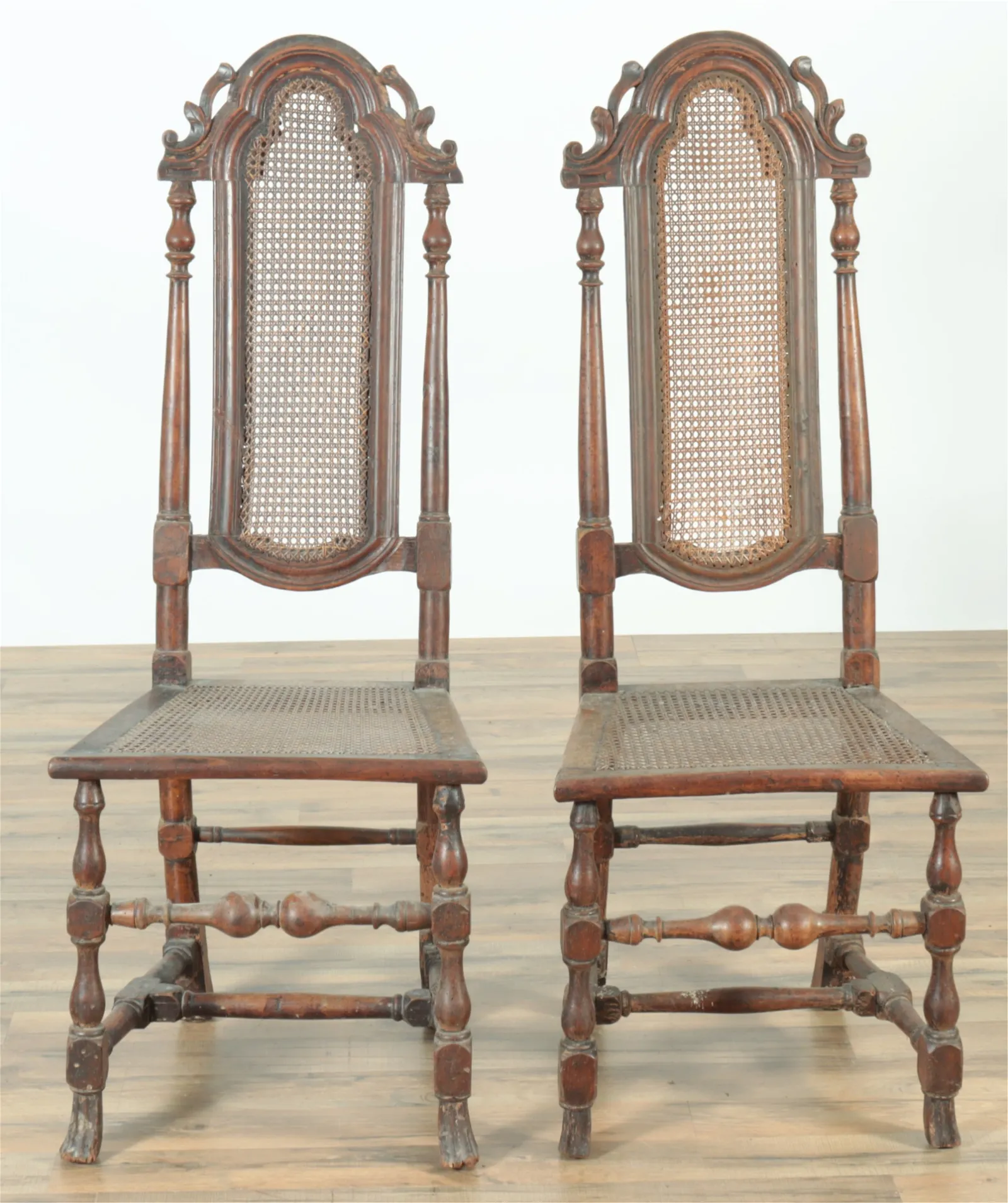
Here we have a stately Pair of Late 19th Century William and Mary Style Oak Caned Side Chairs — tall, slim, and just a touch theatrical.
These high backs, with their arched, scrolled crests and narrow cane panels, are a direct homage to English chairs of the late 1600s, when William and Mary furniture announced a new, more continental elegance after the Restoration. Collectors love this silhouette: architectural, almost ecclesiastical, yet still domestic enough for the hall or dining room.
Look closely at the legs and stretchers: the block-and-baluster turning is quite regular, a hint of machine assistance rather than purely hand-turned 17th-century work. The caning, too, feels more standardized, and the overall construction suggests a late Victorian or Edwardian revival workshop tipping its hat to history.
Condition-wise, there’s honest, workaday wear — abrasions on the stretchers, scuffs to the feet, and age-softened finish. The cane appears aged and may be fragile, but that kind of lived-in surface is exactly what we expect from chairs around a century old, not three centuries.
On the authenticity spectrum, I’d place these at about 25%: genuine antiques, yes, but of the revival period, not William and Mary’s own court. In today’s auction rooms, I’d expect the pair to bring in the region of $300 to $600, whereas true late 17th-century examples could stretch into several thousands.
… Charles here, signing off: Let the Mink have a Think!
Used for this report's TTS and avatar presentation.
Item Report
Pair of Late 19th Century William and Mary Style Oak Caned Side Chairs
By:Unknown cabinetmaker, factory or workshop
Style:William and Mary Revival / Late Victorian
Origin:England or possibly Continental Europe (made for English market)
Materials:Stained oak (or other hardwood), woven cane, iron/nail fasteners, glue
Age:Circa 1880–1910
Condition:Fair to good (wear to finish, stretchers and joints, aged and possibly weakened caning, structurally presentable but used)
Value:Authentic late 17th-century period pair: $4,000–$8,000 at auction; as late 19th–early 20th century William and Mary revival pair: $300–$600 at auction
Maker's Marks / Writing:No maker’s marks or inscriptions visible in the provided image.
Date:2025-12-27 23:03:01.806857
Description:
Pair of high-back side chairs with arched and scrolled crest rails, elongated oval caned backs framed by turned uprights, and caned slip-in seats. The bases have block-and-baluster turned legs joined by bulbous front stretchers and multiple side and rear stretchers. Dark stained oak (or similar hardwood) with worn, oxidized finish and evident age to the caning and joints. Form and details emulate late 17th-century English William and Mary period examples but construction and overall look indicate later revival manufacture.
Curator Questions
Curated by Jade
Assessment:
This is a decorative pair of late 19th to early 20th century William and Mary revival side chairs, not period William and Mary examples. The tall, arched backs with cane panels, turned front legs and central bulbous stretcher follow English late 17th-century prototypes, but the wood surfaces, more regular machine-turned elements, and the overall consistency of the caning and joinery point to industrial-era manufacture. They display honest wear—abrasion to stretchers, oxidized finish, scattered knocks—and some weakness in the joints and caning which is typical of chairs around 120–140 years old. A word about copies.. in this category, revival chairs vastly outnumber genuine late 1600s survivors, and period sets nearly always show more hand-tool irregularities and earlier methods of joinery. As attractive decorative seating or as accent pieces beside a refectory table or in a hall, they retain charm, but their collector value is modest compared to true William and Mary period chairs.
Individual Images:
whole pair of caned high-back chairs
Provenance:
Not provided.
Condition:
Fair to good (wear to finish, stretchers and joints, aged and possibly weakened caning, structurally presentable but used)
Identification Score: 88%
Form, caned high backs, baluster-turned legs, and bulbous front stretchers closely match known William and Mary style side chairs; visible construction and finish strongly support a late 19th–early 20th century revival dating.
Authenticity Score: 25%
Authentic as late Victorian/Edwardian William and Mary revival chairs, but very unlikely to be late 17th-century period pieces; turning regularity, finish quality, and overall condition suggest machine-assisted, later manufacture.
Image Memory Note
None
None
Keywords
William and Mary style, high-back chairs, caned seats, caned backs, oak side chairs, Victorian revival furniture, English furniture, 19th century chairs, antique chairs, England
The report was edited after initial Artmink draft. Original AI draft preserved in Artmink audit history.

Share: