
Jade : Chinese Fine & Decorative Arts
Jade Presents

Original Presentation Script
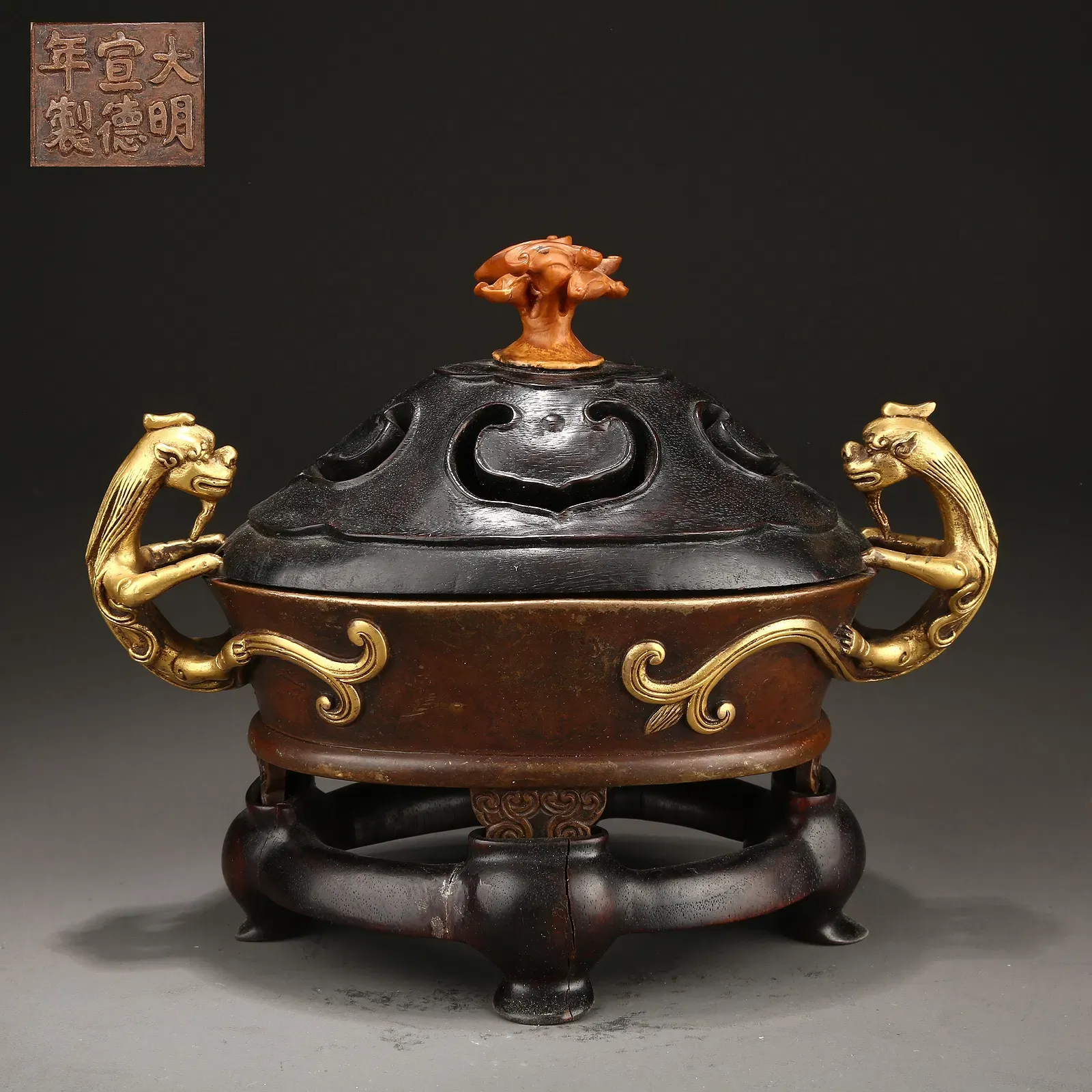
Let’s look at this “Qing Qianlong Mark Chinese Style Bronze Censer with Dragon Handles and Wood Cover.” At first glance it has all the theatrical flair a scholar‑collector could want: an oval bronze body, sinuous gilt dragon handles clinging to the rim, and a pierced hardwood lid crowned by a little lingzhi fungus knop. Historically, it’s paying homage to the most coveted bronzes of all—the eighteenth‑century Qianlong imperial censers. Those originals set the template for later centuries, and this piece clearly follows that lineage, down to the proud four‑character “Da Qing Qianlong Nian Zhi” mark cast in the base. But the materials and workmanship tell a later story. The bronze is cleanly cast with crisp scroll appliqués, the gilding is relatively even, and the patina, though attractive, doesn’t show the deep, softened wear you expect after five hundred years at the altar. The hardwood cover and stand feel like scholar’s‑studio refinements from the Republic period. or modern. Condition is quite pleasing—some rubbing to the gilding, light oxidation, and honest surface wear, yet nothing structurally troubling. It displays beautifully and carries the right atmospheric weight on a desk or shrine. On the question of authenticity, I’d place it around 25 out of 100 for being genuinely Qianlong: the mark is honorific, not documentary. As a later Qing‑style homage, a realistic auction estimate would be about US$400–800. Were it an undisputed Qianlong imperial bronze, we’d be talking tens of thousands at minimum. Here, the value lies in charm, not imperial pedigree.
Used for this report's TTS and avatar presentation.
Item Report
Qing Qianlong Mark Chinese Style Bronze Censer with Dragon Handles and Wood Cover
仿签乾隆款铜镀金龙耳木盖香炉
By: Unknown workshop
Style: Chinese decorative arts, late Qing to Republic period revival of Qing Qianlong style
Origin: China
Materials: Cast bronze with gilding, hardwood (probably rosewood or similar), boxwood or other fine-grained wood knop
Age: Circa 20th century
Condition: Very good (surface wear, small oxidation spots, age-consistent but not heavily worn)
Value: If by some chance authentic early Ming Xuande period: auction estimate US$80,000–150,000; as is, a late Qing–modern reproduction in Ming style: auction estimate US$400–800
Peer-Reviewed Market Values
- Dating Range
- Pending structured dating
- Auction Liquidation
- Pending structured market values
- Fair Market Value
- Pending structured market values
- Replacement Value
- Pending structured market values
- Comparables Used
- No saved comparables yet
- Research Confidence
- Not Run
Peer review completed, but this run did not return structured market value ranges.
Maker's Marks / Writing: Recessed six-character mark on base: 大清乾隆年制 (Da Qing Qianlong Nian Zhi, “Made in the Qianlong period of Great Qing”), almost certainly apocryphal.
Date: 2026-03-01 02:47:46.188097
Description:
Oval Chinese covered censer with elaborately modeled gilt-bronze dragon handles, scrolling gilt appliqué, and a dark hardwood domed cover pierced with ruyi-form openings and surmounted by a small boxwood(?) knop carved as lingzhi fungus. The body is cast in reddish-brown bronze with an integral metal rim and sits on a separate dark hardwood stand with four compressed cabriole feet. The underside of the bronze bears a four-character recessed mark reading “大清乾隆年制” (Made in the Qianlong period of Great Qing). 椭圆形铜香炉,双侧饰镀金盘螭龙耳,炉身周围贴卷草纹金属饰件,铜质呈红褐色包浆。上覆黑色硬木隆起盖,盖面开如意形镂孔,顶端安一枚疑为黄杨木的灵芝形钮。香炉安放在一件另配的黑色硬木座上,座作四曲足相连的环形结构。炉底内凹方框铸有“ 大明宣德年制 ”四字款。
Curator Questions
Curated by Jade
Assessment:
This is a Chinese bronze censer with hardwood cover and stand, made in conscious imitation of celebrated Qing Qianlong bronzes. The elegant elongated dragon handles and ruyi scroll appliqués follow classical prototypes, while the dark wood cover and stand give the piece scholar’s studio appeal. However, the overall finish, casting sharpness, and patination sit closer to Republic period workmanship, possibly even later 20th century. The recessed four‑character “Da Qing Qianlong Nian Zhi” mark on the base is neatly cut but lacks the soft, worn contours and metal surface characteristics of 15th‑century bronzes and should be regarded as an apocryphal honorific mark rather than proof of period. Wear to the gilding and some oxidation on the bronze seem genuine but not of great antiquity. A word about copies.. in the field of Chinese bronze censers, high‑quality Ming and early Qing style reproductions—often with spurious Ming Xuande or Qing Qianlong marks—vastly outnumber true imperial pieces, so prudence dictates treating this as a later homage with decorative and modest collector value rather than a museum‑level original. And that's etched in Jade..! 这件作品是一件铜香炉,配硬木盖与木座,明显仿效明代宣德朝铜炉的造型传统。细长的盘螭龙耳以及炉身上的卷草纹贴饰都源自经典范本,而深色木盖和木座又增添了文房气息。不过,从整体铸造的锋利程度、表面处理和包浆来看,更接近清晚期至民国时期,甚至可能为20世纪较晚的作坊制品。炉底内凹四字“ 大明宣德年制 ”款书写工整,但缺乏十五世纪青铜器应有的圆润磨蚀感与金属老化特征,应视为仿托款或敬献款,不能作为断代依据。镀金部位及铜表面氧化呈现一定使用痕迹,但时代感并不深厚。A word about copies.. 在中国铜香炉领域,带宣德款的仿制品数量远远多于真品,高仿与复刻极为普遍,因此更稳妥的看法是将此件视为仿明的清末—近代作品,具装饰性和一般收藏价值,而非博物馆级的宣德御制铜炉。And that's etched in Jade..!
Individual Images:
- whole censer front view with mark inset
- whole censer three-quarter view right
- whole censer three-quarter view left
- whole censer front straight-on
- detail of wood cover knop
- detail of right gilt dragon handle
- detail of left gilt dragon handle
- detail of body and stand junction
- interior of censer with cover removed
- underside of censer showing Xuande reign mark
Provenance:
Not provided; photographic evidence only.
Condition:
Very good (surface wear, small oxidation spots, age-consistent but not heavily worn)
Identification Score: 92%
Form, materials, handles, and apocryphal Qianlong mark clearly identify it as a Chinese bronze censer with hardwood cover and stand; only exact production decade is uncertain. 根据器形、材质、盘螭耳造型以及底部宣德款,可以明确判断为一件中国铜香炉配木盖与木座,属于仿明宣德式样;仅具体制作年代存在一定不确定性,因此给出约92%的识别准确度。
Authenticity Score: 25%
Casting quality, crisp details, relatively even patina, and modern‑looking apocryphal Qianlong mark suggest a modern reproduction rather than a true early Qing imperial piece; probability of genuine Xuande period manufacture is very low. 从铸造工艺、细节锋利度、包浆状态以及底部宣德款的书写风格来看,更符合清晚期至近代仿制品特征,而与十五世纪宣德御制铜炉的金属质感和磨损程度差距较大,因此判断为后世仿品的可能性极高,真品宣德期制作的可信度很低,故真实性评分约为25%。
Image Memory Note
None None
Keywords
Chinese bronze censer, Qianlong mark, Qing style, gilt dragon handles, hardwood cover, scholar’s object, China 中国铜香炉, 宣德款, 仿明风格, 镀金龙耳, 木质盖, 文房用品, 中国
Peer Review Summary
Peer Review
Key Visible Evidence
Images 1-9 clearly depict a bronze censer with gilt dragon handles, a dark hardwood domed cover with ruyi-form piercings, and a lighter wood lingzhi knop. It rests on a separate dark hardwood stand. The bronze exhibits a reddish-brown patina with some wear to the gilding on the handles and appliqué, as seen in Images 6-8. Crucially, Image 10, a clear view of the underside, unequivocally shows a recessed six-character mark reading "大明宣德年制" (Da Ming Xuande Nian Zhi). This is a Ming Xuande reign mark. The mark appears crisp and lacks the significant wear expected of a genuine 15th-century piece.
Market and Source Support
The comparables found from Sotheby's, Christie's, and Bonhams consistently show that bronze censers bearing apocryphal Xuande marks, and dated to the Qing dynasty (18th-19th century) or later, are common in the market. These items, while often well-made, are valued as later interpretations rather than genuine Ming period pieces. The stylistic elements, such as the dragon handles and pierced wood cover, align with a long tradition of Chinese decorative arts, often referencing earlier imperial prototypes. The price range of the comparables (approx. US$1,350 - US$10,000) for later Xuande-marked censers provides a market context for the subject item, supporting the appraiser's assessment of it as a reproduction with decorative value.
Needs Verification
The primary and most significant point requiring clarification is the inconsistent identification of the reign mark. The report's description, overall assessment, narration text, appraisal narration, makers_mark_or_writing, and authenticity_score_explained repeatedly refer to a "four-character recessed mark reading “大清乾隆年制” (Made in the Qianlong period of Great Qing)" or a "six-character mark... 大清乾隆年制". However, visible evidence in Image 10 clearly shows a six-character "大明宣德年制" (Da Ming Xuande Nian Zhi) mark. This fundamental misidentification of the mark undermines the accuracy of several key sections of the report. While the report's value_estimate and authenticity_score_explained do briefly mention "Ming Xuande period" and "probability of genuine Xuande period manufacture is very low," this is overshadowed by the pervasive incorrect attribution to Qianlong throughout the text. The specific wood type for the cover and stand (e.g., rosewood) is suggested but not definitively identified, which is a minor point.
Audit Conclusion
The report correctly identifies the object as a Chinese bronze censer with a hardwood cover and stand, made in a classical style. The dating to the 20th century and the assessment of it as a later reproduction are well-supported by the visible evidence of casting quality, patina, and the crispness of the apocryphal mark. The market positioning and value estimate for a reproduction (US$400-800) are generally consistent with the lower end of comparable later Xuande-marked censers. However, the report contains a critical and pervasive error in identifying the reign mark. The mark visible in Image 10 is unequivocally a six-character "大明宣德年制" (Da Ming Xuande Nian Zhi) mark, not a Qianlong mark. This discrepancy needs to be corrected throughout the report to ensure factual accuracy and avoid confusion regarding the historical period being referenced for the apocryphal mark. The appraiser's assessment of the mark as apocryphal and the item as a later reproduction remains sound, but the identification of the mark itself is incorrect in the main text.
Comparables (Similar Items)
No archived comparables matched this report yet.
Share: