Premium upgrade: Monique delivers your appraisal as a guided podium narration with synced visuals and voiceover.
Output is a narrated, animated slideshow with video intro and outro, sandwiching the autoplay voiceover sequence in actual video.
French Comtoise Wall Clock
LANGUAGE UNLOCK
Glossary Roundup
Original Presentation Script
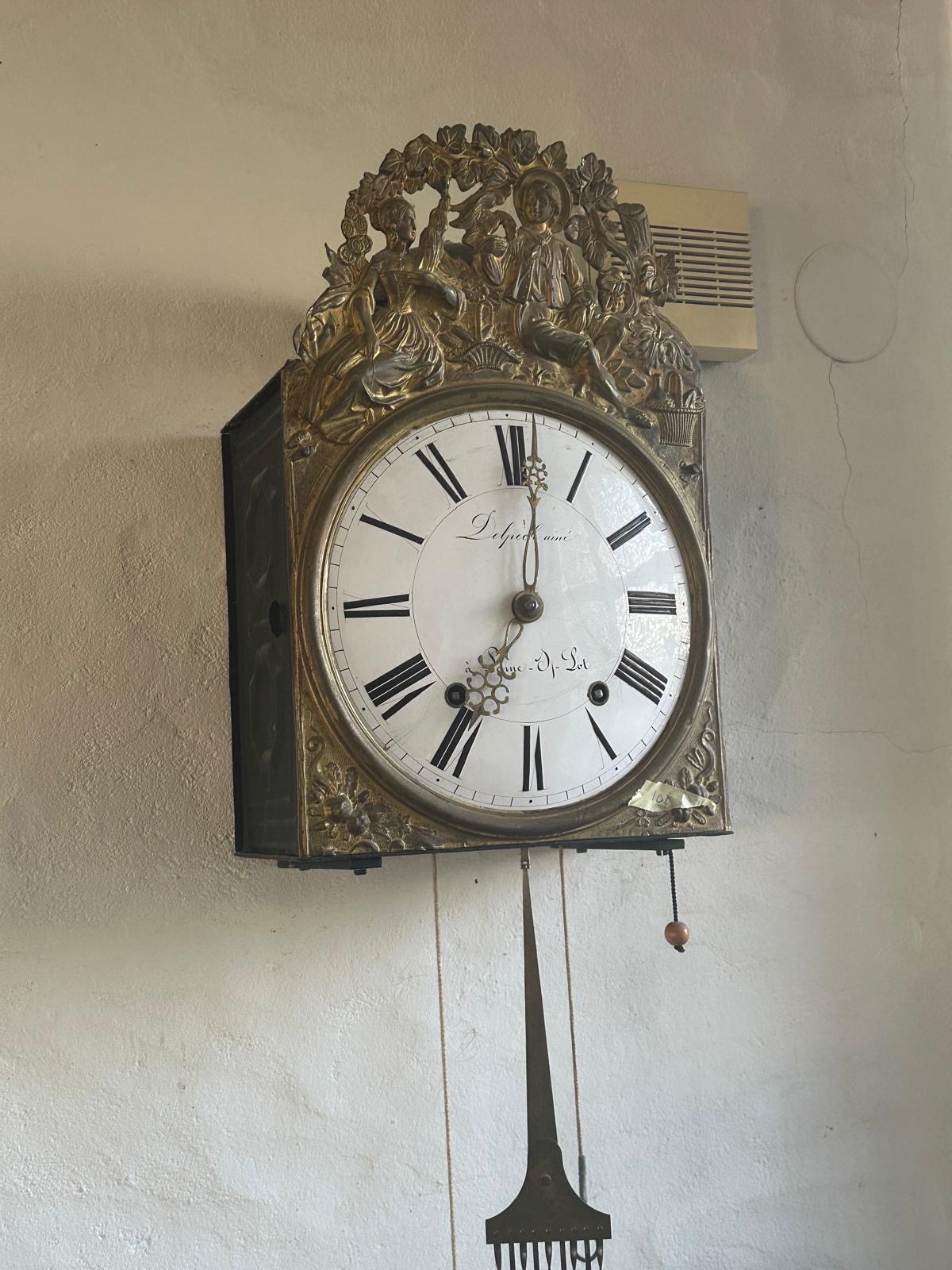
This striking timepiece is a classic French Comtoise wall clock, also known as a Morbier clock, originating from the Franche-Comté region. Dating to the mid-to-late 19th century, circa 1850 to 1880, these clocks were the workhorses of French provincial homes, known for their robust iron movements and loud strikes. What immediately catches the eye is the elaborate pressed brass surround, or fronton, featuring a charming repoussé scene of figures amidst foliage—a typical decorative flourish of the period. The large, legible white enamel dial bears the name 'Delpech ainé à Puy-l'Évêque', pointing to a specific maker or retailer in the Lot department of southwestern France, adding a wonderful layer of regional history. The clock features a characteristic gridiron pendulum, designed to compensate for temperature changes, though often more decorative than functional in these later models. The visible wear and patina on the brass, along with the style of the hands and dial, strongly support its authenticity as a genuine 19th-century piece. Assuming the movement is intact, a conservative auction estimate for this authentic Comtoise clock would be between $200 and $400. It's a wonderful piece of French provincial history that still commands attention today.
Used for this report's TTS and avatar presentation.
Expert Review Script
This striking timepiece is a classic French Comtoise wall clock, also known as a Morbier clock, originating from the Franche-Comté region. Dating to the mid-to-late 19th century, circa 1850 to 1880, these clocks were the workhorses of French provincial homes, known for their robust iron movements and loud strikes. What immediately catches the eye is the elaborate pressed brass surround, or fronton, featuring a charming repoussé scene of figures amidst foliage—a typical decorative flourish of the period. The large, legible white enamel dial bears the name 'Delpech ainé à Prayssac - Dpt Lot', pointing to a specific maker or retailer in the Lot department of southwestern France, adding a wonderful layer of regional history. The clock features a flat iron pendulum rod, typical of the robust construction of these provincial clocks. The visible wear and patina on the brass, along with the style of the hands and dial, strongly support its authenticity as a genuine 19th-century piece. Assuming the movement is intact, a conservative auction estimate for this authentic Comtoise clock would be between $200 and $400. It's a wonderful piece of French provincial history that still commands attention today.
Condition:Good (visible wear and patina consistent with age, some minor discoloration to the dial, pendulum and weights present but working condition unknown)
Peer review completed, but this run did not return structured market value ranges.
Maker's Marks / Writing:Delpech ainé / à Prayssac - Dpt Lot
Date:2026-11-01 09:56:57.920623
Description:
A French Comtoise (or Morbier) wall clock, featuring a large white enamel dial with Roman numerals and the maker's name 'Delpech ainé à Prayssac - Dpt Lot'. The dial is surrounded by a pressed brass surround (fronton) decorated with a repoussé scene of figures, possibly agricultural or allegorical, amidst foliage. It has a flat iron pendulum rod and is housed in a typical sheet iron case.
Curator Questions
Curated by Jade
Assessment:
This is a characteristic example of a French Comtoise clock from the 19th century. The pressed brass surround and the specific style of the enamel dial are typical of the mid-to-late 19th-century production of these robust provincial clocks. The maker's name and location add a nice touch of regional history.
Individual Images:
front view of Comtoise clock on wall
Provenance:
None provided
Condition:
Good (visible wear and patina consistent with age, some minor discoloration to the dial, pendulum and weights present but working condition unknown)
Identification Score: 95%
The form, materials, and specific decorative elements (pressed brass surround, enamel dial, iron pendulum rod) are highly characteristic of French Comtoise clocks.
Authenticity Score: 90%
The wear, patina on the brass, and the style of the dial and hands are consistent with a genuine 19th-century Comtoise clock. The maker's inscription appears authentic to the period.
Image Memory Note
None
None
Keywords
Comtoise clock, Morbier clock, French wall clock, antique clock, brass repoussé, enamel dial, Delpech ainé, Prayssac, France
The report was edited after initial Artmink draft. Original AI draft preserved in Artmink audit history.
Peer Review Summary
Dating Range
Mid to late 19th century (circa 1850-1880)
Fair Market Value
Pending structured market values
Replacement Value
Pending structured market values
Archived Matches
No archive matches yet
Research Confidence
Insufficient Data
Research Findings
Key Visible Evidence
The image shows a French Comtoise clock with a pressed brass fronton and an enamel dial. The dial inscription clearly reads 'Delpech ainé / à Prayssac - Dpt Lot', contradicting the report's reading of 'Puy-l'Évêque'. Furthermore, the visible pendulum is a flat iron rod with a comb-like lower section (likely part of a folding pendulum or a simple iron rod), not a multi-rod gridiron pendulum as claimed.
Market and Source Support
Reference guides to Comtoise clocks confirm that one-piece stamped brass surrounds (frontons) and enamel dials of this style are characteristic of mid-to-late 19th-century production. Prayssac is a commune in the Lot department, confirming the regional origin, though correcting the specific town.
Needs Verification
['The full pendulum bob and weights are not visible; their presence and condition require verification.', 'The condition and functionality of the internal iron movement cannot be assessed from the exterior view.']
Advisory Conclusion
The report is partly supported but contains two specific errors in visual observation. The maker's location is misread, and the pendulum type is misidentified. The dating and general classification as a 19th-century Comtoise clock are plausible.


Share: