Premium upgrade: George delivers your appraisal as a guided podium narration with synced visuals and voiceover.
Output is a narrated, animated slideshow with video intro and outro, sandwiching the autoplay voiceover sequence in actual video.
English Sterling Silver Assembled Three-Piece Tea Set
LANGUAGE UNLOCK
Glossary Roundup
Original Presentation Script
Here we have a classic English sterling silver three-piece tea set, featuring an elegant Neoclassical fluted design. At first glance, this looks like a perfect, unified George III service from the late 18th century. However, as the provided notes suggest, the secret to this set's history lies in reading the hallmarks carefully. Crafted from solid sterling silver with a substantial total weight of 1098 grams, the set features beautiful bright-cut engraving and square pedestal bases. But when we look closely at the marks, we see a fascinating story of continuity. Some pieces bear the marks of the respected silversmith Henry Chawner from London in 1793, while another bears the marks of Joseph Angell II from 1860. This makes it an 'assembled' or 'harlequin' set. It was very common in the Victorian era to have a silversmith create a bespoke piece to replace a damaged original or expand an inherited family service, perfectly matching the older style. The craftsmanship here is seamless, showing how carefully the Victorian silversmith replicated the 1793 design. Because it is an assembled set rather than a single-date original, the value is slightly moderated, but it remains a substantial and beautiful collection of antique silver. At auction, a composite set of this quality would carry a conservative estimate of $1,200 to $1,800. It's a wonderful example of how antique silver was cherished and maintained across generations.
Used for this report's TTS and avatar presentation.
Expert Review Script
Here we have a classic English sterling silver three-piece tea set, featuring an elegant Neoclassical fluted design. At first glance, this looks like a perfect, unified George III service from the late 18th century. However, as the provided notes suggest, the secret to this set's history lies in reading the hallmarks carefully. Crafted from solid sterling silver with a substantial total weight of 1098 grams, the set features beautiful bright-cut engraving, with the sugar and creamer raised on square pedestal bases. But when we look closely at the marks, we see a fascinating story of continuity. The pedestal pieces bear the marks of the respected silversmith Henry Chawner from London in 1793, while the teapot bears the marks of Joseph Angell II from 1860. This makes it an 'assembled' or 'harlequin' set. It was very common in the Victorian era to have a silversmith create a bespoke piece—often a teapot, which was most susceptible to heat damage—to replace a lost original or expand an inherited family service, perfectly matching the older style. The craftsmanship here is seamless, showing how carefully the Victorian silversmith replicated the 1793 design. Because it is an assembled set rather than a single-date original, the value is slightly moderated, but it remains a substantial and beautiful collection of antique silver. At auction, a composite set of this quality would carry a conservative estimate of $1,200 to $1,800. It's a wonderful example of how antique silver was cherished and maintained across generations.
Item Report
English Sterling Silver Assembled Three-Piece Tea Set
Peer review completed, but this run did not return structured market value ranges.
Maker's Marks / Writing:Hallmarks for Henry Chawner (London, 1793) and Joseph Angell II (London, 1860), including Lion Passant, Leopard's Head, duty marks, and date letters.
Date:2026-09-17 17:00:49.132378
Description:
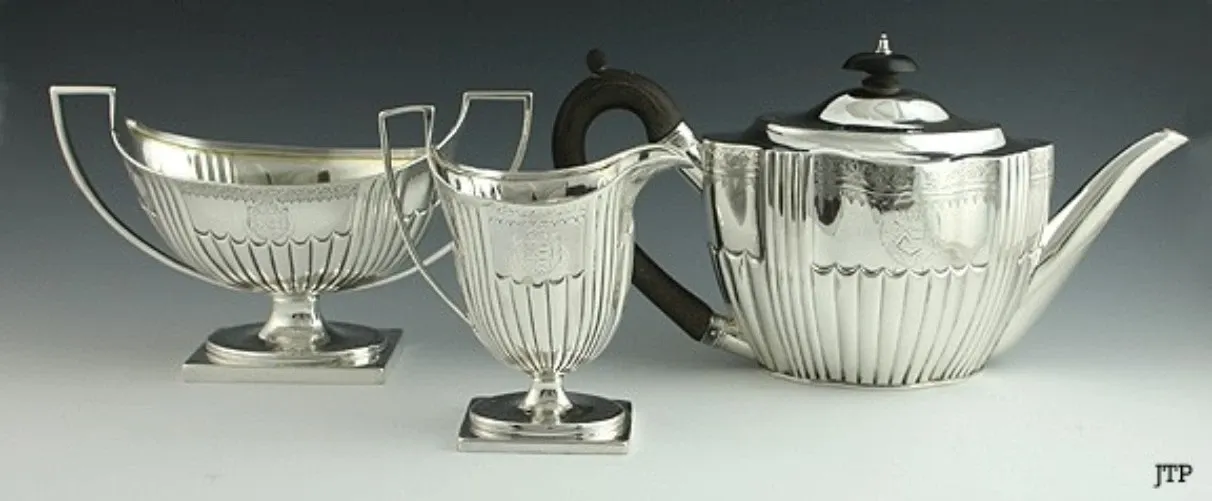
An assembled three-piece sterling silver tea service comprising a teapot, a twin-handled sugar bowl, and a cream jug. The pieces share a cohesive Neoclassical design characterized by fluted lower bodies, engraved bright-cut upper bands, and central armorial crests. The sugar bowl and cream jug are raised on square pedestal bases, while the teapot rests on a flat, scalloped base and features a wooden C-scroll handle and finial. As noted in the provided details, the set is composite: hallmarks indicate the pedestal pieces were made by Henry Chawner of London in 1793, and the teapot by Joseph Angell II of London in 1860, likely commissioned to match or complete the earlier service. The total weight is 1098 grams.
Curator Questions
Curated by Jade
Assessment:
A handsome and highly usable assembled antique silver tea set. The matching of a later Victorian piece to earlier George III pieces was a common practice to replace a lost or damaged item (frequently the teapot, which was most susceptible to heat damage) or to expand a family service. The quality of the matching here is excellent, maintaining the elegant Neoclassical aesthetic across the centuries.
Individual Images:
whole three-piece tea set
front view of sugar bowl
side view of cream jug with ruler
front view of sugar bowl
front view of cream jug
detail of Joseph Angell II hallmarks
detail of Henry Chawner hallmarks
side view of teapot
Provenance:
Total weight provided as 1098 grams.
Condition:
Very Good (minor surface wear commensurate with age, clear hallmarks, no obvious major dents visible)
Identification Score: 95%
The forms, style, and clearly photographed hallmarks allow for a confident identification of the makers, dates, and origin.
Authenticity Score: 100%
The hallmarks are clear, correct for their respective periods, and consistent with the construction and wear of the pieces, confirming this as a genuine assembled antique silver set.
Image Memory Note
None
None
Keywords
sterling silver, tea set, George III, Victorian, assembled set, Henry Chawner, Joseph Angell II, Neoclassical, fluted, London silver
The report was edited after initial Artmink draft. Original AI draft preserved in Artmink audit history.
Fair Market Value
Pending structured market values
Replacement Value
Pending structured market values
Archived Matches
No archive matches yet
Research Confidence
Insufficient Data
Peer Review
Key Visible Evidence
Image 1 displays a three-piece tea set sharing a cohesive Neoclassical fluted design, though only the sugar bowl and cream jug feature square pedestal bases; the teapot rests on a flat, scalloped base. Image 6 shows hallmarks on a curved base (likely the teapot): maker 'JA', Lion Passant, uncrowned Leopard's Head, Victoria duty head, and Gothic lowercase 'e'. Image 7 shows marks on a square pedestal base (matching the sugar/creamer): maker 'HC', Lion Passant, crowned Leopard's Head, George III duty head, and Roman lowercase 's'. Metal-standard trace: Lion Passant and full official assay sequences are clearly seen in both sets; no plate indicators are present; conclusion is solid sterling silver.
Market and Source Support
RAG hallmark tables confirm the dates. Trace 1 (Image 6): observed 'e' / lowercase / Gothic; candidates 1860, 1920; eliminations applied (duty head present, uncrowned leopard); final year 1860. Trace 2 (Image 7): observed 's' / lowercase / Roman; candidates 1753, 1793, 1833, 1913; eliminations applied (duty head present, crowned leopard); final year 1793. Silvercollection.it confirms 'JA' in a lobed punch for Joseph Angell II and 'HC' in an oval for Henry Chawner.
Needs Verification
- The total weight of 1098 grams is standard provenance but cannot be independently verified from the images.
- The specific armorial crests are not legible enough in the provided images to identify the original family.
Audit Conclusion
The draft report is strongly supported by the hallmark evidence, confirming an assembled sterling silver set from 1793 and 1860. A minor correction is required in the final report regarding the teapot's base, which is flat rather than pedestal-footed.

Share: