
Monique : French Fine and Decorative Arts
Monique Presents

Original Presentation Script
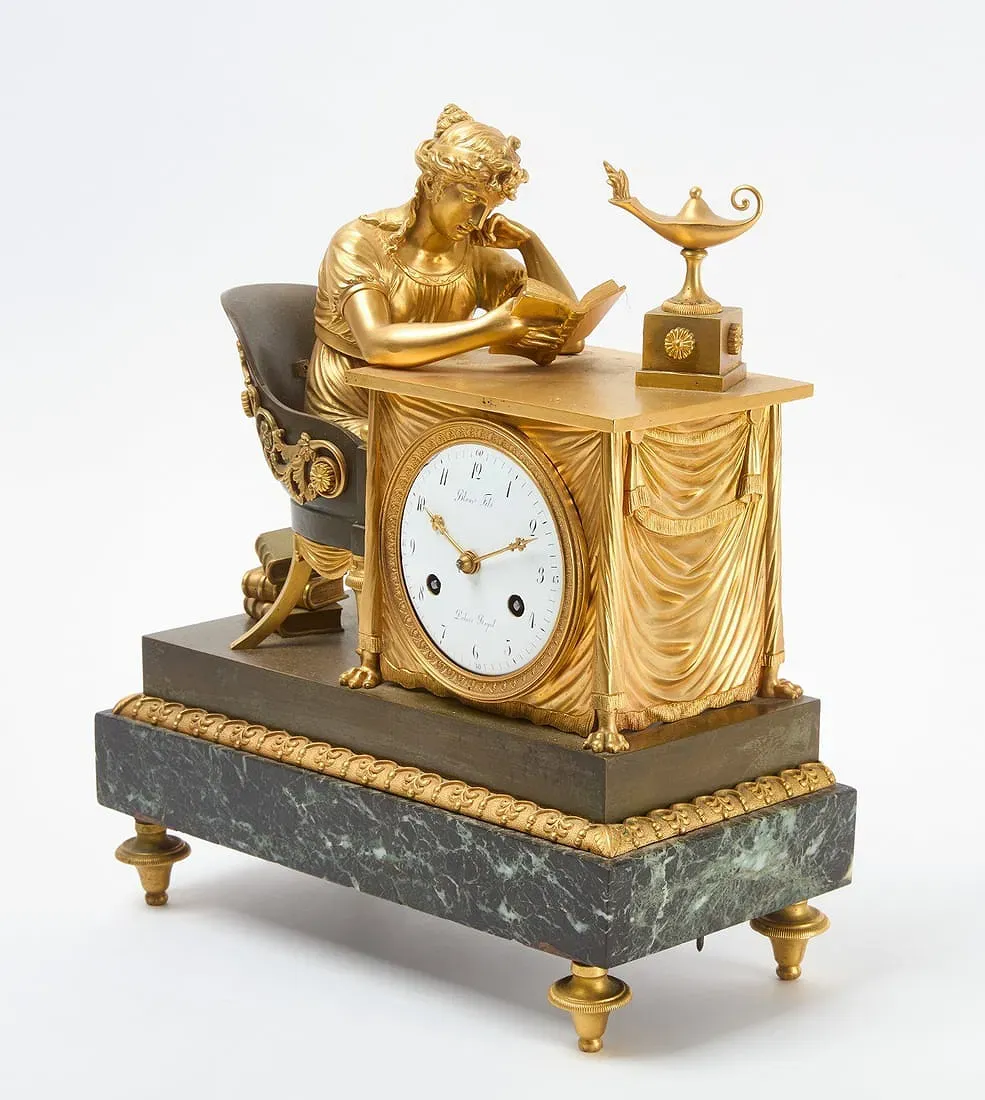
Here we have a French Empire Period ormolu and marble figural mantel clock, dating to circa 1805–1825—one of those wonderfully theatrical domestic objects that turns timekeeping into sculpture. The model shows a classical young woman absorbed in a book, seated beside a draped table-form clock case crowned with an oil lamp. It is equal parts instrument, allegory, and interior decoration. This subject belongs beautifully to the Napoleonic era, when France embraced antiquity with scholarly seriousness and a touch of stagecraft. Learned female figures, oil lamps, architectural marble plinths, and refined gilt-bronze mounts all speak the language of Empire neoclassicism. The materials are telling: ormolu paired with a dark veined marble base and a white enamel dial signed, appearing to read “Blanc Fils, à Paris.” The gilding presents a softened, matured surface rather than a sharp modern brilliance, and the casting appears reasonably crisp in the visible details. Condition from the available views appears generally sound, with age-appropriate rubbing to the gilt surfaces and no obvious repairs visible. That said, we do not see the movement, rear door, or underside—critical areas for confirming period authenticity. Empire clocks have been widely reproduced since the late 19th century, and even convincing examples require internal verification. Based on the visible evidence, this clock aligns well with early 19th-century Parisian production, but final confirmation rests with examination of the movement and construction. If period, the market range is consistent with comparable examples in the $2,500 to $5,500 range; if later, substantially less. In short: a refined and scholarly Empire timepiece, awaiting its final technical inspection.
Used for this report's TTS and avatar presentation.
Item Report
French Empire Period Ormolu and Marble Figural Mantel Clock
法国帝政时期鎏金铜与大理石人物座钟
Merge Reports: Yes (reconciled). Approval remains manual.
Final authentication and valuation depend on inspection of the internal movement and construction details.
Style: French Empire period neoclassical decorative arts
Origin: France
Materials: ormolu (gilt bronze), dark green/black veined marble, white enamel dial, brass clock movement (movement not inspected)
Age: circa 1805-1825 (Empire period)
Condition: Good (visible age-appropriate rubbing to gilt surfaces; no obvious damage observed; mechanism untested)
Value: Auction estimate: if confirmed as an authentic Empire period example, approximately $2,500–$5,500 USD; if later 19th or 20th century Empire-style reproduction, approximately $400–$1,200 USD.
Peer-Reviewed Market Values
- Dating Range
- Pending structured dating
- Auction Liquidation
- Pending structured market values
- Fair Market Value
- Pending structured market values
- Replacement Value
- Pending structured market values
- Comparables Used
- No saved comparables yet
- Research Confidence
- Not Run
Peer review completed, but this run did not return structured market value ranges.
Maker's Marks / Writing: White enamel dial signed, appearing to read “Blanc Fils” and “à Paris” (requires high-resolution confirmation).
Date: 2026-03-24 01:37:50.007932
Description:
A gilt-bronze (ormolu) and dark green/black veined marble mantel clock modeled as a classical seated woman reading at a draped table-form case, surmounted by an oil lamp finial. The base rests on toupie feet, and the white enamel dial is signed, appearing to read “Blanc Fils” above and “à Paris” below. The allegorical subject, neoclassical drapery, and architectural marble plinth are characteristic of the French Empire taste. 一件鎏金铜(奥莫鲁)与深绿色/黑色纹理大理石制成的法国帝政时期座钟。造型为古典女性坐于椅上阅读书籍,钟壳伪装为覆有帷幔的桌案,上方饰有油灯形顶饰。底座为大理石材质,配有圆锥形脚。白色珐琅表盘署名,上行似为“Blanc Fils”,下行为“à Paris”。整体寓意性题材与新古典主义装饰风格为帝政时期典型特征。
Curator Questions
Curated by Jade
Assessment:
This appears to be a French Empire figural mantel clock dating to the early 19th century, circa 1805–1825. The composition—an allegorical female reader seated beside a draped clock case with an oil lamp finial—fits squarely within documented Parisian Empire models of the Napoleonic era. The gilt-bronze surfaces show a softened, aged patina rather than a bright modern finish, and the dark marble plinth with toupie feet is consistent with period construction. The white enamel dial is signed, appearing to read “Blanc Fils” and “à Paris,” indicating a Parisian retailer or clockmaker, though precise attribution requires a sharper close-up for full legibility. No obvious damage or repairs are visible in the provided views. While the stylistic and material evidence strongly supports an Empire period origin, definitive authentication would require examination of the movement, rear door, casting quality, winding arbor wear, pendulum suspension, and any internal stamps. Empire clocks were widely reproduced in later periods, and internal construction details are essential for categorical confirmation. 该座钟风格与材质特征显示其应为法国帝政时期(约1805–1825年)人物座钟。女性阅读题材、帷幔式钟壳、油灯顶饰以及大理石底座均符合拿破仑时期巴黎钟饰设计的典型范式。鎏金表面呈现柔和陈化光泽,而非现代复制品常见的明亮镀金效果。 白色珐琅表盘署名似为“Blanc Fils, à Paris”,显示其与巴黎制钟业相关,但需更清晰特写方可确认具体制作者。 尽管风格与材料均支持帝政时期制作,但仍需通过机芯、后盖、铸造细节及内部标记等进一步检视,方可最终确认其时代真伪。
Individual Images:
- Overall three-quarter and frontal views only; no movement
- rear
- underside
- or dial close-up provided.
Provenance:
No provenance documentation provided.
Condition:
Good (visible age-appropriate rubbing to gilt surfaces; no obvious damage observed; mechanism untested)
Identification Score: 96%
The object is clearly a French Empire figural mantel clock. The neoclassical subject, ormolu and marble construction, toupie feet, and signed Paris dial make the identification highly secure, even though the exact maker attribution requires confirmation. 该器物在造型、题材、材质及巴黎署名表盘等方面均明确指向法国帝政时期人物座钟类型,识别度极高,但具体制作者仍需确认。
Authenticity Score: 70%
The softened gilded patina, marble base, neoclassical modeling, and Paris dial signature are consistent with an early 19th-century Empire clock. However, without inspection of the movement and internal construction details, it is not possible to conclusively distinguish a period example from a high-quality later revival. A hands-on technical review would be required for a higher confidence level. 鎏金表面陈化状态、大理石底座与新古典造型均符合19世纪初帝政时期特征,但因未检视机芯及内部结构,仍无法完全排除后期高质量仿制的可能,需实物技术鉴定以提高确定性。
Image Memory Note
Two overall images reviewed; no internal mechanism visible. 基于两张整体图片评估;未见内部机芯结构。
Keywords
French Empire mantel clock, ormolu clock, marble base, figural clock, Blanc Fils, à Paris, neoclassical, seated woman reading, early 19th century 法国帝政座钟, 鎏金铜座钟, 大理石底座, 人物座钟, Blanc Fils, 巴黎制钟, 新古典主义, 阅读女性, 19世纪初
Peer Review Summary
Peer Review
Key Visible Evidence
Images 1 and 2 clearly show a figural mantel clock composed of gilt bronze (ormolu) and a dark green/black veined marble base. The central figure is a classical woman seated in a chair, reading a book, with an oil lamp finial on the clock case. The clock case itself is draped, and the base features classical ornamentation and toupie feet. The white enamel dial is visible, with an inscription that appears to read 'Blanc Fils' (possibly) on the upper line and 'à Paris' on the lower line. The gilt surfaces exhibit a softened, aged patina consistent with early 19th-century examples, rather than a harsh modern finish. No obvious damage or repairs are discernible in the provided views.
Market and Source Support
The overall form, neoclassical style, and figural subject of a seated woman reading are well-documented characteristics of French Empire period mantel clocks, as confirmed by numerous examples from reputable auction houses. The 'à Paris' inscription on the dial, while needing full maker confirmation, is consistent with Parisian clockmaking centers of the Empire era. The report's estimated value range for an authentic period example ($2,500-$5,500) is generally supported by the realized prices of the provided comparables, which range from approximately $2,100 to $4,700 for similar period pieces.
Needs Verification
The precise dating of 'circa 1805-1825' is stylistically plausible but lacks definitive internal evidence (e.g., dated movement, specific maker's mark with known active dates). A high-resolution close-up of the dial is required to fully and definitively read the maker's name ('Blanc Fils' or similar) for accurate attribution. The report's authenticity score of 68% is appropriately cautious, as confirmation of authenticity as a period piece versus a later revival example necessitates detailed inspection of the clock movement, rear door, casting quality (seams, chasing), winding arbor wear, pendulum suspension, and any hidden maker's stamps or marks. These critical details are not visible in the provided images. The material of the internal clock movement (brass) is stated but not visible for verification.
Audit Conclusion
The report accurately identifies the object as a French Empire figural mantel clock based on strong visible stylistic and material evidence. The assessment of condition and the acknowledgment of the need for further evidence for authenticity and precise dating are well-founded and align with auditor skepticism. The value estimate is reasonable given the range of comparable auction results for similar period pieces, with the crucial caveat of confirmed authenticity. The primary areas requiring further verification are the full legibility of the dial signature and a comprehensive internal examination of the movement and construction details to definitively confirm period authenticity.
Comparables (Similar Items)
No archived comparables matched this report yet.
Share: