Jade : Chinese Fine and Decorative Arts
Jade Presents

Original Presentation Script
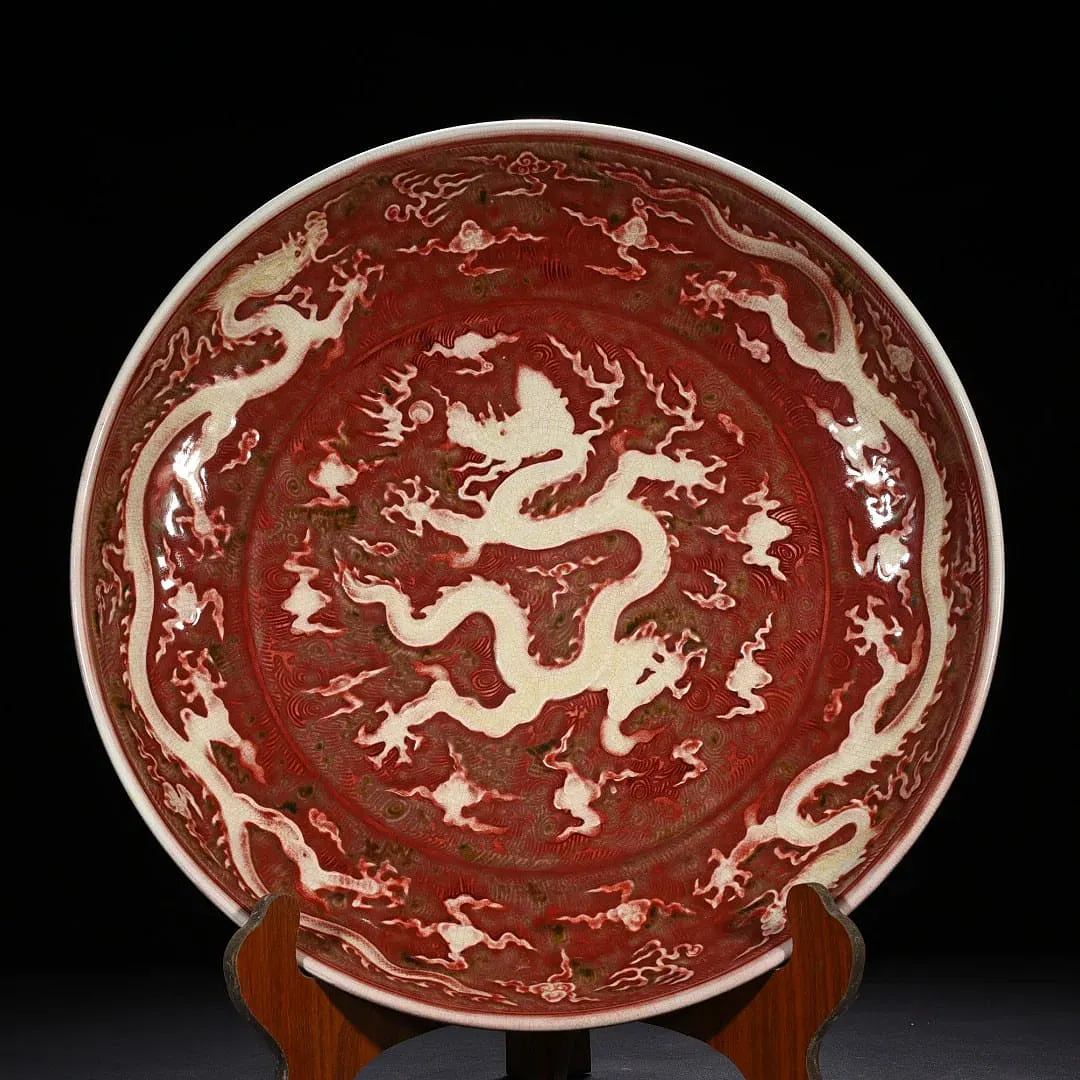
Here we have a striking Chinese Yongle Style Red Glazed Dragon Charger — the kind of object designed to stop you in your tracks. With its writhing pale dragon reserved or silhouetted, against a saturated iron-red ground, it borrows the visual language of imperial Chinese porcelain, where dragons, clouds, and powerful color were never merely decorative: they signaled authority, rank, and cosmic force. The trouble is that this category is also a minefield. Dragon chargers in early Ming taste have been reproduced endlessly, and that matters here. The form is plausible, and the blue-glazed reverse is a familiar historic touch, but the details push me toward caution. The crackle is quite even, the gloss a bit too showroom-bright, and the dragon itself feels more mechanically decorative than truly period-driven. Look closely at the underside and foot: instead of the nuanced wear, kiln grit, and lived-in age one hopes to see on a 15th-century porcelain body, the base reads comparatively clean and uniform. That does not make it unattractive — far from it. It is a handsome decorative object. But it likely whispers history rather than embodies it. So, authenticity score: 5%. As a genuine Yongle-period charger, it could potentially bring $50,000 to $80,000 at auction. As a later reproduction, a more realistic auction result is about $100 to $300. A splendid dragon, yes — but probably one hatched in a modern kiln rather than an imperial one.
Used for this report's TTS and avatar presentation.
Item Report
Chinese Yongle Style Red Glazed Dragon Charger
中国康熙风格红釉龙纹大盘
By: Unknown
Style: Ming Yongle Style Chinese porcelain
Origin: China
Materials: Porcelain, iron-red glaze, cobalt-blue glaze
Age: Likely late 20th to early 21st century
Condition: Very Good (no major visible breaks, some surface wear/scratches; condition based only on photos)
Value: Auction estimate if authentic Yongle period example: $50,000-$80,000; auction estimate as later reproduction/decorative piece: $100-$200
Peer-Reviewed Market Values
- Dating Range
- Pending structured dating
- Auction Liquidation
- Pending structured market values
- Fair Market Value
- Pending structured market values
- Replacement Value
- Pending structured market values
- Comparables Used
- No saved comparables yet
- Research Confidence
- Not Run
Peer review completed, but this run did not return structured market value ranges.
Maker's Marks / Writing: No visible maker's mark or writing shown.
Date: 2026-03-16 12:42:28.660858
Description:
Large Chinese porcelain charger with a molded and reserve-decorated five-clawed dragon amid clouds on a rich iron-red ground, the reverse covered in deep cobalt-blue glaze and the foot left unglazed. The surface shows an even crackle network and highly glossy finish suggestive of a later decorative production rather than an early Ming imperial piece. 中国大型瓷盘,盘心及盘沿以留白堆饰五爪龙穿行云间,通体施浓重铁红地,背面施深钴蓝釉,圈足露胎。表面开片较均匀,釉光很亮,整体更像后期装饰性制品,而非清初御窑真品。
Curator Questions
Curated by Jade
Assessment:
This appears to be a Chinese dragon charger made in Kangxi taste, but the evidence strongly favors a modern reproduction or later decorative revival piece. The dragon design is bold and attractive, yet the crackle reads as broad and uniform, the glaze is overly glossy, and the carved/molded reserve decoration lacks the spontaneity and refinement expected in a genuinely early Ming piece. The underside is especially telling: the cobalt-blue back is smooth and even, and the foot rim and exposed biscuit show a clean, relatively fresh appearance without the convincing wear, grit accumulation, or kiln character one expects from a 15th-century charger. No reign mark is visible. A word about copies.. Chinese ceramics, including reserve dragon-decorated wares in Yongle and Xuande taste—have been heavily reproduced in recent decades, with modern workshop pieces vastly outnumbering genuine period examples. Conservatively, I would treat this as a modern Yongle-style decorative porcelain charger unless further testing, UV examination, and in-hand study prove otherwise. However, based on what I can see from the photos, there is little chance that an in-hand-examination would sway the verdict regarding authenticity. 这件器物看起来是一件仿康熙风格的中国龙纹大盘,但现有证据明显更支持其为现代仿制品或后期装饰性仿古瓷。龙纹图案醒目华丽,但开片显得过于均匀,釉面光泽偏亮,留白堆饰的塑造感也缺乏清初真品应有的自然气韵与精细度。背面尤其值得警惕:通体蓝釉过于平整一致,圈足与露胎部分也显得较“新”,缺少十七世纪大盘常见的自然磨损、积垢与老窑烧成痕迹。未见款识。A word about copies.. 中国瓷器,尤其是仿康熙、雍正、乾隆风格的龙纹器,是市场上复制最泛滥的门类之一,现代作坊制品远多于真正的断代实物。保守判断,我会将其视为一件现代康熙风格装饰瓷盘,除非后续经上手、紫外线检查及更多检测能证明其年代更早。{chavatar_catchphrase}
Individual Images:
- whole charger front
- front charger closer view
- detail of central dragon
- detail of rim dragon
- detail of upper rim
- underside charger
- base closer view
- detail of foot rim
Provenance:
No provenance documentation provided.
Condition:
Very Good (no major visible breaks, some surface wear/scratches; condition based only on photos)
Identification Score: 94%
The form, dragon iconography, iron-red ground, and blue-glazed reverse clearly identify the object as a Chinese porcelain dragon charger made in Qing taste; only the exact date and status as period or reproduction remain uncertain. 从器形、龙纹题材、铁红地以及蓝釉背面等特征看,可较明确判断这是一件中国风格的瓷质龙纹大盘;不确定之处主要在于其具体年代,以及究竟是断代真品还是后期仿作。
Authenticity Score: 18%
I assign a low score because the glaze and crackle appear too even and decorative, the finish is unusually glossy, the reserve dragon lacks period subtlety, and the foot/underside do not show convincing age-related wear. In this category, absent strong evidence, reproduction should be assumed. 我给予较低真伪评分,因为其釉面与开片显得过于均匀、偏装饰化,整体光泽过亮,留白龙纹缺少时期真品的细腻神采,而圈足与底部也未呈现出令人信服的自然老化痕迹。在这一门类中,如无强有力证据,应优先按仿品看待。
Image Memory Note
None None
Keywords
Chinese dragon charger, Kangxi style, red glazed porcelain, blue glazed reverse, five-clawed dragon, Qing style, China, decorative reproduction 中国龙纹大盘, 康熙风格, 红釉瓷盘, 蓝釉背面, 五爪龙, 清代风格, 中国, 装饰性仿制品
Peer Review Summary
Peer Review
Key Visible Evidence
The subject charger features a white five-clawed dragon and clouds in reserve against an iron-red ground, with a deep cobalt-blue glazed reverse (Images 1-6). The red glaze exhibits a uniform, broad crackle network and a notably high-gloss finish (Images 1-5). The unglazed footrim and base reveal a clean, light buff-colored biscuit with concentric turning marks, lacking the expected signs of significant age, wear, or kiln grit typical of authentic early Ming porcelain (Images 6-8). No reign marks or inscriptions are visible on the base or body (Images 6-8).
Market and Source Support
Comparables of authentic Ming Yongle/Xuande red-glazed dishes typically feature incised dragons under a monochrome copper-red glaze, or underglaze blue and white, rather than the white reserved technique with a blue reverse seen on the subject item. The comparable 'A CHINESE RED GLAZED 'DRAGON' DISH, QING DYNASTY, 18TH/19TH CENTURY' (Doyle New York, $1,200) demonstrates that this specific decorative combination (red ground, white reserved dragon, blue reverse) was produced in later Qing periods, not exclusively early Ming, and can still command a modest price as a period piece. Multiple 20th-century reproduction comparables (e.g., eBay, LiveAuctioneers, Bidamount, ranging from $100-$200) confirm the existence of a robust market for modern decorative pieces in this style, aligning with the report's lower value estimate.
Needs Verification
The report's dual stylistic reference to 'Yongle Style' (title) and 'Kangxi taste' (overall assessment) for the reproduction, while plausible for later copies, could benefit from a more precise stylistic analysis to delineate which specific period elements are being referenced in the reproduction. As suggested by the report, UV light examination would be beneficial to detect any repairs, restorations, or inconsistencies in the glaze composition that could further confirm its modern origin. In-hand examination is necessary to assess the tactile qualities of the porcelain body, the specific nature of the crackle, and the presence of any subtle tool marks or firing characteristics that are difficult to discern from photographs alone.
Audit Conclusion
The visible evidence, particularly the glaze characteristics (uniform crackle, high gloss) and the pristine condition of the unglazed footrim and base, strongly supports the report's conclusion that the subject item is a modern reproduction or later decorative piece, rather than an authentic early Ming Yongle period charger. The absence of a reign mark and the lack of convincing age-related wear further corroborate this assessment. Grounded comparables confirm the market for both later period stylistic matches and modern reproductions, validating the report's differentiated value estimates. The report's low authenticity score and conservative dating are well-justified by the available evidence.
Comparables (Similar Items)
No archived comparables matched this report yet.
Share: