George : English Fine and Decorative Arts
George Presents

Original Presentation Script
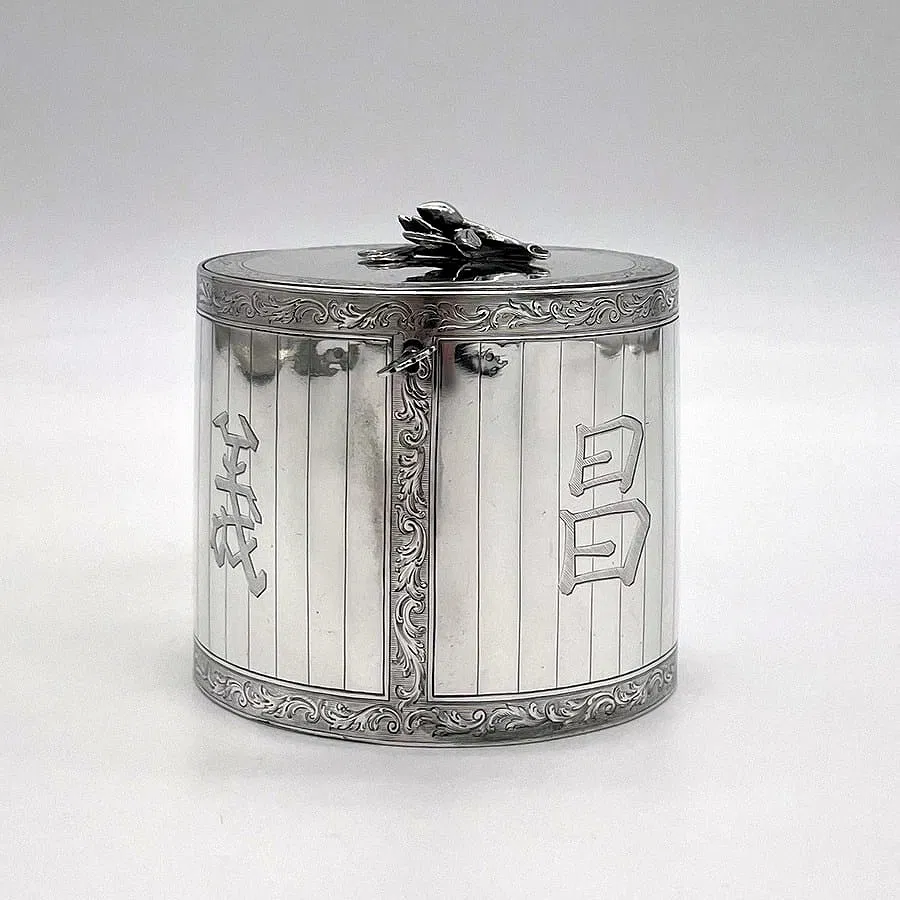
Here we have a handsome Art Deco period German silver tea caddy — a compact cylindrical box made to store tea, dated to the early decades of the 20th century and bearing the German crescent-and-crown hallmark introduced in 1888. The bold East Asian characters and lotus-form thumbpiece give it that fashionable fascination with Japonisme that ran through Continental decorative arts in the 1920s and 1930s. This is not an Edo-period Japanese object, but rather a Continental silverwork interpretation of Asian taste, produced in Germany circa 1920–1935. European makers of the period frequently blended modern forms with exoticizing motifs for cosmopolitan and export markets alike. The materials and workmanship are telling. The body is silver — likely .800 or .835 standard — with engraved scroll borders, a hinged lid, and a cast floral finial. The underside hallmarks are the anchor: the crescent and crown definitively establish German origin, while the remaining marks indicate fineness and a maker whose initials are unfortunately indistinct. The two large characters on the body read 壽 (longevity) and 昌 (prosperity). These are traditional auspicious symbols in East Asian culture, chosen for their positive connotations rather than as literal labels for contents. Condition is quite respectable. There is honest scratching to the base, light wear throughout, and interior patina consistent with age and use — reassuring signs for a piece approaching a century old. I see no glaring evidence of recent manufacture. Comparable German 800 silver tea caddies from the same era support a market estimate in the $400 to $800 range. A tidy, intelligent little object with real period charm.
Used for this report's TTS and avatar presentation.
Item Report
Art Deco Period German Silver Tea Caddy with Auspicious Characters
德国银质茶叶罐(装饰“寿”“昌”字)
Merge Reports: Yes (reconciled). Approval remains manual.
By: Unidentified German silversmith; rectangular maker's mark present but indistinct
Style: Art Deco / Japonisme-influenced Continental silver
Origin: Germany
Materials: Silver, likely .800 or .835 standard; engraved and raised decoration
Age: circa 1920-1935 (post-1888, as indicated by German crescent and crown hallmark)
Condition: Very Good (visible base scratching and general surface wear consistent with age; no major structural damage observed)
Value: Auction estimate: $400-$800 USD
Peer-Reviewed Market Values
- Dating Range
- Pending structured dating
- Auction Liquidation
- Pending structured market values
- Fair Market Value
- Pending structured market values
- Replacement Value
- Pending structured market values
- Comparables Used
- No saved comparables yet
- Research Confidence
- Not Run
Peer review completed, but this run did not return structured market value ranges.
Maker's Marks / Writing: Underside bears four hallmarks: German crescent and crown national mark (post-1888), a likely .800 or .835 fineness mark (not fully legible), a rectangular maker’s mark with indistinct initials, and an additional small rectangular control mark. Exterior decorated with characters 壽 and 昌.
Date: 2026-03-24 02:43:40.020915
Description:
A cylindrical German silver tea caddy with hinged lid, floral/foliate finial, engraved scroll borders, vertically striped body panels, and two large applied or engraved East Asian characters reading 壽 (longevity) and 昌 (prosperity). The form and engraved decoration reflect early 20th-century Continental design with strong Japonisme influence. 一件德国银质圆筒形茶叶罐,带铰链盖、花卉形钮、卷草纹雕刻边饰及纵向条纹罐身。器身饰有两个大型东亚文字:“寿”(象征长寿)与“昌”(象征昌盛)。整体造型与装饰体现20世纪早期欧洲大陆银器设计风格,并带有明显的日本风格影响。
Curator Questions
Curated by Jade
Assessment:
This is a genuine early 20th-century German silver tea caddy, produced circa 1920–1935, and clearly bearing the German national crescent-and-crown silver hallmark introduced in 1888. The form — cylindrical body, hinged lid, engraved borders, and floral finial — aligns comfortably with Art Deco–period Continental silver, while the bold East Asian characters and lotus-form thumbpiece reflect the era’s fascination with Japonisme. The underside hallmarks are decisive. The crescent and crown confirm German origin and silver content. A fineness mark, likely .800 or .835, is present though not perfectly legible, and a rectangular maker’s mark appears but cannot be securely attributed from the available impression. The two prominent characters on the exterior read 壽 (longevity) and 昌 (prosperity). These are traditional auspicious symbols in East Asian culture and would have appealed to contemporary tastes for exotic or celebratory motifs rather than specifically denoting tea contents. Construction appears machine-assisted but hand-finished, entirely appropriate for a quality German silver object of the 1920s–30s. Visible scratching to the base and interior patina are consistent with age and normal use. There is no persuasive indication of modern reproduction. Comparable German .800 silver tea caddies of similar date and style support the proposed valuation range. Altogether, this is a well-executed and attractive example of Art Deco–era German silverwork with cross-cultural decorative flair. 此件为一件20世纪早期(约1920–1935年)德国银质茶叶罐,底部清晰可见德国1888年启用的新月与王冠银器国家标记。其圆筒形器身、铰链盖、雕刻边饰及花形钮,均符合装饰艺术时期欧洲大陆银器的设计特征;而莲花式开启钮与大型东亚文字装饰,则体现当时流行的日本风格影响。 底部印记为判断关键。新月与王冠标志确认其德国银器身份;旁侧应为“.800”或“.835”成色标记(略显模糊),另有一枚长方形制造商印记,但目前无法准确辨识具体工匠。 器身文字为“寿”与“昌”,分别寓意长寿与昌盛,属于东亚传统吉祥符号,并非专指茶叶用途,而是具有祝福与装饰意义。 制作工艺为机器辅助成型并经手工修饰,符合1920–30年代德国银器制作特征。底部划痕与内部氧化包浆与自然使用状态相符,未见现代仿制的明显迹象。 结合市场可比案例,其估值区间合理。整体而言,这是一件兼具装饰艺术风格与跨文化装饰趣味的德国银器佳作。
Individual Images:
- front tea caddy
- three-quarter view
- side view
- overhead view
- interior view showing patina
- opposite side view
- underside with four hallmarks including crescent and crown
- detail of characters 壽 and 昌
Provenance:
No provenance documentation provided.
Condition:
Very Good (visible base scratching and general surface wear consistent with age; no major structural damage observed)
Identification Score: 92%
The form, hinged construction, interior configuration, and strong comparables securely identify the object as a German silver tea caddy from the Art Deco period. The hallmarks definitively establish national origin, though the exact maker remains unreadable. 器形、铰链结构、内部结构及市场可比案例均清楚表明其为装饰艺术时期的德国银质茶叶罐。底部印记明确指向德国制造,但具体工匠仍无法辨识。
Authenticity Score: 85%
The presence of the German crescent-and-crown hallmark, appropriate period construction, honest surface wear, and interior patina all support authenticity as an early 20th-century German silver object. The slightly indistinct fineness and maker’s marks prevent a higher score but do not materially undermine authenticity. 德国新月与王冠标记、符合年代特征的制作工艺、自然使用磨损与内部包浆,均支持其为20世纪早期德国银器真品。由于成色及制造商印记略显模糊,真实性评分未达更高水平,但整体判断稳健。
Image Memory Note
German silver cylindrical tea caddy with crescent-crown hallmark and characters 壽 and 昌, circa 1920-1935. 德国银质圆筒形茶叶罐,带新月王冠标记及“寿”“昌”字样,约1920-1935年。
Keywords
German silver tea caddy, crescent and crown hallmark, 800 silver, Art Deco, Japonisme, auspicious characters, longevity, prosperity, cylindrical tea canister, 1920s German silver 德国银茶叶罐, 新月王冠标记, 800银, 装饰艺术风格, 日本风格影响, 吉祥文字, 寿, 昌, 圆筒形茶罐, 1920年代德国银器
Peer Review Summary
Peer Review
Key Visible Evidence
The object is a cylindrical silver tea caddy with a hinged lid, a floral/foliate finial, engraved scroll borders, and vertically striped body panels (Images 1-7). A stylized lotus-form thumbpiece is present for opening the lid. The underside (Image 8) clearly displays four hallmarks. The leftmost mark is a crescent and crown, the national mark for German silver. The second mark appears to be a fineness standard, likely '800' or '835', though not perfectly legible. The third mark is a rectangular maker's mark with indistinct initials. The fourth mark is also a small, indistinct rectangular mark. The exterior features two large characters: the left character is 壽 (Shou/Kotobuki), meaning 'longevity' or 'congratulations'; the right character is 昌 (Chang/Masa/Aki), meaning 'prosperous' or 'flourishing'. Visible surface scratching on the base and general use wear are consistent with age (Image 8). The interior shows appropriate patina (Image 5).
Market and Source Support
The crescent and crown hallmark is a definitive German national mark for silver, introduced in 1888, confirming the object's German origin and silver composition. The characters 壽 and 昌 are well-established auspicious symbols in East Asian cultures, commonly associated with longevity and prosperity, respectively. They are not specifically 'tea-related'. Comparables of German 800 silver tea caddies and Art Deco silver objects from the early 20th century support the proposed dating and material identification.
Needs Verification
The exact fineness of the silver (e.g., .800 vs. .835) cannot be definitively confirmed from the provided image of the hallmark (Image 8) due to blurriness; macro photography or physical inspection is needed. The specific maker's initials within the third hallmark are too indistinct to attribute to 'E.W.' or any other specific silversmith; clearer imaging is required. The report's claim that the Japanese characters 'likely denoting tea-related contents' is ungrounded, as the characters 壽 and 昌 translate to 'longevity' and 'prosperity' and are general auspicious symbols, not directly related to tea. Further research into the specific context of these characters on German export silver of this period might clarify their intended meaning or market appeal.
Audit Conclusion
The object is a genuine early 20th-century German silver tea caddy, consistent with the Art Deco period and Japonisme influence, as strongly supported by the visible German hallmarks (crescent and crown) and stylistic elements. The material is confirmed as silver, likely of .800 or .835 standard. The dating to circa 1920-1935 is well-supported by both visual evidence and comparable market examples. However, the report's interpretation of the exterior characters as 'tea-related' is inaccurate; they are auspicious symbols for longevity and prosperity. The precise silver fineness and specific maker remain unconfirmed due to the legibility of the hallmarks. The condition assessment is consistent with visible wear and patina.
Comparables (Similar Items)
No archived comparables matched this report yet.
Share: