Jade : Chinese Fine and Decorative Arts
Jade Presents

Original Presentation Script
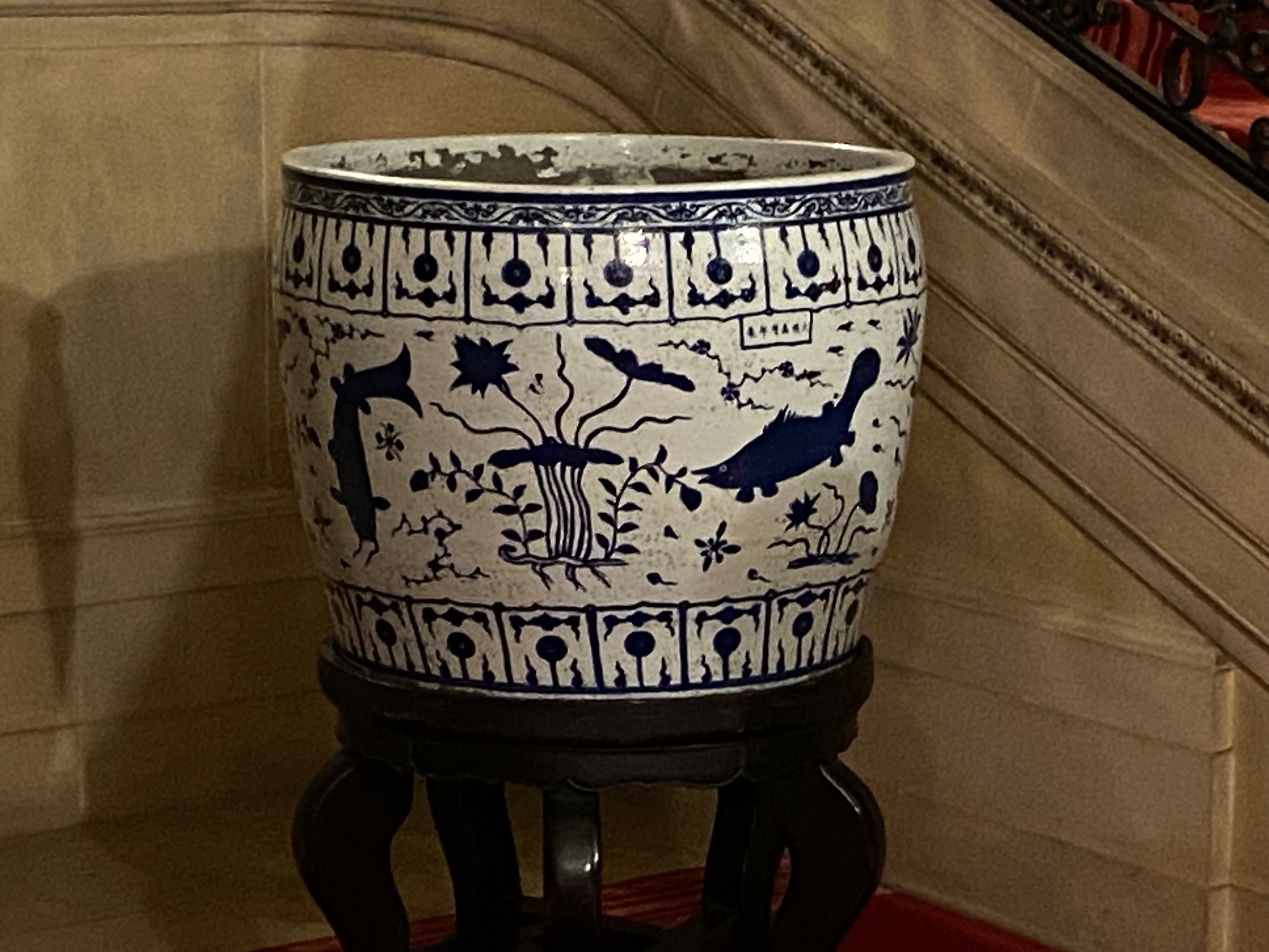
Here we have a handsome Chinese Ming-style blue-and-white jardiniere — the sort of object that brings instant decorative gravity to a room, especially when set upon a carved wooden stand. Its broad cylindrical form is animated with lively fish and aquatic plants, a motif long associated in Chinese art with abundance and cultured taste. The six-character inscription reads 'Da Ming Jiajing nian zhi' — 'Made in the Jiajing years of the Great Ming.' Such marks can sound thrilling, but on pieces of this character they are most often respectful quotations of earlier glory rather than literal dates. The brushwork here is bold and serviceable, yet lacks the finesse and controlled elegance seen on genuine 16th-century imperial wares. The glaze surface is intentionally speckled to suggest age, while the interior tells a more practical story: heavy mineral accretion, staining, and glaze wear confirm that this vessel served dutifully as a planter for many years. That honest use supports age, but not Ming age. Comparable 20th-century blue-and-white fish jardinieres trade in the low hundreds at auction, placing this example comfortably within a decorative art context. A true Jiajing-period jardiniere, by contrast, would reside in an entirely different financial universe. As decoration, this piece has presence and charm. As a Ming original, however, it does not withstand close scrutiny.
Used for this report's TTS and avatar presentation.
Item Report
Chinese Ming Style Blue and White Glazed Ceramic Jardiniere with Jiajing Mark
中国明式青花釉陶瓷花盆(嘉靖款)
Merge Reports: Yes (reconciled). Approval remains manual.
By: Unknown
Style: Chinese Ming Style blue and white decorative ceramic
Origin: China
Materials: Glazed ceramic or earthenware body with underglaze cobalt-blue decoration and white glaze
Age: 20th century, likely mid-20th century (circa 1920–1970)
Condition: Good (used as planter, heavy interior mineral staining and glaze wear, visible surface wear and minor edge imperfections, not professionally graded)
Value: Auction estimate as a decorative later piece: USD 300–800. Comparable 20th-century examples have realized prices in the low hundreds. A genuine Ming Jiajing-period jardiniere of this type would command a vastly higher price, often in the millions at international auction.
Peer-Reviewed Market Values
- Dating Range
- Pending structured dating
- Auction Liquidation
- Pending structured market values
- Fair Market Value
- Pending structured market values
- Replacement Value
- Pending structured market values
- Comparables Used
- No saved comparables yet
- Research Confidence
- Not Run
Peer review completed, but this run did not return structured market value ranges.
Maker's Marks / Writing: Rectangular cartouche with six-character Kaishu mark reading right-to-left: '大明嘉靖年製' ('Made in the Jiajing years of the Great Ming'). Interpreted as a decorative or spurious reign mark.
Date: 2026-03-28 14:27:57.088838
Description:
Large cylindrical Chinese-style jardiniere or cachepot decorated in underglaze cobalt blue on a white ground. The exterior features stylized fish swimming among aquatic plants, framed by geometric and pendant borders. The white glaze displays deliberate brown speckling intended to evoke age. The interior shows heavy mineral staining, calcification, and glaze wear from prolonged use as a planter. A rectangular cartouche bears a six-character Kaishu mark reading right-to-left '大明嘉靖年製' ('Made in the Jiajing years of the Great Ming'), used here decoratively rather than as reliable evidence of period manufacture. 这是一件大型中国风圆筒形花盆或套盆,白地青花装饰游鱼、水草,并配以几何与垂饰纹边框。外壁白釉可见刻意形成的褐色斑点,以营造仿古效果。内壁因长期作为花盆使用而产生明显矿物沉积、结垢与釉面磨损。器身一处长方形开光内书六字楷书款“⼤明嘉靖年製”,自右向左书写,在此更具装饰性意义,不能作为断代依据。
Curator Questions
Curated by Jade
Assessment:
This is a Chinese blue-and-white jardiniere made in Ming revival taste, most consistent with 20th-century production. The six-character inscription reads '大明嘉靖年製' ('Made in the Jiajing years of the Great Ming') in Kaishu script and is best understood as a decorative, spurious reign mark rather than factual dating. The boldly rendered brushwork, intentionally speckled glaze surface, and overall decorative character differ markedly from the refined execution seen on genuine Ming Jiajing imperial wares. Heavy interior mineral accretion and glaze wear confirm long practical use as a planter, but do not support a 16th-century origin. As such, it should be regarded as a later decorative revival piece rather than a Ming-dynasty vessel. 这是一件采用明代风格的青花花盆,更符合20世纪制作特征。器身所书“⼤明嘉靖年製”六字楷书款,应视为装饰性伪托年款,而非真实断代依据。其绘画笔触较为概括,釉面刻意布满褐色斑点,整体装饰感较强,与真正明代嘉靖官窑器物所见精细程度存在明显差异。内壁严重的矿物沉积与釉面磨损说明其长期作为花盆使用,但并不能支持其为16世纪原作。因此,应将其定位为后期仿古装饰性作品,而非明代本器。
Individual Images:
- whole jardiniere front
- whole jardiniere closer view
- whole jardiniere side view
- looking in jardiniere
- detail of fish and inscription
- detail of upper border
- detail of fish motif
- detail of six-character mark
Provenance:
No documentary provenance provided.
Condition:
Good (used as planter, heavy interior mineral staining and glaze wear, visible surface wear and minor edge imperfections, not professionally graded)
Identification Score: 93%
The cylindrical form, scale, interior planter wear, and blue-and-white aquatic decoration clearly identify the object as a Chinese jardiniere or cachepot. Only the precise ceramic composition and narrower dating range remain uncertain without technical analysis. 根据其圆筒形器形、尺寸比例、内壁种植磨损,以及青花水生题材装饰,可明确判断为中国花盆或套盆。仅胎釉具体成分与更精确年代范围,仍需借助技术检测方可进一步确认。
Authenticity Score: 22%
Although bearing a six-character Jiajing reign mark, the inscription functions decoratively and is not persuasive as Ming-period evidence. The calligraphy and painted decoration are broadly executed and lack the refinement associated with imperial Jiajing wares. The deliberate brown speckling suggests intentional archaizing. Genuine interior wear supports age and use, but not a 16th-century attribution. On balance, the piece should be considered a 20th-century revival rather than a Ming original. 尽管器身带有“嘉靖年製”六字款,但该款识更具装饰性质,不能作为明代依据。书法与绘画风格较为概括,缺乏明代嘉靖官窑器应有的精细水准。釉面刻意布设的褐色斑点带有明显仿古意图。内壁真实使用磨损说明其具有一定年代与实际用途,但不足以支持16世纪断代。综合判断,应视为20世纪仿古作品,而非明代原器。
Image Memory Note
None None
Keywords
Chinese jardiniere, blue and white, Ming style, Jiajing mark, spurious reign mark, fish motif, 20th century ceramic, decorative revival, cachepot, China 中国花盆,青花,明式,嘉靖款,伪托年款,鱼纹,20世纪陶瓷,仿古装饰,套盆,中国
Peer Review Summary
Peer Review
Key Visible Evidence
The subject item is a cylindrical ceramic jardiniere decorated in underglaze cobalt blue on a white ground (Images 1-3). The decoration features stylized fish and aquatic plants, bordered by geometric and pendant motifs. The white glaze exhibits intentional brown speckling, designed to impart an aged appearance (Images 1-3, 5-8). The interior shows significant mineral staining, calcification, and glaze loss, consistent with prolonged use as a planter (Image 4). A six-character Kaishu reign mark is present within a rectangular cartouche, reading right-to-left as '大明嘉靖年製' (Dà Míng Jiājìng Nián Zhì), translating to 'Made in the Jiajing years of the Great Ming' (Images 5, 6, 8). The brushwork for both the decoration and the mark is broadly rendered, lacking the precision and refinement typically associated with imperial Ming dynasty wares.
Market and Source Support
The report's identification of the mark as '大明嘉靖年製' is confirmed by direct transcription from Image 8. Comparables (Rank 1, 2, 4) featuring similar blue and white fish-decorated jardinieres, explicitly dated to the 20th century, support the report's dating of the subject item and its valuation as a decorative revival piece, with realized prices in the low hundreds. Conversely, Comparable (Rank 3) from Christie's, a genuine Ming Jiajing period 'fish' jar, demonstrates a vastly superior quality of execution and a market value in the millions, thereby validating the report's assertion that a genuine Ming piece would exist in an 'entirely different financial universe' and supporting its authenticity assessment.
Needs Verification
The report contains an internal inconsistency: the 'description' field initially mentions a 'Xuande mark panel,' while the 'overall_assessment' and 'makers_mark_or_writing' fields correctly identify it as a 'Jiajing mark.' This discrepancy should be rectified for clarity. While the 20th-century dating (circa 1920-1970) is plausible based on stylistic cues and market comparables, a more precise dating would ideally benefit from technical analysis of the ceramic body and glaze composition, or documented provenance, neither of which is available. Further investigation into the exact method of achieving the 'brown speckling' (e.g., intentional iron spots in the glaze, applied pigment) through macro photography or material analysis could provide additional insight into its manufacturing process, though its intent to simulate age is clear.
Audit Conclusion
The report's overall assessment of the Chinese blue and white jardiniere as a 20th-century decorative revival piece in Ming style is well-supported by both visible evidence and grounded comparables. The six-character mark, clearly reading '大明嘉靖年製' (Made in the Jiajing years of the Great Ming) in Kaishu script (Image 8), is correctly identified by the report as spurious and decorative rather than indicative of a Ming-period manufacture. The intentional brown speckling on the glaze (Images 1-3, 5-8) and the broad, decorative brushwork are consistent with a later production. The heavy interior wear (Image 4) indicates genuine use but does not contradict a 20th-century dating. The provided comparables strongly corroborate the market positioning and estimated value for such a later decorative item, while a genuine Ming Jiajing example highlights the significant difference in value and quality. The report's authenticity score of 22% is appropriate given the evidence. The only minor inconsistency is the initial mention of a 'Xuande mark' in the description, which is immediately corrected to Jiajing in subsequent sections.
Comparables (Similar Items)
No archived comparables matched this report yet.
Share: