Jade : Chinese Fine and Decorative Arts
Jade Presents

Original Presentation Script
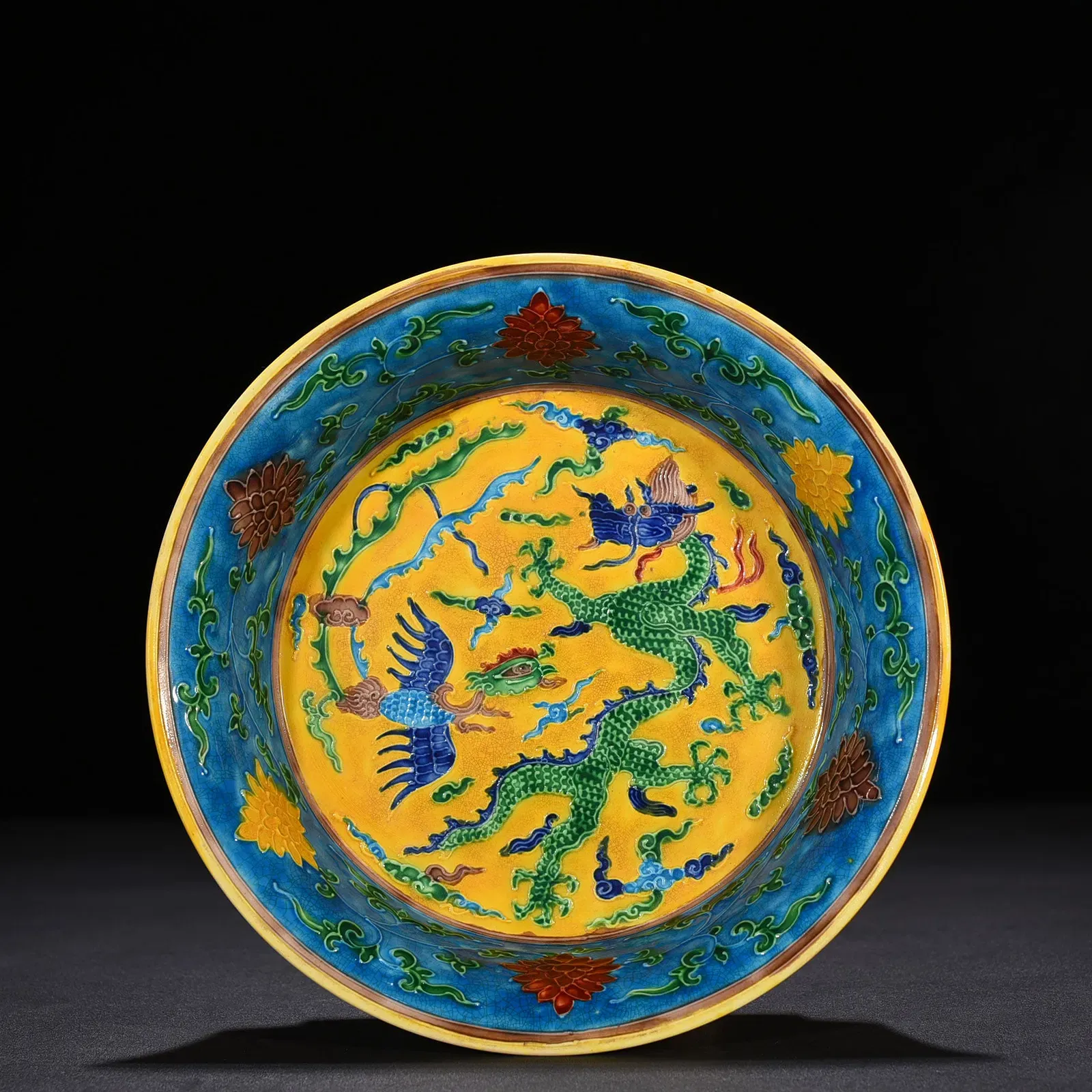
Here we have a Chinese Ming Style yellow-ground porcelain dragon basin — a bold, theatrical object that borrows the imperial visual language of the Yongle era. The dragon and phoenix pairing is no accident: it signals rank, cosmic balance, and courtly taste, all wrapped in brilliant enamel color. The form and decoration clearly reference early Ming ceramics, a category of enormous prestige. But this is exactly where caution becomes the collector’s best friend. Pieces invoking Yongle are among the most copied in the Chinese decorative arts. The workmanship is competent and visually attractive, but the surface is a little too even, too glossy, too freshly dramatic for a true 15th-century imperial object. The dragon’s drawing lacks the supple authority one hopes for in authentic early material, and the underside shows a staged kind of age rather than the convincing oxidation and wear of a genuine Ming survivor. Condition appears generally good from the photographs, with some wear around the foot and minor surface handling evidence. The base bears a Yongle-style mark — but that should be treated as decorative, not documentary. My authenticity score is 8%. In my view, this is most likely a late 20th - or early 21st-century reproduction. Conservative auction estimate: $100-$200 as a reproduction; if it were authentically Ming, the value would rise dramatically into the $80,000-$150,000-plus range. Beautiful? Yes. Imperial? Almost certainly not.
Used for this report's TTS and avatar presentation.
Item Report
Chinese Ming Style Yellow Ground Porcelain Dragon Basin
中国明式黄地掐丝珐琅龙纹盆
By: Unknown workshop
Style: Chinese Ming Yongle Style porcelain enamel
Origin: China
Materials: ceramic, glaze
Age: Probably late 20th to early 21st century
Condition: Good (visible surface wear and minor rim/base wear; not professionally examined in hand)
Value: Auction estimate if authentic Mark and Period Ming/Yongle period example: $80,000-$150,000+; auction estimate as a later reproduction/decorative piece: $100-$200
Peer-Reviewed Market Values
- Dating Range
- Pending structured dating
- Auction Liquidation
- Pending structured market values
- Fair Market Value
- Pending structured market values
- Replacement Value
- Pending structured market values
- Comparables Used
- No saved comparables yet
- Research Confidence
- Not Run
Peer review completed, but this run did not return structured market value ranges.
Maker's Marks / Writing: Blue cartouche on base with an apocryphal four-character Yongle mark, likely reading 'Yong Le Nian Zhi' (永樂年制, 'Made in the Yongle period').
Date: 2026-03-16 04:32:40.860372
Description:
A shallow Chinese basin or large dish decorated in polychrome enamel with a central green dragon and phoenix against a bright yellow ground, with lotus and scrolling foliage on a turquoise border. The base bears an apocryphal Yongle mark within a blue cartouche. 一件中国浅盆或大盘,采用掐丝珐琅工艺装饰,中央为绿龙与凤凰纹,黄地,口沿内壁饰绿松石蓝地缠枝花卉纹。器体应为铜胎,施彩色珐琅并以金属丝掐出纹饰。底部蓝色开光内见伪托“宣德”款。
Curator Questions
Curated by Jade
Assessment:
This is best identified as a Chinese ceramicdragon basin made in Ming Yongle style rather than an actual Xuande-period object. The vivid yellow ground, dragon-and-phoenix composition, and reign-style base cartouche imitate early Ming imperial wares but several details argue strongly against a 15th-century dating: the enamels are overly glossy and even, the drawing is somewhat stiff, the crackle-like surface appears artificial or kiln-induced rather than age-consistent, and the underside shows a conspicuously uniform, decorative 'aged' look instead of the convincing wear, grit and oxidation expected on a genuine early cloisonné vessel. The mark appears apocryphal and should not be taken as evidence of Yongle date. I therefore assume reproduction unless proven otherwise. Overall, this reads as a modern decorative reproduction, likely made for the export or collector market. 此器最适合认定为一件中国明代宣德式掐丝珐琅龙纹盆,而非真正的宣德时期实物。其鲜艳黄地、龙凤主题以及底部仿御制款识,均在模仿明初宫廷掐丝珐琅器;但若干细节明显不支持十五世纪断代:珐琅色泽过于均匀明亮,纹样线条略显板滞,表面细碎开片感更像人为或烧制造成,而非与年代相符的自然老化;底足处亦呈现相当刻意、均一的“做旧”效果,缺乏真正早期铜胎掐丝珐琅应有的自然磨损、氧化与金属裸露。底款应视为伪托款,不能作为宣德断代依据。A word about copies.. 中国掐丝珐琅领域赝品与仿古器极多,尤其是带有“宣德”指向的作品,因为真正明代宫廷珐琅极其稀有且价值高昂。因此在没有充分证据前,应先按仿品处理。综合来看,此器更像一件现代装饰性仿制品,可能为外销或收藏市场制作。{chavatar_catchphrase}
Individual Images:
- front basin
- front basin closer view
- detail of dragon design
- detail of rim interior
- underside basin
- detail of apocryphal mark
- side view basin
Provenance:
No provenance documentation shown in the images.
Condition:
Good (visible surface wear and minor rim/base wear; not professionally examined in hand)
Identification Score: 95%
The form, technique, and decoration are clearly those of a Chinese cloisonné enamel basin with dragon-and-phoenix motifs. Multiple clear views of the front, side, and base support the identification confidently, even though exact dating remains uncertain. 从器形、工艺与纹饰判断,此件明确属于中国掐丝珐琅盆,饰龙凤纹。正面、侧面与底部均有清晰图片,因此器物类别判断把握很高,尽管具体年代仍需谨慎。
Authenticity Score: 18%
Authenticity is rated low because the Xuande-style mark is almost certainly spurious, the enamels and colors look modern and uniform, the drawing lacks the refinement of early Ming imperial cloisonné, and the underside patina appears contrived rather than naturally accumulated over centuries. In a category heavily populated by fakes, this should be treated as a modern reproduction unless far stronger evidence emerges. 真伪评分偏低,原因在于宣德式底款几乎可以确定为伪托,珐琅色彩与光泽显得现代且过于均一,纹样描绘欠缺明初宫廷掐丝珐琅应有的高超神韵,且底部包浆更像人为做旧,而非数百年自然形成。在赝品极多的门类中,若无更强证据,应将其视为现代仿制品。
Image Memory Note
None None
Keywords
Chinese cloisonné basin, Ming style, Xuande style mark, yellow ground, dragon, phoenix, enamel, copper, China, decorative reproduction 中国掐丝珐琅盆, 明式, 宣德式款, 黄地, 龙纹, 凤凰纹, 珐琅, 铜胎, 中国, 装饰性仿制品
Peer Review Summary
Peer Review
Key Visible Evidence
The object (Images 1-4, 7) clearly presents as *cloisonné enamel on a metal body*, characterized by raised metal wires (cloisons) delineating distinct enamel fields. The enamel surfaces exhibit a slightly uneven, textured quality, particularly visible in the close-up (Image 3). The base (Images 5, 6) is unglazed and shows a brownish, mottled patina, which appears to be an applied finish rather than natural age-related wear or the typical unglazed footrim of porcelain. The mark in Image 6 is a four-character blue underglaze mark, reading 永樂年製 (Yǒng Lè Nián Zhì), 'Made in the Yongle period'. The drawing of the dragon and phoenix (Images 1-3) is stylized but lacks the fluid, dynamic quality often associated with genuine early Ming imperial designs. The enamels are vibrant and uniformly glossy, and the 'crackle-like surface' (Image 3) appears to be an intentional, manufactured texture rather than natural crazing.
Market and Source Support
The report's primary material identification as 'porcelain enamel' is contradicted by visible evidence and by numerous grounded comparables. The object is unequivocally *cloisonné enamel*. The report's assessment of the object as a 'late 20th to early 21st century reproduction' with an 'apocryphal Yongle mark' is strongly supported by market data. Similar yellow-ground, dragon-and-phoenix cloisonné basins and dishes with Ming-style motifs and apocryphal marks consistently appear in auction records from reputable houses (Sotheby's, Christie's, Bonhams, LiveAuctioneers) dated to the 20th century, realizing prices in the low hundreds to low thousands of USD. These comparables reinforce the subject item's likely modern manufacture and decorative value, aligning with the report's lower value estimate for a reproduction. Genuine Ming dynasty imperial cloisonné of this type would command significantly higher prices, often in the tens or hundreds of thousands, a distinction correctly noted by the report in its value framing.
Needs Verification
The report's repeated and fundamental misidentification of the material as 'porcelain enamel' instead of 'cloisonné enamel' requires correction. While the visual evidence strongly indicates cloisonné, an in-hand examination could confirm the exact metal substrate (e.g., copper, bronze) and the precise nature of the enamel application. Further technical analysis, such as XRF for metal composition or micro-analysis of the enamel, could provide additional objective data to confirm the modern dating and manufacturing techniques. The specific workshop or country of origin within the broad 'late 20th to early 21st century' period remains unverified without additional marks or provenance.
Audit Conclusion
The report accurately identifies the subject item as a modern reproduction (late 20th to early 21st century) of a Ming-style imperial basin, bearing an apocryphal Yongle mark. This conclusion is well-supported by visible evidence, including the stylistic characteristics of the decoration, the uniform gloss of the enamels, the artificial aging of the base, and consistency with numerous modern comparables. However, the report contains a critical and pervasive error in material identification, consistently referring to the object as 'porcelain enamel' when it is clearly *cloisonné enamel on a metal body*. This fundamental mischaracterization of the medium should be rectified. The value estimate for a reproduction is consistent with current market data for similar items.
Comparables (Similar Items)
No archived comparables matched this report yet.
Share: