Papua New Guinea Sepik River Ceremonial Wood Mask with Natural Pigments and Feather Trim
LANGUAGE UNLOCK
Glossary Roundup
Original Presentation Script
No narration for this appraisal report
Used for this report's TTS and avatar presentation.
Item Report
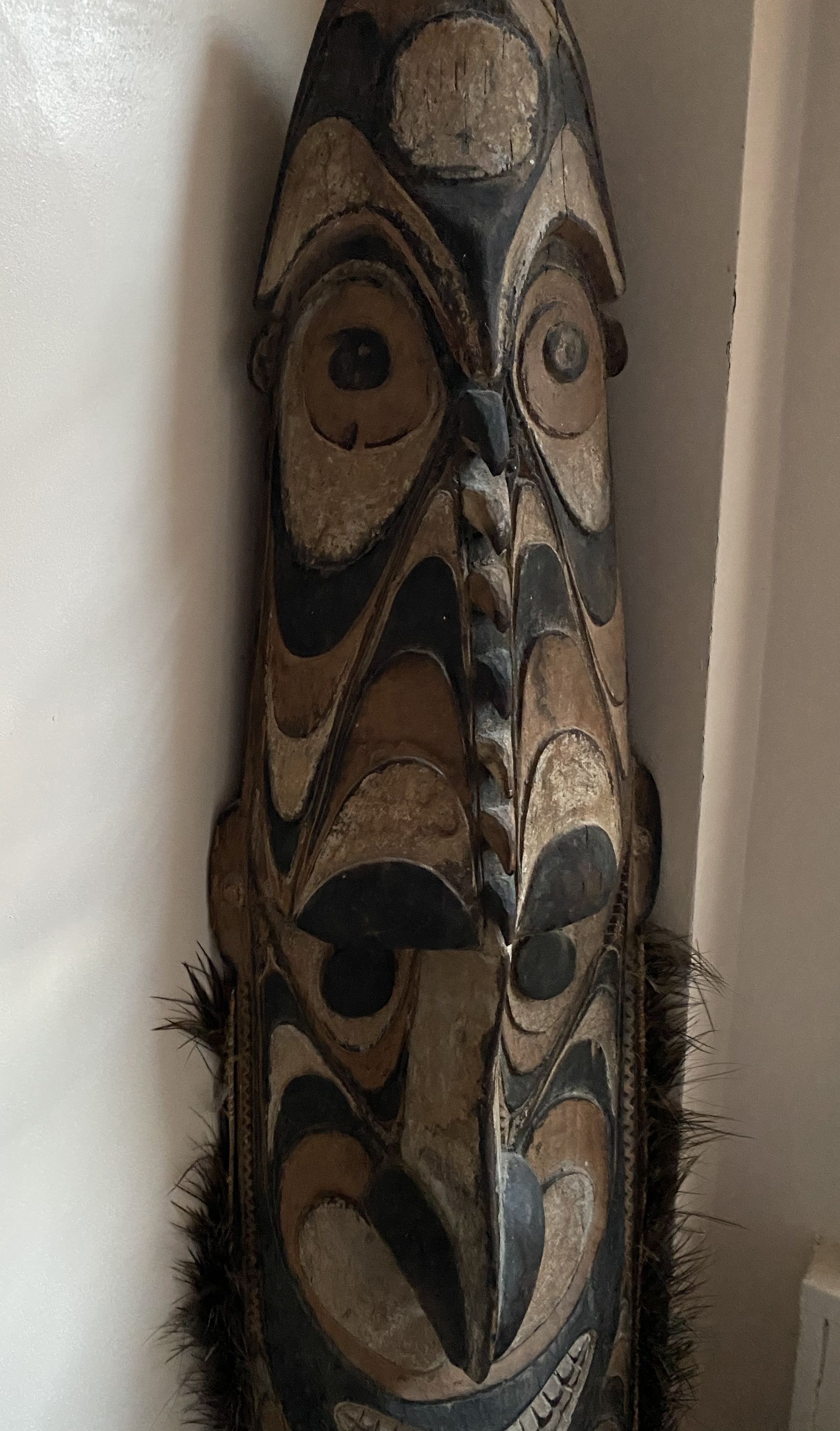
Papua New Guinea Sepik River Ceremonial Wood Mask with Natural Pigments and Feather Trim
By:Unknown carver, Sepik River region
Style:Oceanic Art — Sepik River (Papua New Guinea), ceremonial/house mask
Origin:Papua New Guinea
Materials:Carved softwood, natural earth pigments (charcoal/kaolin/ochre), plant binder, cassowary feathers or similar
Age:Circa 1950-1980
Condition:Good (age-consistent pigment wear, edge chips, small split near nasal ridge, feather losses; not professionally conserved)
Value:$300-600 (auction)
Maker's Marks / Writing:No visible maker’s mark or writing observed on front; reverse not shown.
Date:2025-08-15 11:37:47.489737
Description:
Tall carved wooden mask from the Sepik River region of Papua New Guinea, presenting a stacked visage with a long hooked nose, round staring eyes, and a toothed, smiling mouth. The surface is carved in shallow relief and painted in matte black, cream/white and ochre earth pigments. A dorsal central ridge of fin-like protrusions runs vertically, and the outer borders show alternating notches. Tufts of dark, hair-like feathers (likely cassowary) are fixed along both sides through drilled holes. Form and paint application are consistent with mid-20th-century ceremonial/house masks produced in the Middle/Lower Sepik area.
Curator Questions
Curated by Jade
Assessment:
This appears to be a Sepik River ceremonial mask intended for men’s house display or dance use rather than a war shield or bark-cloth mask. Hallmarks include the long hooked nose, carved and painted crescent motifs, circular eyes, a toothed lower ridge, a notched perimeter, and the dramatic central dorsal ridge recalling crocodile scutes—an important Sepik motif. The matte, abraded pigments and accumulated surface wear look consistent with mid-20th-century production with subsequent domestic handling. Without documented field collection history, I treat it cautiously as a traditional-style object likely made for local use and/or early tourist trade. A word about fakes.. Oceanic/PNG masks are widely reproduced; be wary of overly fresh paint, machine-smooth carving, and synthetic fibers. This example shows convincing hand-tool work, pigment oxidation, edge chipping, and aged feather tufts, so it reads as period-made rather than recent.
Individual Images:
Detail images show: 1) A pronounced central dorsal ridge made of alternating fin-like protrusions
each with hand-tool facets and wear to tips. 2) The mouth with incised teeth—carved individually with V-gouge work; abrasion to high points. 3) Side borders with zigzag/notched carving and drilled perforations holding dark hair-like feathers; several tufts missing
others brittle with dust accretion. 4) Paint layers are matte and chalky; black likely charcoal-based
white likely kaolin
and ochre iron oxide. Craquelure and micro-abrasions are visible on black areas. 5) Minor vertical crack and small losses around the lower nose; edge knocks and scratches overall. These details support hand-carved manufacture and some age
while not proving ritual use.
Provenance:
No provenance documents provided.
Condition:
Good (age-consistent pigment wear, edge chips, small split near nasal ridge, feather losses; not professionally conserved)
Identification Score: 78%
Strong match to Middle/Lower Sepik wooden mask traditions: stacked facial imagery, hooked nose, central crocodile-like ridge, earth pigments, and feathered edges. The form and decoration are less consistent with New Ireland, New Britain, or Torres Strait types.
Authenticity Score: 45%
Likely mid-20th-century Sepik carving with age-consistent wear, but the category is heavily faked and many masks were produced for trade. Absent provenance or UV/fluorescence testing, I avoid a higher score.
Image Memory Note
Object: A tall, vertically oriented carved wooden mask, likely 3–5 feet high (exact size unknown). Overall palette: matte black, cream/white, and ochre brown. Primary features: stacked facial imagery with large circular eyes at top and midsection; a very long, hooked, projecting nose; a crescent-shaped mouth with individually incised teeth; multiple crescent and tear-drop motifs in low relief. A central vertical ridge runs the full height with alternating fin-like protrusions resembling crocodile scutes. Borders: notched/zigzag carving along both sides, with drilled holes containing dark, hair-like feather tufts (many intact, some missing). Surface: heavy abrasion on high points; chalky white and black pigments with localized craquelure, especially on the nose and cheek crescents; ochre areas show scuffing and grime accumulation. Damage/wear: small edge chips throughout; slight vertical split visible adjacent to the lower nose; one fin on the central ridge shows tip loss; scattered scratches; feather losses and brittleness; minor paint losses near the edges and high-relief elements. No signatures, stamps, or inscriptions visible in photos. Iconographic notes: crocodile-like central ridge; stacked faces with round eyes; toothy grinning mouth typical of Sepik masks. Contextual materials: carved softwood; natural earth pigments; feather trim likely cassowary.
Keywords
Papua New Guinea, Sepik River, Oceanic art, ceremonial mask, carved wood, natural pigments, cassowary feathers, mid-20th century, tribal art
The report was edited after initial Artmink draft. Original AI draft preserved in Artmink audit history.

Share: