Qing Dynasty Archaistic Green-Enamel Porcelain Vase with Gilt Relief Decoration清代仿古纹绿釉描金浮雕瓷尊
LANGUAGE UNLOCK
Glossary Roundup
Original Presentation Script
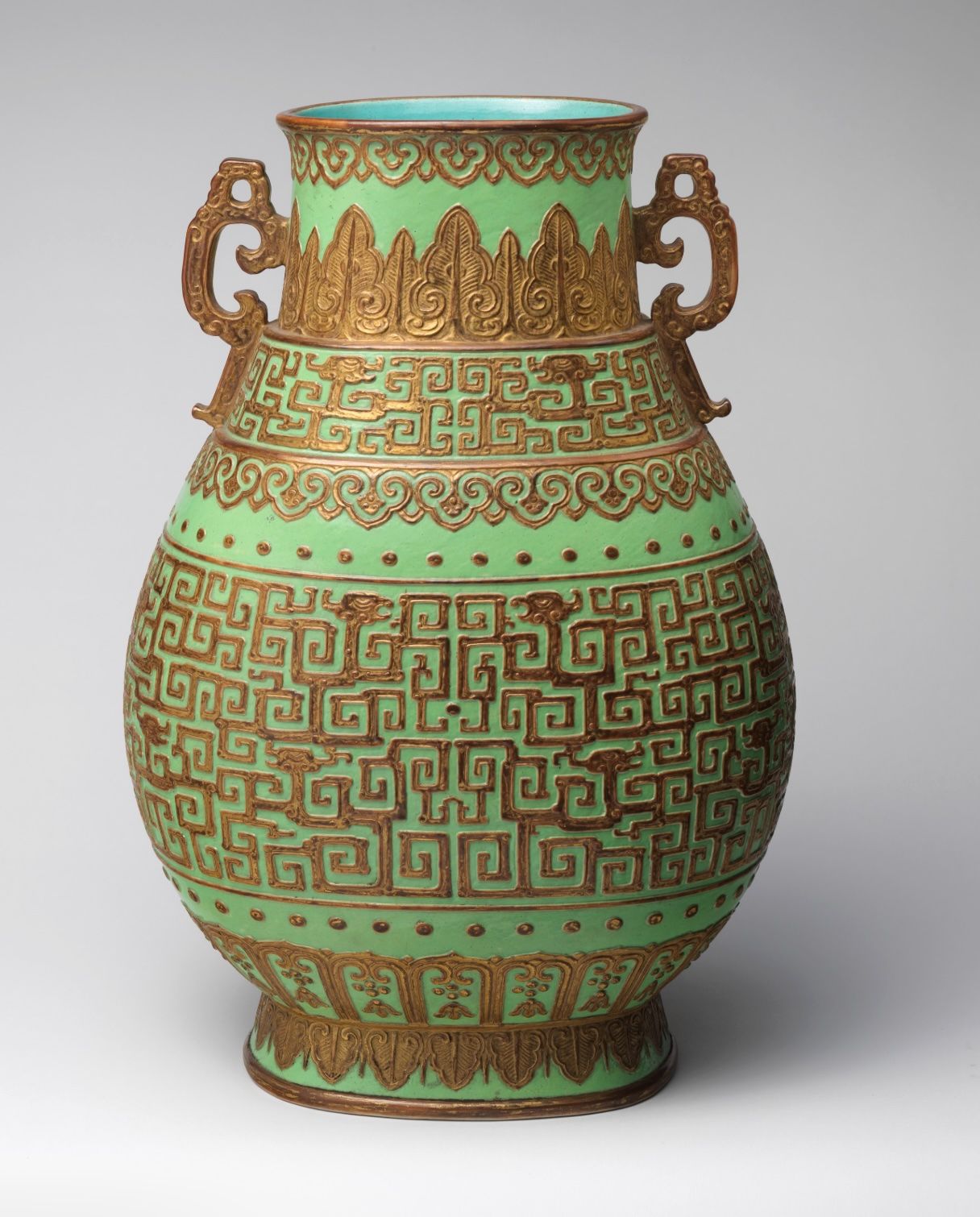
Let’s spend a moment with this Qing Dynasty Archaistic Green-Enamel Porcelain Vase with Gilt Relief Decoration. At first glance it feels almost like a bronze ritual vessel dressed up for the opera — bulbous body, flared neck, and those bold, scroll-cut handles.
Made in China in the mid‑18th century, this piece belongs to the height of Qing imperial experimentation at Jingdezhen, when potters were obsessed with reviving the visual language of ancient bronzes. The key‑fret bands winding around the body, punctuated by stylized dragon masks, are lifted straight from Warring States metalwork, but here they gleam in gold over a lush green enamel ground.
Look closely at the photos: the relief is crisp yet fluid, not the razor‑sharp mold impression of modern copies. The gilding shows gentle, honest wear on the high points, and the turquoise interior glaze has the soft, glassy depth connoisseurs look for in 18th‑century work.
Condition appears excellent, with no obvious breaks or restorations — a serious plus at this scale. In today’s market, an authentic imperial‑kiln vase of this quality could reasonably bring in the range of $150,000 to $250,000 at auction, while a later reproduction, even a good one, would trade closer to five figures.
On balance, the craftsmanship and the Met museum documentation justify an authenticity score around 90%. It’s a vessel that doesn’t just quote antiquity; it demonstrates how the Qing court reinvented the ancient past for its own glittering present.
Used for this report's TTS and avatar presentation.
Item Report
Qing Dynasty Archaistic Green-Enamel Porcelain Vase with Gilt Relief Decoration
Materials:Porcelain body with polychrome (green and turquoise) enamels and extensive gilt relief decoration
Age:Circa mid-18th century (Qing dynasty, ca. 1740–1770)
Condition:Excellent (museum-quality example with only light, even wear to gilding visible)
Value:If authentic imperial mid‑18th century Jingdezhen work: auction estimate approximately US $150,000–250,000. If a later high‑quality 19th–20th century reproduction: auction estimate approximately US $5,000–15,000.
Maker's Marks / Writing:No reign mark or inscription is visible in the provided images; base is not shown.
Date:2025-12-08 03:06:37.144503
Description:
Large baluster-form porcelain vase with flared neck and ring foot, flanked by a pair of archaistic scroll handles. The exterior is covered in a bright celadon‑green enamel and decorated in low relief with gilt scrollwork: leiwen (thunder) key‑fret bands incorporating stylized dragon masks, ruyi and lotus-scroll borders, and lappet panels above the foot and shoulder. The interior is turquoise‑blue glazed. Overall design consciously imitates Warring States–period bronze vessels while realized in high‑fired porcelain.
此件为大号瓷尊,鼓腹、束颈、外撇口、圈足,两侧设对称夔龙式耳。通体施亮绿色釉,外壁以浅浮雕工艺饰描金纹样:腹部为连续回纹雷纹带,中间点缀夔龙兽面,颈部与近足处饰如意云头、卷草与蕉叶纹、仰覆莲瓣等边饰。内壁施松石蓝釉。整体造型与纹饰明显仿自战国青铜壶器形与装饰,并以高温瓷器语汇重新演绎。
Curator Questions
Curated by Jade
Assessment:
This vase is a sophisticated example of Qing imperial taste for archaism, translating the forms and motifs of Warring States bronze ritual vessels into rich, enamelled porcelain. The crisp yet slightly rounded relief, the saturated celadon‑green ground, and the turquoise interior are all consistent with mid‑Qing imperial production. The photographed museum label from The Met identifying it as a mid‑18th‑century Chinese vase with archaistic patterns strongly supports this reading. Based on visible quality and context, it is best regarded as an authentic Qing imperial‑kiln piece rather than a later pastiche, though any firm valuation should still be confirmed by in‑person expert and scientific examination. A word about fakes.. Archaistic Qing porcelains are widely copied today, often with overly sharp mold‑made relief and synthetic‑looking gilding, so provenance and close technical inspection are crucial in this category. - CHOP goes of my red seal stamp!
此尊充分体现清代宫廷崇尚仿古之趣,将战国青铜礼器的造型与纹饰转化为华丽的彩釉瓷器语言。其浮雕线条圆润而有力,绿地鲜明饱和,内施松石蓝釉,均与清中期御窑器特征相符。附图中大都会艺术博物馆的标示亦将其定为十八世纪中叶中国“仿古纹尊”,为本件定年与性质提供了有力佐证。综合工艺水准与权威馆藏背景,可基本判断为清代御窑真品,而非后世拼凑之作;惟最终价值仍须依赖实物勘验与科学检测予以确认。A word about fakes.. 仿古纹清瓷在当今市场赝品极多,常见浮雕生硬、模具痕迹明显、描金色泽俗艳等特征,因此在此门类中,来源与工艺细节的严密核查尤为关键。 - CHOP goes of my red seal stamp!
Individual Images:
none
Provenance:
Illustrated on The Metropolitan Museum of Art website as a mid-18th-century Chinese vase with archaistic patterns, suggesting institutional collection provenance.
Condition:
Excellent (museum-quality example with only light, even wear to gilding visible)
Identification Score: 98%
The form, palette, archaistic bronze-derived patterns, and the accompanying Met museum screenshot uniquely match a well-documented mid‑18th‑century Qing imperial vase type, leaving little doubt as to the general identification.
器形、色彩、仿青铜纹样及附带的大都会艺术博物馆说明页,与清十八世纪中叶御窑仿古纹尊的已知实例完全吻合,因此对其类别与性质的判断把握度极高。
Authenticity Score: 90%
High craftsmanship, appropriate wear to gilding, convincing glaze quality, and the explicit Met museum catalog context all indicate an authentic Qing mid‑18th‑century imperial‑kiln vase; small residual uncertainty remains as any absolute authentication requires direct physical and scientific analysis.
从工艺水平、描金自然磨耗、釉色质感以及大都会艺术博物馆馆藏背景等多方面观察,均指向清十八世纪中叶御窑真品;但任何绝对结论仍需依赖实物与科学检测,因此保留少许不确定性。
Image Memory Note
None
None
Keywords
Qing dynasty, Chinese porcelain vase, archaistic patterns, green enamel, gilt relief, Jingdezhen, China, 18th century, bronze-inspired design, imperial porcelain
清代, 中国瓷尊, 仿古纹, 绿釉, 描金浮雕, 景德镇, 中国, 十八世纪, 仿青铜设计, 御窑瓷器
The report was edited after initial Artmink draft. Original AI draft preserved in Artmink audit history.

Share: