Jade : Chinese Fine and Decorative Arts
Jade Presents

Original Presentation Script
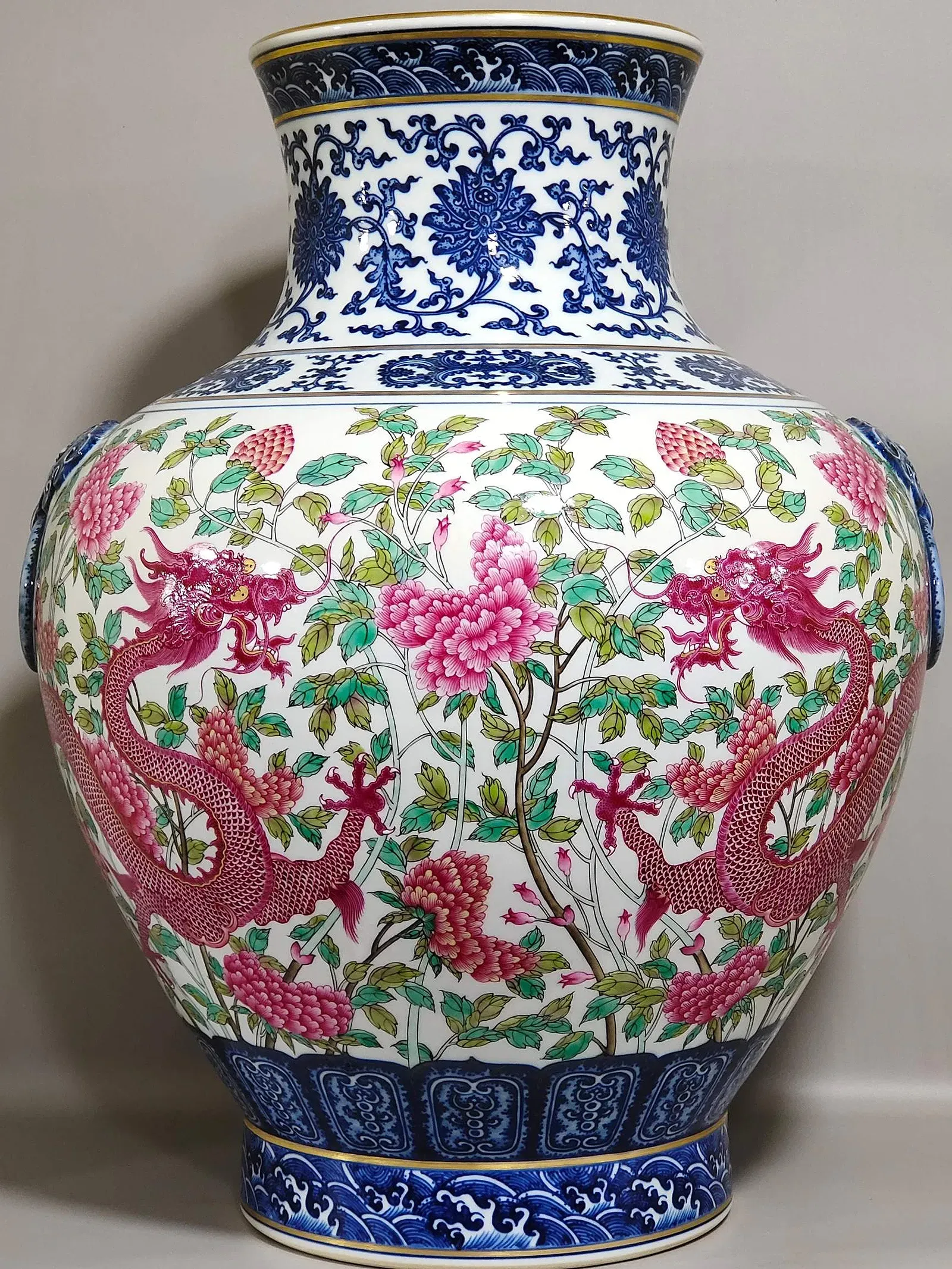
Here we have a grand Chinese Qing Style famille rose and underglaze blue porcelain dragon vase — the kind of object designed to stop a room in its tracks. With its swelling baluster body, flared neck, pink dragons, peonies, and deep blue borders, it borrows its visual language from imperial Chinese porcelain, especially pieces associated with the Qianlong taste. Now, the base mark is the big headline: it reads Da Qing Qianlong Nian Zhi, or 'Made in the Qianlong reign of the Great Qing.' That sounds thrilling — and expensive — but in Chinese ceramics, marks like this are copied constantly. In fact, the mark is the very reason to slow down. The craftsmanship is decorative and competent, but the finish appears too glossy and uniform for an 18th-century palace-grade vase. The enamels are bright, the molded ring handles very regular, and the overall painting lacks the nuanced softness and wear one hopes to see on a true period example. The footrim, too, does not strongly support great age. Condition appears very good from the photos, with no obvious major cracks visible, though a hands-on inspection would still be essential. As always, condition and authenticity are separate questions. So, authenticity first: I’d place this around 18% on the authenticity scale — likely a late 20th- or early 21st-century reproduction. Auction estimate as a reproduction: about $300 to $900. If it were genuinely of the Qianlong period, we’d be in a very different conversation — perhaps $8,000 to $15,000 or more at auction. Beautiful? Yes. Imperial? Almost certainly not.
Used for this report's TTS and avatar presentation.
Item Report
Chinese Qing Style Famille Rose and Underglaze Blue Porcelain Dragon Vase
中国清式粉彩青花龙纹瓷瓶
By: Unknown maker
Style: Qing Style Chinese export-decorative porcelain / modern decorative revival
Origin: China
Materials: Porcelain, overglaze famille rose enamels, underglaze blue, gilt line accents
Age: Late 20th to early 21st century, circa 1980-2020
Condition: Very Good (no obvious major cracks seen, light wear to footrim, not examined in hand)
Value: Auction estimate if authentic: $8,000-$15,000; auction estimate as later reproduction: $300-$900
Peer-Reviewed Market Values
- Dating Range
- Pending structured dating
- Auction Liquidation
- Pending structured market values
- Fair Market Value
- Pending structured market values
- Replacement Value
- Pending structured market values
- Comparables Used
- No saved comparables yet
- Research Confidence
- Not Run
Peer review completed, but this run did not return structured market value ranges.
Maker's Marks / Writing: Underside bears a six-character underglaze blue seal mark: 大清乾隆年制, translated as 'Made during the Qianlong reign of the Great Qing.' This mark is almost certainly apocryphal on this example.
Date: 2026-03-21 00:03:14.923249
Description:
Large baluster-form porcelain vase with flared neck, molded faux ring handles, pink dragons amid peony scrolls, and blue decorative borders. The base bears a six-character seal mark reading Da Qing Qianlong Nian Zhi, but the visible finish, crisp transfer-like regularity, and overall decorative program suggest a later reproduction rather than an 18th-century imperial-period vase. 大型撇口束颈鼓腹瓷瓶,带模印仿铺首环耳,通体饰粉彩粉红龙穿行于牡丹花叶之间,并配青花边饰。底部有“大清乾隆年制”六字篆书款,但从表面光泽、纹饰过于规整以及整体装饰风格判断,更像较晚期的仿制品,而非十八世纪乾隆御窑时期真品。
Curator Questions
Curated by Jade
Assessment:
This is a visually striking Chinese dragon vase in Qing taste, but it should be approached very cautiously as a likely modern decorative reproduction. The six-character seal mark on the underside reads 'Da Qing Qianlong Nian Zhi' (Made in the Qianlong reign of the Great Qing), yet the vase does not present the surface character, enamel subtlety, age wear, or imperial-level refinement expected of a genuine Qianlong-period object. The enamels are bright and clean, the molded ring handles appear mechanically regular, and the body shows a glossy, uniform finish with little convincing age patina. The underside footrim also looks comparatively fresh, with only light artificial-looking toning. Fakery check: the spurious Qianlong mark is the clearest red flag here; in Chinese ceramics, such marks are extremely common on later decorative wares. A word about copies.. Chinese porcelain is one of the most heavily reproduced categories in the global antiques market, especially pieces bearing Qianlong marks or imperial-style dragon decoration. This example is decorative and attractive, but I would value it as a modern reproduction unless supported by stronger evidence such as kiln-consistent wear, period provenance, and close technical examination. {chavatar_catchphrase} 这是一件颇具视觉效果的中国龙纹大瓶,风格仿清代,但应非常谨慎看待,更可能是现代装饰性仿制品。底部六字篆书款为“大清乾隆年制”,然而整器并未呈现出乾隆时期真品应有的釉面气息、彩料层次、自然老化痕迹或御窑级别的精致水准。彩料鲜亮洁净,模制铺首环耳规整得近乎机械,器表通体光泽均一,缺乏可信的岁月包浆。底足处也显得较新,仅见轻微、略似人为形成的旧色。作伪核查:最明显的警讯就是这枚可疑的乾隆款;在中国瓷器领域,此类款识极常见于后仿装饰瓷。A word about copies.. 中国瓷器是全球古玩市场中仿制最泛滥的门类之一,尤其是带乾隆款或御制龙纹风格的作品。此瓶装饰效果佳,但若无更有力的证据——例如符合窑口特征的自然磨损、可靠旧藏来源及更深入的工艺检测——应按现代仿品估值。{chavatar_catchphrase}
Individual Images:
- front vase
- side view vase
- back vase
- opposite side view vase
- upper half vase
- detail of molded ring handle
- detail of dragon body
- detail of dragon head
- underside vase with seal mark
Provenance:
No provenance documentation shown in the images.
Condition:
Very Good (no obvious major cracks seen, light wear to footrim, not examined in hand)
Identification Score: 95%
The form, decoration, famille rose palette, molded handles, and visible six-character seal mark clearly identify this as a Chinese Qing-style dragon vase with Qianlong mark. 从器形、纹饰、粉彩设色、模印环耳以及可见的六字篆书底款来看,可以较明确地判断这是一件带乾隆款的中国清式龙纹瓷瓶。
Authenticity Score: 18%
Low score due to the highly suspect Qianlong seal mark, overly even glossy finish, modern-looking enamel brightness, very regular molded ornament, and lack of convincing age wear. Following the rule to assume reproduction until proven otherwise, this is most likely a late 20th or early 21st century decorative reproduction. 真实性评分较低,原因在于乾隆篆书款高度可疑、器表光泽过于均匀、彩料鲜艳带现代感、模印装饰过于规整,且缺乏可信的自然老化磨损。依照“除非有力证实,否则先按仿品处理”的原则,此件最可能是二十世纪晚期至二十一世纪初的装饰性仿制品。
Image Memory Note
None None
Keywords
Chinese vase, Qing Style vase, famille rose, underglaze blue, dragon vase, peony decoration, Qianlong mark, porcelain, China 中国瓷瓶, 清式瓷瓶, 粉彩, 青花, 龙纹瓶, 牡丹纹, 乾隆款, 瓷器, 中国
Peer Review Summary
Peer Review
Key Visible Evidence
The subject item is a large baluster-form porcelain vase with a flared neck and molded faux ring handles, decorated with two prominent pink/red dragons amidst dense peony scrolls (Images 1-4, 7). The upper and lower borders feature underglaze blue floral and wave patterns, respectively (Images 1-5). Gilt line accents are visible at the rim and separating decorative bands (Image 5). The overall aesthetic is characterized by vibrant colors, a highly glossy and uniform glaze finish, and crisp, seemingly regular decoration (Images 1-7). The molded mask handles appear mechanically regular (Image 6). The underside of the vase reveals a six-character underglaze blue seal mark (Image 8). The footrim is relatively clean and smooth, exhibiting only minimal, possibly artificial, toning or grime (Image 8).
Market and Source Support
The six-character underglaze blue seal mark on the base (Image 8) clearly reads '大清乾隆年制' (Dà Qīng Qiánlóng Nián Zhì), which translates to 'Made in the Qianlong reign of the Great Qing.' This reading is consistent with known Qianlong reign marks (RAG_REF_1). The decorative system employed, primarily Famille Rose enamels, places the earliest possible manufacture date around 1720, during the Yongzheng period, as opaque pink/carmine enamels were introduced then. However, the overall execution, including the glossy, uniform finish, bright enamels, and mechanical regularity of the molded elements, strongly contradicts the characteristics expected of genuine 18th-century imperial Qianlong porcelain. Authentic Qianlong imperial wares typically exhibit a more nuanced surface character, subtle enamel variations, and signs of age-consistent wear. Comparables for modern decorative vases with apocryphal Qianlong marks consistently realize prices in the hundreds of dollars, supporting the report's lower valuation for a reproduction.
Needs Verification
While the visual evidence strongly indicates a modern decorative reproduction, a definitive technical examination would provide further conclusive evidence. This would include: 1. UV light examination to detect any restorations or inconsistencies in the glaze and enamels. 2. Microscopic analysis of the enamels and underglaze blue pigments to assess their composition and application techniques, which can reveal modern manufacturing processes. 3. A more detailed inspection of the firing characteristics of the porcelain body and footrim for consistency with known period examples. 4. Examination of the interior of the vase for any manufacturing marks or techniques that might further confirm its modern origin.
Audit Conclusion
The report's assessment that this is a 'Chinese Qing Style Famille Rose and Underglaze Blue Porcelain Dragon Vase' dating to the 'Late 20th to early 21st century, circa 1980-2020' is well-supported by the visible evidence and aligns with established ceramic dating principles. The presence of a clear 'Da Qing Qianlong Nian Zhi' mark (Image 8) is noted, but the report correctly identifies it as apocryphal, given the object's modern aesthetic, glossy finish, and lack of convincing age patina (Images 1-7). The crispness of the decoration and the mechanical regularity of the molded handles (Image 6) further reinforce the conclusion of a later reproduction rather than an 18th-century imperial piece. The dual valuation provided by the report, distinguishing between an authentic Qianlong piece and a modern reproduction, is appropriate and reflects current market realities for such items. The authenticity score of 18% is a reasonable reflection of the strong indicators pointing towards a modern decorative piece.
Comparables (Similar Items)
No archived comparables matched this report yet.
Share: