Jade : Chinese Fine and Decorative Arts
Jade Presents

Original Presentation Script
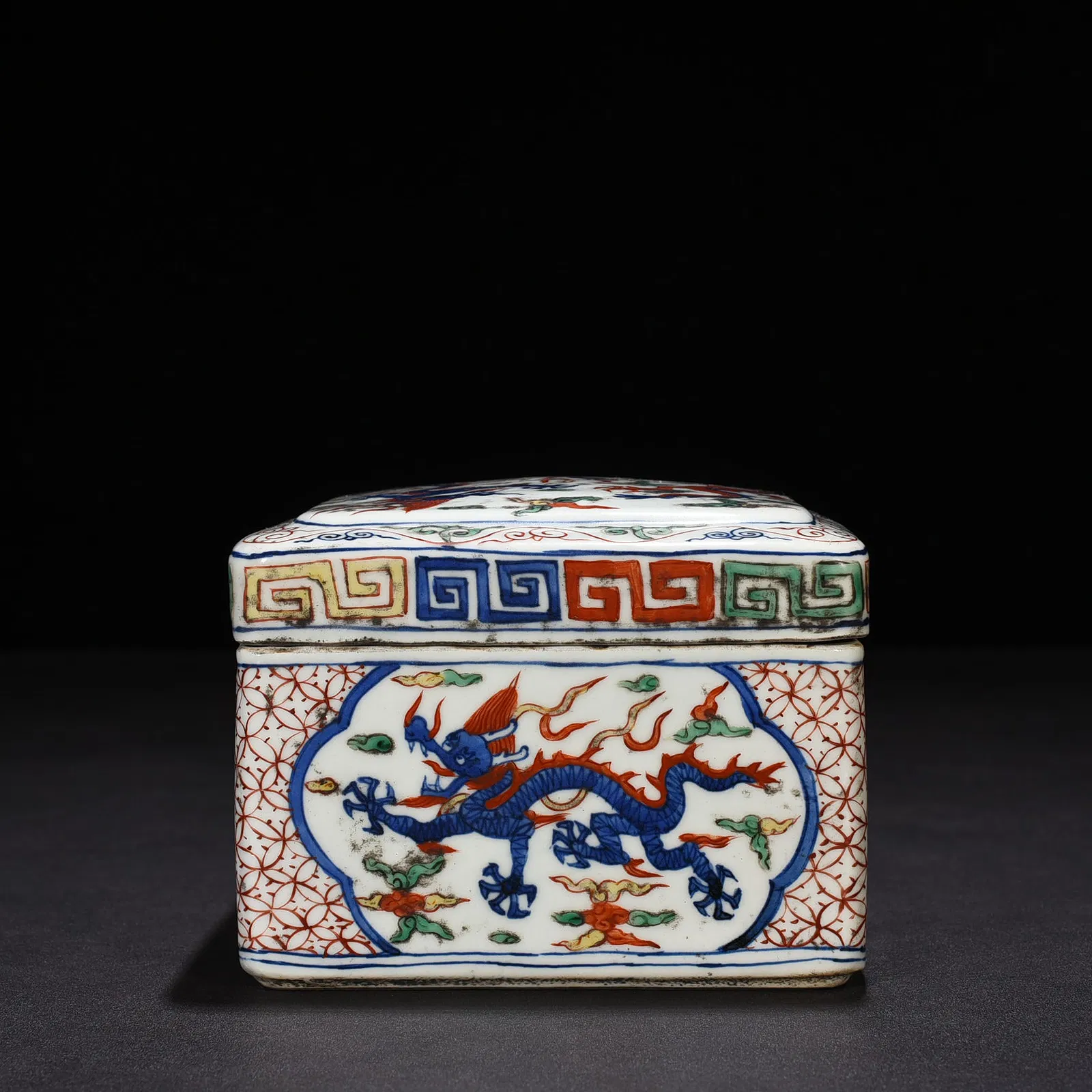
Here we have a Chinese Wanli-style wucai porcelain covered box, a charming little form that borrows the visual drama of late Ming dragon wares. Square, compact, and brightly enameled, it was designed to impress at first glance — and it certainly understands the assignment. The decoration nods toward the Ming taste for lively polychrome surfaces: dragons, flaming pearls, cloud scrolls, and geometric borders, all packed into a richly patterned composition. The base bears the inscription 大明隆庆年造 — 'Made in the Great Ming, Longqing period' — which sounds thrilling, but in this case should actually make us more cautious, not less. Why? Because genuine imperial or near-imperial Ming boxes of this type are scarce, and this one shows several warning signs. The mark does not inspire confidence, the dragons feel somewhat stiff and repetitive rather than spontaneous, and the base abrasion looks suspiciously theatrical, as though age has been applied with intent. That sort of strategic wear is one of the oldest tricks in the ceramics-forgery playbook. Condition appears generally decent, with rubbing, grime, and surface wear, but nothing here rescues the dating. A word about copies.. in Chinese dragon-decorated porcelains, reproductions and revival wares are extraordinarily common, especially when bold reign marks are involved. So, my view is that this is best catalogued as a modern decorative reproduction, not a Ming-period treasure. Authenticity score: 18%. Conservative auction estimate: $150-500 as a reproduction; if unquestionably authentic period, the value gap would be enormous — roughly $20,000-60,000 or more. A handsome box, yes; a sixteenth-century survivor, very likely not.
Used for this report's TTS and avatar presentation.
Item Report
Chinese Wanli Style Wucai Porcelain Covered Box
中国万历风格五彩瓷盖盒
By: Unknown
Style: Chinese Ming revival / Wanli style export-decorative porcelain
Origin: China
Materials: Porcelain, underglaze cobalt blue, overglaze enamels
Age: Likely late 20th to early 21st century
Condition: Good (visible wear, grime, scattered enamel/surface rubbing, no official condition report possible from photos)
Value: If authentic period Ming/Longqing-Wanli related example: USD 20,000-60,000+ at auction depending on proven authenticity, condition, and scholarly acceptance. As a later reproduction/decorative copy: USD 150-500 at auction.
Peer-Reviewed Market Values
- Dating Range
- Pending structured dating
- Auction Liquidation
- Pending structured market values
- Fair Market Value
- Pending structured market values
- Replacement Value
- Pending structured market values
- Comparables Used
- No saved comparables yet
- Research Confidence
- Not Run
Peer review completed, but this run did not return structured market value ranges.
Maker's Marks / Writing: Blue four-character mark on base: 大明隆庆年造, translated as 'Made in the Great Ming, Longqing period.' The mark is likely apocryphal/spurious.
Date: 2026-03-22 23:38:21.643888
Description:
A square porcelain covered box decorated in underglaze blue and overglaze iron-red, green and yellow enamels with opposing dragons chasing a flaming pearl. The sides feature lobed cartouches on a diaper ground, the lid has twin dragons, and the base bears a blue four-character mark reading 'Da Ming Longqing Nian Zhi' ('Made in the Great Ming, Longqing period'). Visible artificial-looking base abrasion, unusually uniform decorative scheme, and the reign mark strongly suggest a later decorative copy rather than a Ming imperial-period object. 一件方形瓷盖盒,以青花配釉上矾红、绿彩及黄彩装饰,绘双龙戏火珠纹。盒身四面设开光,外围为锦地纹,盒盖绘双龙纹,底部有青花双方框四字款“大明隆庆年造”。底足磨损显得刻意,纹饰布局过于整齐程式化,加之年款可疑,整体更像后期装饰性仿作,而非明代御窑时期真品。
Curator Questions
Curated by Jade
Assessment:
This appears to be a Chinese wucai-style covered porcelain box inspired by late Ming dragon-decorated wares, but it is unlikely to be of the Longqing or Wanli period. The painted mark '大明隆庆年造' is a major red flag: Longqing-marked porcelains are rare, and the calligraphy, overall execution, and suspiciously abraded base do not support a 16th-century attribution. The enamel palette is plausible in a general sense, yet the dragons are stiff and repetitive, the surfaces lack convincing century-spanning wear, and the foot abrasion looks manufactured to simulate age. A word about copies.. this category is flooded with reproductions, fantasy marks, and revival wares, especially dragon-decorated boxes carrying prestigious Ming reign marks. I would treat this conservatively as a modern decorative reproduction. 此件应为一件仿明末五彩龙纹瓷盖盒,但大概率并非隆庆或万历时期真品。青花“四字款”‘大明隆庆年造’本身就是重要警讯:隆庆官款瓷极为少见,而本器款识书法、整体绘工以及刻意磨旧的底部,都不足以支持16世纪断代。釉彩搭配在大方向上模仿五彩无误,但龙纹造型较僵硬重复,表面也缺乏跨越数百年的自然使用痕迹,底足旧气更像人为做旧。A word about copies.. 此类器物中充斥着大量仿品、臆造款与复古装饰瓷,尤其是带有显赫明代年款的龙纹盖盒,更须谨慎。综合判断,宜保守视为现代装饰性仿制品。
Individual Images:
- front of porcelain box
- open porcelain box
- base of porcelain box mark
- back of porcelain box
- overhead porcelain box
- side view porcelain box
- opposite side porcelain box
Provenance:
No provenance documentation shown in the images.
Condition:
Good (visible wear, grime, scattered enamel/surface rubbing, no official condition report possible from photos)
Identification Score: 94%
The form, decoration, enamels, and covered-box construction clearly indicate a Chinese wucai-style porcelain box. Multiple angles, lid interior, and base mark support the object identification with high confidence, even though the exact dating is doubtful. 从器形、纹饰、彩料以及带盖盒的结构判断,可较明确认定为一件中国五彩风格瓷盖盒。多角度图像、盖内与底款信息都足以支持器物类别判断,因此在“是什么”这一层面识别度较高,尽管具体年代存疑。
Authenticity Score: 18%
Low score due to several fakery indicators: the prestigious Longqing mark is unlikely and appears spurious; the base wear looks artificially induced rather than naturally accumulated; decoration is formulaic and lacks the vitality of documented late Ming wucai; and the object overall reads as a modern workshop reproduction. Because Ming mark-and-period boxes of this type are rare and valuable, reproduction must be assumed unless proven otherwise. 真实性评分较低,原因在于多项仿品征象同时出现:其一,显赫的“隆庆年造”款识可信度很低,疑为伪托;其二,底部磨损更像人为做旧,而非长期自然磨耗;其三,纹饰程式化明显,缺乏已知明末五彩器应有的灵动气韵;其四,整体观感更接近现代作坊仿品。此类带明代年款的盖盒若为真品价值极高,因此在无充分证据前应先按仿品看待。
Image Memory Note
None None
Keywords
Chinese porcelain box, wucai, Wanli style, Longqing mark, dragon box, covered box, Ming style, polychrome enamel, China 中国瓷盒, 五彩, 万历风格, 隆庆款, 龙纹盒, 盖盒, 明代风格, 彩瓷, 中国
Peer Review Summary
Peer Review
Key Visible Evidence
The subject item is a square porcelain covered box decorated in wucai enamels, featuring dragons chasing flaming pearls within lobed cartouches on a diaper ground (Images 1, 4, 6, 7). The lid also displays two dragons (Image 5). The enamels appear bright and somewhat uniformly applied. The interior of the box and lid are plain white (Image 2). The unglazed base (Image 3) exhibits significant, uniform abrasion, which visually suggests artificial aging rather than natural wear accumulated over centuries. The foot rim is similarly abraded. A four-character underglaze blue mark in Kaishu script is present on the base, clearly reading: 大明隆庆年造 (Da Ming Longqing Nian Zao).
Market and Source Support
The mark on the base, 大明隆庆年造, translates to 'Made in the Great Ming, Longqing period.' The Longqing reign (1567-1572) was a short but significant period in Ming dynasty porcelain production. However, genuine imperial Longqing marked porcelains are exceptionally rare. The visual characteristics of the subject item, particularly the artificial-looking base abrasion and the somewhat formulaic execution of the dragon decoration, are inconsistent with authentic Ming period manufacture. Grounded sources, including auction records for similar wucai 'dragon' boxes explicitly dated to the 20th century, consistently show realized prices in the low hundreds to low thousands of USD. This market data strongly supports the report's assessment of the subject item as a later decorative reproduction, rather than a period-authentic Ming piece, and aligns with its lower value estimate.
Needs Verification
The report's transcription of the base mark as 'Da Ming Longqing Nian Zhi' contains a minor inaccuracy; the visible character in Image 3 is 造 (zao, 'made') rather than 製 (zhi, 'made'). While both convey a similar meaning, precise transcription of reign marks is critical for scholarly accuracy. A macro photograph of the enamel surfaces and underglaze blue could provide additional detail regarding pigment characteristics and firing techniques, which might offer further insights into the object's manufacturing period, although the current visual evidence strongly points to a later date. Scientific analysis, such as thermoluminescence dating, could definitively determine the age of the porcelain body, but this is typically reserved for high-value items where authenticity is in serious contention.
Audit Conclusion
The report's conclusion that the subject item is a modern decorative reproduction, rather than a Ming-period object, is well-supported by the visible evidence and corroborated by market comparables. The artificial abrasion on the base, the stylistic execution of the decoration, and the presence of an apocryphal Longqing reign mark are all strong indicators of a later date. The minor discrepancy in the transcription of the last character of the reign mark (造 vs. 製) does not alter the overall assessment of the object's authenticity. The value framing for a reproduction is consistent with current market trends for similar items.
Comparables (Similar Items)
No archived comparables matched this report yet.
Share: