Premium upgrade: Monique delivers your appraisal as a guided podium narration with synced visuals and voiceover.
Output is a narrated, animated slideshow with video intro and outro, sandwiching the autoplay voiceover sequence in actual video.
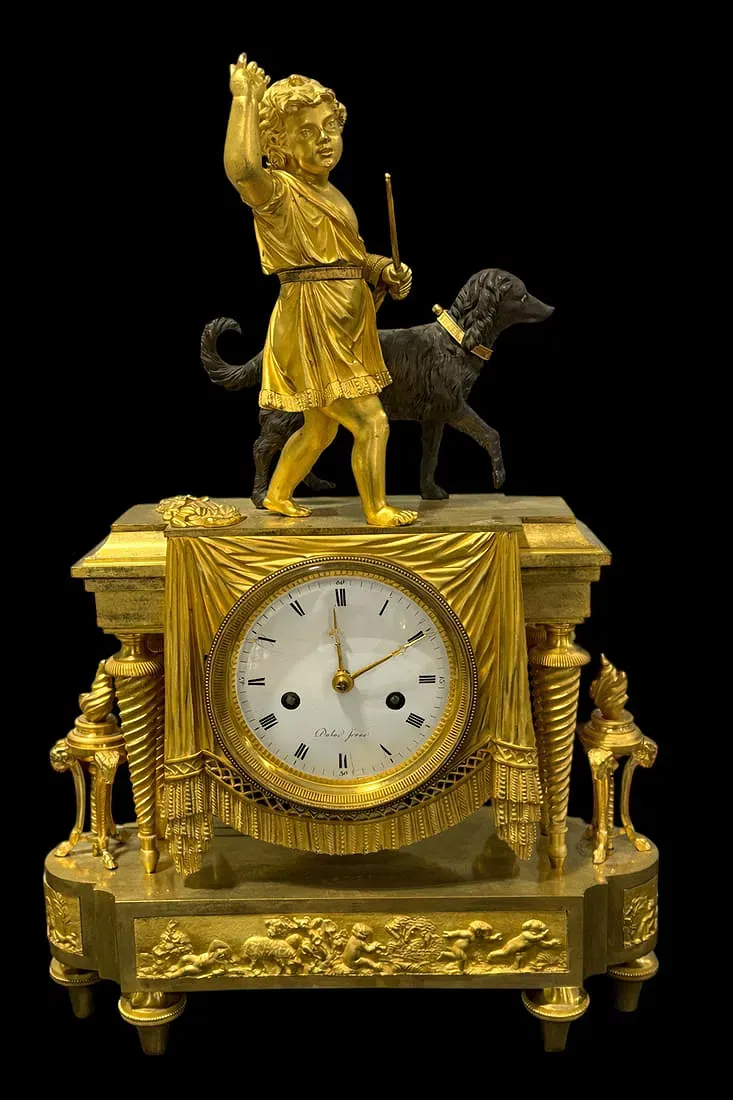
French Empire Period Gilt Bronze Mantel Clock with Young Hunter and Dog
LANGUAGE UNLOCK
Glossary Roundup
Original Presentation Script
Let’s begin with a piece that perfectly captures the confidence and clarity of Napoleonic France: this French Empire period gilt bronze mantel clock by Dubuc Jeune of Paris.
Surmounted by a youthful classical hunter and his loyal dog, the clock immediately evokes the Empire’s fascination with antiquity, virtue, and heroic idealism. These sculptural groups were not mere decoration — they were statements of taste aligned with the new imperial order.
Dating to around 1805 to 1815, this clock bears the signature of Dubuc Jeune, a well-documented Parisian clockmaker. The architectural case, draped swags, spiral columns, and putti friezes are all hallmarks of early Empire design, executed here in richly chased and fire-gilded bronze.
Look closely and you’ll see the story of age: gentle wear to the gilding, a small hairline to the enamel dial, and evidence of old screw holes and adjustments. These are not flaws — they are the honest fingerprints of two centuries of life. Importantly, the movement and bell appear period-correct, not later replacements.
A word about copies.. Empire clocks are among the most reproduced of all French decorative arts. However, the weight, depth of casting, hand-finished surfaces, and natural patina here place this firmly above the realm of modern reproductions.
I would assign an authenticity score of roughly 75 percent. At auction, assuming authenticity, a conservative estimate would be $12,000 to $20,000. A later reproduction, by contrast, would struggle to reach a fraction of that.
In short, this is Empire elegance with real presence — and real history — ticking away beneath the bronze.
Used for this report's TTS and avatar presentation.
Item Report
French Empire Period Gilt Bronze Mantel Clock with Young Hunter and Dog
Condition:Good (original wear to gilding, minor losses, hairline to dial, historical repairs; not restored to modern standards)
Value:If authentic: auction estimate $12,000–$20,000. If later reproduction or heavily altered: auction estimate $1,500–$3,000.
Maker's Marks / Writing:Signed on dial: 'Dubuc Jeune, Paris'; stamped numerals on backplate.
Date:2026-01-08 07:17:35.932721
Description:
An elegant French Empire mantel clock surmounted by a classical gilt bronze figure of a youthful hunter accompanied by a dog. The architectural case features draped motifs, spiral columns, and relief friezes of putti. The white enamel dial bears Roman numerals and is signed 'Dubuc Jeune, Paris'. The movement is housed within a finely cast ormolu case with a bell-striking mechanism visible at the rear.
Curator Questions
Curated by Jade
Assessment:
This is a high-quality French Empire period mantel clock attributable to Dubuc Jeune of Paris, a respected early 19th-century clockmaker. The sculptural quality of the figure group, the finely chased ormolu, and the signed enamel dial are all consistent with early Empire production. Visible wear, minor losses, and historical repairs are in keeping with genuine age. A word about copies.. Empire clocks are widely reproduced in the late 19th and 20th centuries, but the depth of chasing, natural wear to gilding, and period movement here argue strongly against a modern reproduction.
Individual Images:
front view of mantel clock
three-quarter front view with door open
right side view
back view showing bell
left side view
closeup of hunter figure
detail of dog sculpture
detail of screw hole on top
detail of enamel dial hairline
detail of Dubuc Jeune signature
detail of corner ormolu foot
rear movement and bell
detail of stamped numbers on backplate
Provenance:
No written provenance provided.
Condition:
Good (original wear to gilding, minor losses, hairline to dial, historical repairs; not restored to modern standards)
Identification Score: 95%
The form, iconography, signed dial, and construction details clearly identify this as a French Empire mantel clock by Dubuc Jeune.
Authenticity Score: 75%
The period movement, hand-finished ormolu, natural patina, and signed Paris dial support authenticity. Minor later interventions and replaced elements cannot be ruled out, keeping the score conservatively below certainty.
Image Memory Note
None
None
Keywords
French Empire mantel clock, Dubuc Jeune, gilt bronze clock, ormolu, Paris, early 19th century
The report was edited after initial Artmink draft. Original AI draft preserved in Artmink audit history.

Share: