Jade : Chinese Fine and Decorative Arts
Jade Presents

Original Presentation Script
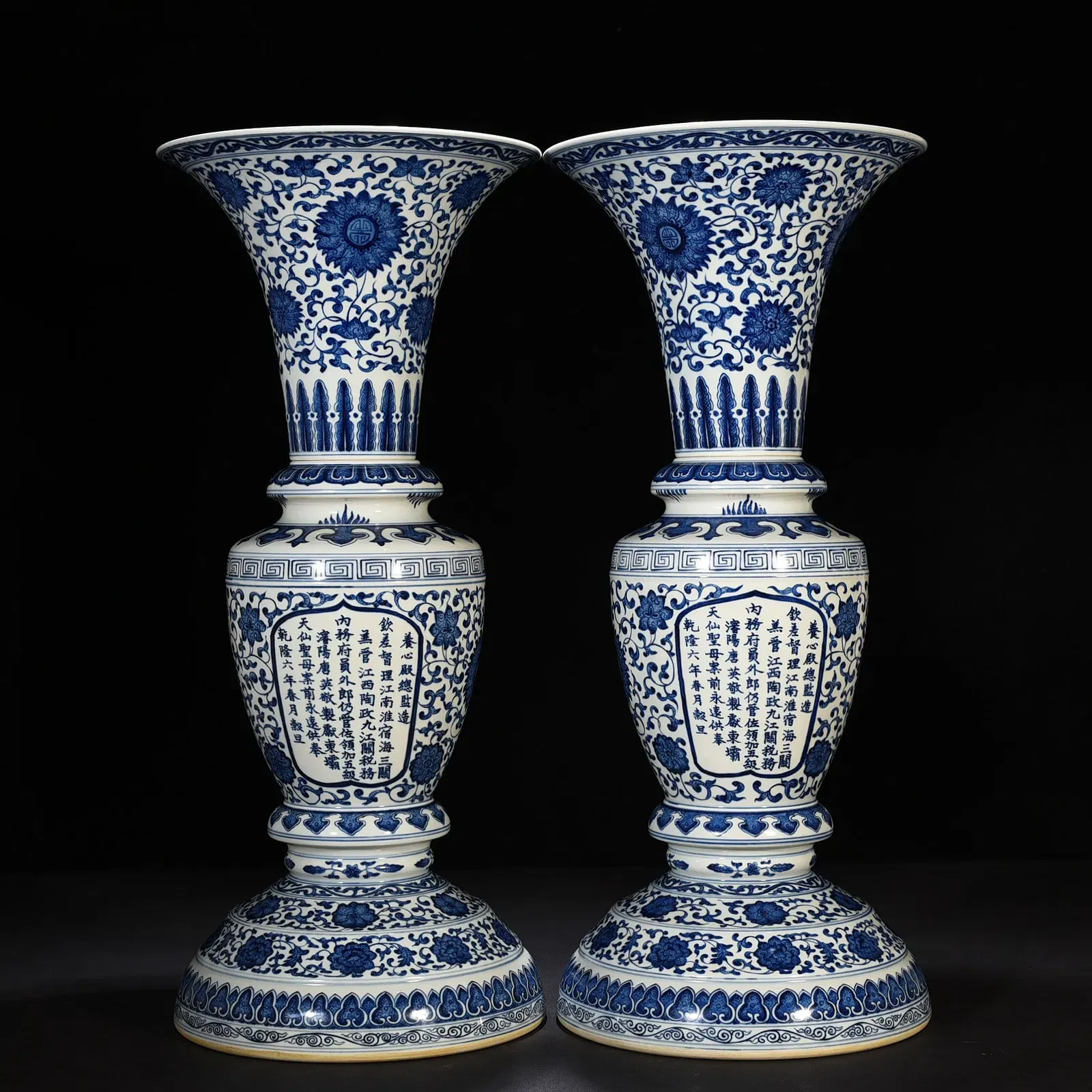
Here we have a striking pair of Chinese Qing Style blue and white porcelain garniture floor vases — tall, theatrical, and clearly meant to command a room. Their trumpet necks, scrolling floral ornament, and grand calligraphic panels borrow heavily from imperial and temple-display aesthetics. Now, the inscription is where things get interesting. It appears to reference official supervision and even gives a Qianlong cyclical date, 'Qianlong sixth year,' which would sound wonderfully important if true. But this is exactly where seasoned caution must step in. Grand historical inscriptions on oversized decorative porcelain are often less a passport to authenticity than a costume. The materials are straightforward enough: porcelain with underglaze cobalt blue. But the execution is telling. The blue is very controlled, the patterning highly repetitive, the glaze bright and fresh, and the surfaces lacking the kind of nuanced wear one expects from genuinely old, monumental vases. The later images showing detachable upper sections are another clue that these were made as decorative modular display pieces. Condition appears very good overall, with only modest wear at the edges and foot areas visible. No major cracks or restoration jump out from the photos, which is good for decoration — though almost too good for a purported 18th-century survivor. So, authenticity? I would place it around 18%. Auction estimate as authentic Qing: roughly $15,000 to $30,000. As a modern Qing-style decorative pair: more likely $800 to $2,000. Handsome? Certainly. Imperial? I would not bet the porcelain room on it.
Used for this report's TTS and avatar presentation.
Item Report
Chinese Qing Style Blue and White Porcelain Garniture Floor Vases, a Pair
中国清式青花瓷陈设大瓶一对
By: Unknown workshop
Style: Chinese Qing Style blue and white export-decorative porcelain
Origin: China
Materials: Porcelain with underglaze cobalt blue decoration
Age: Late 20th to early 21st century
Condition: Very good (appears structurally sound, minor base/rim wear visible, no obvious cracks seen in photos)
Value: If authentic Qing period: USD 15,000-30,000 at auction; as a modern or recent Qing style decorative pair: USD 800-2,000 at auction
Peer-Reviewed Market Values
- Dating Range
- Pending structured dating
- Auction Liquidation
- Pending structured market values
- Fair Market Value
- Pending structured market values
- Replacement Value
- Pending structured market values
- Comparables Used
- No saved comparables yet
- Research Confidence
- Not Run
Peer review completed, but this run did not return structured market value ranges.
Maker's Marks / Writing: Large calligraphic inscription panels. Visible text includes '养心殿总监造' and a date reading '乾隆六年春月'. The inscription appears to reference official supervision, Jiangnan/Huai'an customs administration, Yangzhou, and a dedication to Tianxian Shengmu. Translation is approximate: it presents itself as an official commission or offering under imperial-era administration. The wording is highly suspect in this context.
Date: 2026-03-16 03:31:20.429411
Description:
A large matched pair of blue and white porcelain floor vases of baluster form with trumpet flaring necks and broad spreading bases, decorated with dense scrolling floral designs, stylized lappets, key-fret borders, and large calligraphic reserve panels. The bodies appear to separate into upper vase sections and lower stands, suggesting decorative garniture or altar-display construction rather than strictly period one-piece palace vessels. 这是一对大型青花瓷落地陈设瓶,器形为长颈喇叭口、鼓腹、宽大外撇底座,通体饰缠枝花卉、如意形蕉叶纹、回纹边饰,并设大块书法开光。器身似由上部瓶身与下部底座分段组合而成,更接近陈设性瓶具或供器式组合结构,而非严格意义上的清代原配宫廷一体成型重器。
Curator Questions
Curated by Jade
Assessment:
This appears to be a decorative Chinese blue and white porcelain pair made in Qing taste, but very unlikely to be an authentic Qing dynasty pair. The strongest red flags are the unusually crisp, highly even painting; the very glossy, fresh-looking glaze; the ambitious inscriptions; and the modular construction visible in later images where the trumpet tops are removed from the bodies. The calligraphy includes a cyclical date reading 'Qianlong sixth year, spring month' (乾隆六年春月), which would imply 1741, yet the overall finish, decorative regularity, and presentation feel much more recent. FAKER FLAG #3 is especially relevant here: elaborate commemorative inscriptions of this sort on large decorative floor vases are inherently suspicious. The writing references Yangzhou and official ranks, seemingly crafted to lend gravitas. A word about copies.. blue-and-white Chinese porcelain is among the most heavily reproduced categories in the global antiques market, and grand Qing revival floor vases with inscriptions are especially common from the late 20th century onward. I would treat this as a modern decorative pair unless hands-on examination, base photos, and thermoluminescence or other testing prove otherwise. {chavatar_catchphrase} 这对器物看起来是一组仿清风格的中国青花瓷大瓶,但极不可能是真正的清代原作。最明显的警讯包括:绘画线条过于均匀工整、青花发色与施釉显得过新且光亮、题文过于刻意,以及后面图像中可见喇叭口上段可以拆下,说明其为组合式结构。题文中可见“乾隆六年春月”,若按字面理解即为1741年,但整体工艺面貌、装饰规律性与表面状态都更像近现代制品。这里尤其应注意伪作警讯#3:这类大型陈设瓶上出现如此隆重的纪念性长篇题文,本身就高度可疑。文中提及扬州、官职等内容,明显有意增强“来历感”与“历史感”。A word about copies.. 青花瓷是全球古玩市场中仿制最多的门类之一,而带题款、仿清宫廷气息的大型陈设瓶,自20世纪晚期以来尤为常见。在未见到底足、胎釉细节及科学检测前,我会将其视为现代装饰性成对瓷器。{chavatar_catchphrase}
Individual Images:
- whole vase pair front
- lower halves with inscriptions
- detail of inscription panel
- detail of lower body
- upper halves and rims
- reverse of vase pair
- lower halves reverse
- separated vase sections
- interior of trumpet top
Provenance:
No provenance documentation shown.
Condition:
Very good (appears structurally sound, minor base/rim wear visible, no obvious cracks seen in photos)
Identification Score: 94%
Form, decoration, and inscription placement clearly identify these as a pair of Chinese blue and white decorative floor vases or garniture-type vessels in Qing taste. Confidence is high on object type, though lower on precise intended function because the sections appear detachable. 从器形、纹饰与题文布局判断,这是一对中国青花陈设大瓶或类似瓶座组合器,风格明显模仿清代审美。对器物类别的判断把握较高,但由于器身似可拆分,对其原始具体用途仍保留少量疑问。
Authenticity Score: 18%
The piece should be presumed reproduction until proven otherwise. The glaze is too even and glossy, the cobalt painting too controlled and repetitive, the surfaces too clean for an 18th- or 19th-century monumental pair, and the inscription is a major fakery concern. The cyclical Qianlong dating and official-dedication tone read as value-enhancing embellishment rather than convincing period documentation. The detachable construction also points toward recent decorative manufacture. 在没有充分证据前,应先将此类器物视为仿品。其釉面过于均匀明亮,青花绘制过于整齐重复,整体表面也过于干净,不像18或19世纪大型成对陈设瓷器应有的自然老化状态。题文更是重要的伪作警讯,其中“乾隆”纪年及官式奉献语气,更像为提高价值而添加的装饰性文字,而非可信的时代信息。可拆式结构也偏向近现代装饰瓷制作方式。
Image Memory Note
None None
Keywords
Chinese blue and white porcelain, Qing style, pair of floor vases, garniture vases, underglaze blue, floral scrolls, calligraphy panel, decorative porcelain, China 中国青花瓷, 清式, 一对落地大瓶, 陈设瓶, 釉下青花, 缠枝花卉, 书法开光, 装饰瓷, 中国
Peer Review Summary
Peer Review
Key Visible Evidence
The visible evidence strongly supports the report's assessment of these vases as modern decorative pieces. Images 1, 2, 6, and 7 show a pair of large blue and white porcelain vases with dense floral and geometric decoration, and prominent calligraphic panels. The cobalt blue is uniformly vibrant, and the glaze is consistently glossy and unblemished, lacking the subtle variations, pitting, or wear typically associated with genuine antique porcelain. The painting style, particularly the repetitive floral motifs and crisp borders, appears highly regular and precise, suggesting modern production techniques. Crucially, Image 8 clearly demonstrates the modular construction, with the trumpet-form upper sections detaching from the lower baluster bodies. The interior surfaces of these separated sections are remarkably clean and show no signs of age, repair, or traditional joinery methods expected in period pieces. The unglazed foot rim visible in Image 4 also appears clean and relatively new, without significant age-related discoloration or wear. The inscription, clearly legible in Image 3, includes '乾隆六年春月' (Qianlong sixth year, spring month), which would correspond to 1741, but this claim is visually contradicted by the overall newness and manufacturing characteristics of the vases.
Market and Source Support
The report's skepticism regarding the authenticity and dating is well-grounded in common knowledge of Chinese porcelain reproductions. The presence of elaborate, specific reign marks or dedications on pieces that otherwise exhibit modern manufacturing characteristics (such as highly uniform glaze, crisp decoration, and modular construction) is a well-known indicator of later production intended to enhance perceived value. The modular construction, as seen in Image 8, is not typical for large, single-piece Qing dynasty vases of this type, further supporting a modern decorative origin. The overall aesthetic aligns with late 20th to early 21st-century 'Qing style' decorative wares produced for a global market.
Needs Verification
While the visual evidence strongly points to modern manufacture, definitive confirmation of the age would require thermoluminescence (TL) testing. Further detailed macro photographs of the unglazed foot rims and any interior firing imperfections could provide additional clues regarding manufacturing techniques and age. Examination under UV light could reveal any hidden repairs or overpainting, though none are apparent in the provided images.
Audit Conclusion
The report's conclusion that these are a modern decorative pair, likely late 20th to early 21st century, is robustly supported by the visible evidence. The 'Qianlong sixth year' inscription, while clearly present, is highly suspect given the overall newness, uniform glaze, precise painting, and modular construction of the vases. The report accurately identifies the key 'red flags' and provides a well-reasoned assessment of authenticity and value. My audit confirms the report's skeptical stance and its dating of the objects as modern reproductions in Qing taste.
Comparables (Similar Items)
No archived comparables matched this report yet.
Share: