Premium upgrade: Jade delivers your appraisal as a guided podium narration with synced visuals and voiceover.
Output is a narrated, animated slideshow with video intro and outro, sandwiching the autoplay voiceover sequence in actual video.
Chinese Ming Style Blue and White Porcelain Ewer明代风格青花瓷执壶
LANGUAGE UNLOCK
Glossary Roundup
Original Presentation Script
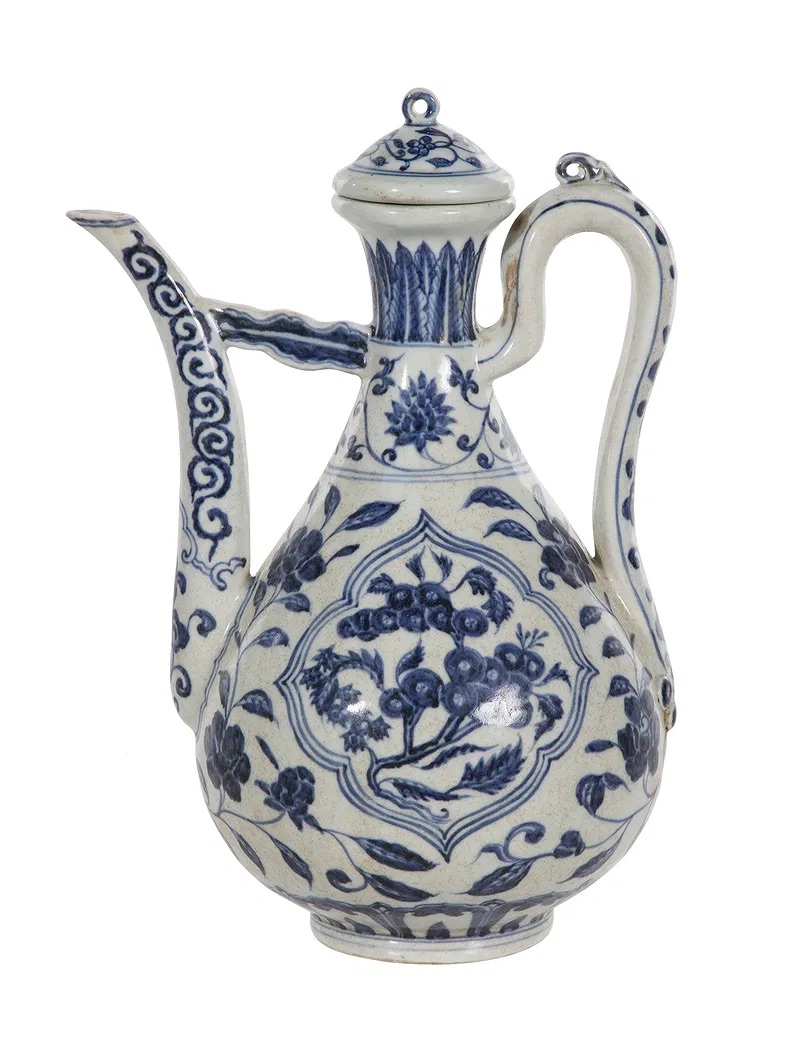
Hello, collectors! Today we're looking at a very elegant form: a Chinese blue and white porcelain ewer. This specific shape, with its pear-shaped body, slender curved spout, and that distinctive little strut connecting the spout to the neck, is directly inspired by Islamic metalwork from the Middle East. It's a classic design that became incredibly popular in China during the early Ming Dynasty, specifically the Yongle and Xuande periods in the early 15th century.
This piece features beautiful cobalt blue underglaze decoration, including ogival panels with floral sprays and upright plantain leaves on the neck. You can even see an attempt to replicate the 'heaping and piling' effect—those darker, concentrated spots of cobalt that are a hallmark of early Ming blue and white wares.
However, when we look closely at the execution, the story changes. The painting style is a bit stiff compared to the fluid mastery of the 15th century. The glaze has a slightly different quality, and the 'heaping and piling' looks a bit contrived, rather than a natural result of the firing process. Furthermore, the unglazed foot rim lacks the specific refinement and firing characteristics we'd expect to see on a genuine early Ming piece.
Therefore, while it's a lovely decorative object that pays homage to a great era of Chinese ceramics, it is a later reproduction, likely from the late 19th or 20th century. As a decorative piece, its auction estimate is a modest $300 to $500. If this were an authentic early Ming ewer, we'd be talking about a museum-quality piece worth tens, if not hundreds, of thousands of dollars. Still, it's a beautiful example of how classic designs endure through the centuries!
Used for this report's TTS and avatar presentation.
Item Report
Chinese Ming Style Blue and White Porcelain Ewer
明代风格青花瓷执壶
By:Unknown
Style:Ming Style Blue and White Porcelain
Origin:China
Materials:Porcelain, Cobalt Blue Underglaze
Age:Late 19th to 20th Century
Condition:Very Good (appears intact with no obvious major damage visible in photos, minor firing imperfections typical of reproductions)
Value:300 - 500 USD (as a later reproduction); 50,000 - 100,000+ USD (if authentic early Ming period)
Maker's Marks / Writing:None visible
Date:2026-07-19 05:29:10.114996
Description:
A Chinese blue and white porcelain ewer, modeled after Islamic metalwork forms. It features a pear-shaped body, a slender curved spout connected to the neck by a strut, and a curved handle with a small loop at the top. The decoration includes ogival panels enclosing floral sprays (possibly peaches or pomegranates) on the body, surrounded by scrolling floral motifs. The neck is decorated with upright plantain leaves, and the spout features a scroll pattern. The piece has a domed cover with a knop finial. The glaze has a slightly greyish-blue tint, and the cobalt blue shows some 'heaping and piling' effect, characteristic of early Ming dynasty wares, though this piece appears to be a later reproduction.
一件中国青花瓷执壶,仿伊斯兰金属器造型。梨形腹,细长弯流,流与颈之间有云形连接件,弯柄顶部有一小圆环。器身开光内绘折枝花果纹(可能是桃或石榴),周围环绕缠枝花卉纹。颈部饰蕉叶纹,流饰卷草纹。带圆顶盖和宝珠形纽。釉色略带灰蓝,青花有“铁锈斑”效果,这是明代早期瓷器的特征,但这件作品似乎是后仿的。
Curator Questions
Curated by Jade
Assessment:
This ewer is designed in the style of early Ming dynasty (Yongle/Xuande period) blue and white porcelain, which heavily borrowed forms from Islamic metalwork. The shape, the strut connecting the spout to the neck, and the specific floral motifs are all classic early 15th-century designs. However, the overall execution, the quality of the glaze, the somewhat stiff painting style, and the appearance of the unglazed foot rim suggest it is a later reproduction, likely dating to the late 19th or 20th century. The 'heaping and piling' effect of the cobalt blue appears somewhat contrived rather than naturally occurring as in genuine early Ming pieces. The foot rim lacks the typical smooth, refined finish and the specific iron-rust firing marks often seen on authentic period examples. Therefore, it is evaluated as a decorative reproduction.
这件执壶的风格仿照明代早期(永乐/宣德时期)青花瓷,其造型大量借鉴了伊斯兰金属器。器型、流与颈之间的连接件以及特定的花卉纹饰都是典型的15世纪早期设计。然而,整体的制作工艺、釉面质量、略显生硬的画风以及无釉底足的外观表明它是一件后仿品,可能年代在19世纪末或20世纪。青花的“铁锈斑”效果显得有些刻意,而不像真正的明代早期作品那样自然形成。底足缺乏典型真品上常见的平滑细腻的修足和特定的火石红痕迹。因此,将其评估为装饰性仿品。
Individual Images:
whole ewer side view
underside showing unglazed foot rim
whole ewer opposite side view
Provenance:
None provided
Condition:
Very Good (appears intact with no obvious major damage visible in photos, minor firing imperfections typical of reproductions)
Identification Score: 95%
The form (ewer with strut) and decorative motifs (ogival panels, plantain leaves) clearly identify it as a Ming-style blue and white porcelain ewer.
器型(带连接件的执壶)和装饰纹样(开光、蕉叶纹)清楚地表明它是一件明代风格的青花瓷执壶。
Authenticity Score: 15%
While it mimics an early Ming form, the glaze quality, painting execution, contrived 'heaping and piling', and the appearance of the foot rim strongly indicate it is a later reproduction rather than a period piece.
虽然它模仿了明代早期的器型,但釉面质量、绘画技法、刻意的“铁锈斑”以及底足的外观强烈表明它是一件后仿品,而非到代真品。
Image Memory Note
None
None
Keywords
Chinese porcelain, blue and white, ewer, Ming style, Islamic form, reproduction, decorative arts, China
中国瓷器, 青花, 执壶, 明代风格, 伊斯兰造型, 仿品, 装饰艺术, 中国
The report was edited after initial Artmink draft. Original AI draft preserved in Artmink audit history.

Share: