George : English Fine and Decorative Arts
George Presents

Original Presentation Script
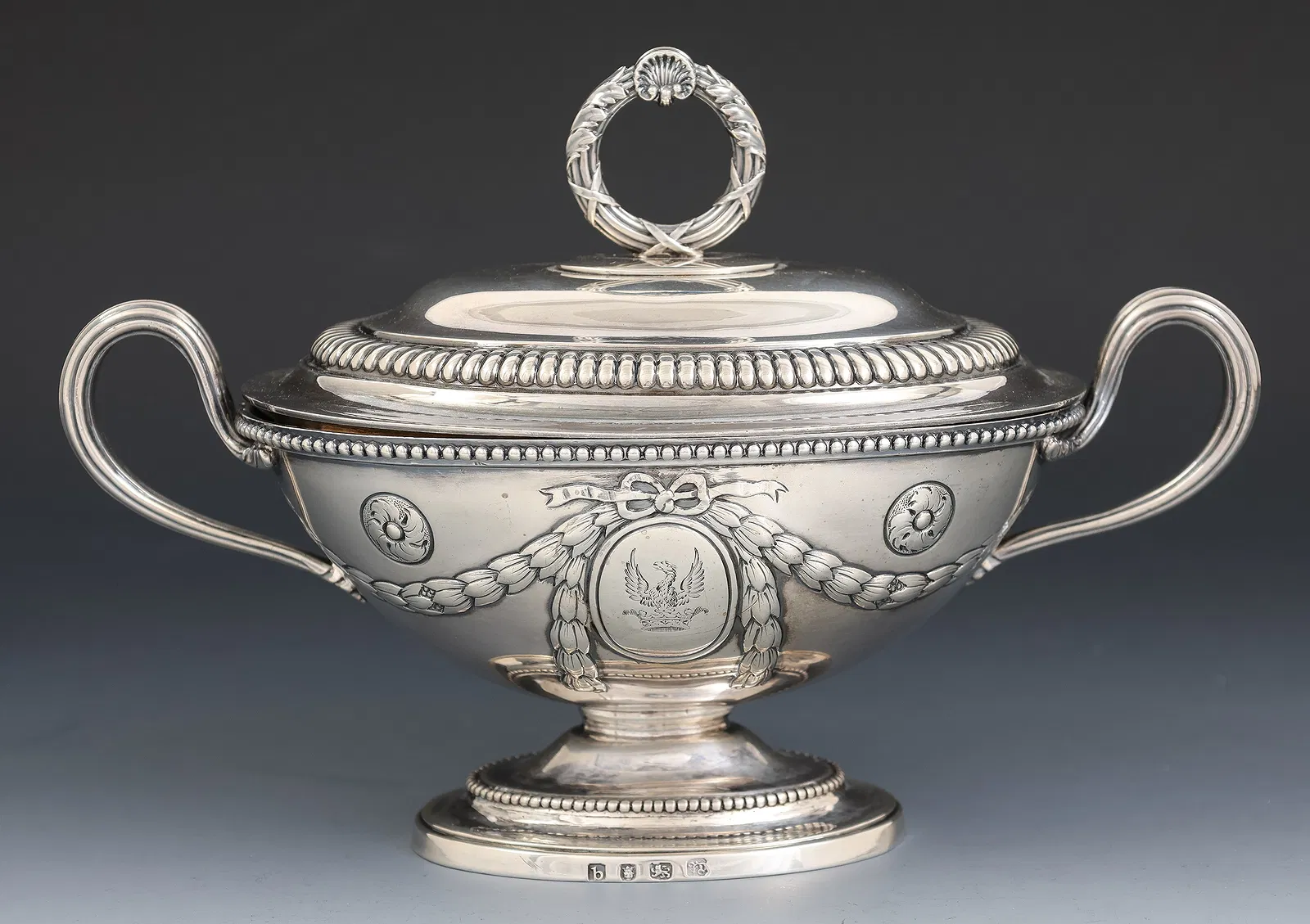
Here we have a rather handsome English George III Sterling Silver Covered Sugar Urn, assayed in London in 1777 — a refined table object made for the rituals of tea and sugar, and a reminder that even utility was elevated to elegance in the later 18th century. Its oval body, pedestal foot, and flowing scroll handles sit comfortably within the neoclassical vocabulary of the Georgian era. The decorative program is especially telling: beaded borders, laurel swags, oval reserves, and a wreath-form finial. The engraved crest — a phoenix-like bird rising above a crown or wreath — lends a note of heraldic distinction and suggests original ownership within a family of standing. The hallmarks on the foot are both clear and decisive. The crowned leopard head of London, lion passant of sterling standard, sovereign duty head, and the Roman lowercase date letter “b,” together with the maker’s mark “SH,” fix the assay year at 1777. The sequence is correct and period-consistent. Condition appears very good, with honest surface scratching and abrasion beneath the foot in keeping with age. The structure of lid, handles, and base appears visually sound. One important note concerns the interior, where an additional and incomplete group of marks appears, including a lion passant, duty head, and a different maker’s mark reading “PS.” The absence of a town mark and date letter in that interior strike, combined with the differing maker’s punch, introduces a question as to whether the interior component was separately marked, later repaired, or at some point married. While the principal 1777 hallmarks support period authenticity, this internal discrepancy tempers confidence and merits closer specialist scrutiny. Taking all into account, the piece presents as an attractive and stylistically correct 1777 London sterling sugar urn, with value appropriately moderated until the marking inconsistency is fully clarified.
Used for this report's TTS and avatar presentation.
Item Report
English George III Sterling Silver Covered Sugar Urn (London, 1777)
英国乔治三世时期伦敦1777年纯银带盖糖罐
Merge Reports: Yes (reconciled). Approval remains manual.
Dual hallmark sets with differing maker’s marks; further specialist examination recommended.
Style: George III Neoclassical silver
Origin: England (London assay)
Materials: Sterling silver
Age: 1777 (London assay year)
Condition: Very good (age-appropriate surface wear and scratching; hallmark discrepancy noted; no major structural damage visible)
Value: Auction estimate: approximately $900–1,800 given hallmark consistency on the foot and unresolved interior mark discrepancy.
Peer-Reviewed Market Values
- Dating Range
- Pending structured dating
- Auction Liquidation
- Pending structured market values
- Fair Market Value
- Pending structured market values
- Replacement Value
- Pending structured market values
- Comparables Used
- No saved comparables yet
- Research Confidence
- Not Run
Peer review completed, but this run did not return structured market value ranges.
Maker's Marks / Writing: Foot: London hallmarks including crowned leopard head, lion passant, duty head, Roman lowercase date letter “b” (1777), and maker’s mark “SH.” Interior: lion passant, duty head, and maker’s mark “PS,” without visible town mark or date letter. Engraved crest to front medallion.
Date: 2026-03-23 03:33:12.634976
Description:
An elegant oval-form covered sugar urn raised on a pedestal foot with double scroll handles and a domed lid surmounted by a wreath-form finial. The body is decorated with repoussé laurel swags, oval medallions, beaded borders, and an engraved crest depicting a phoenix-like bird above a crown or wreath. The foot bears a full and legible set of London hallmarks including a Roman lowercase date letter “b,” crowned leopard head town mark, lion passant sterling mark, sovereign duty head, and a maker’s mark “SH,” corresponding to the London assay year 1777. 此件椭圆形带盖糖罐立于高足座上,配双卷式把手与穹顶式盖,顶部饰花环形钮。器身饰有浮雕月桂花环、椭圆形纹章框与串珠边饰,正面刻有凤凰状徽记,下方似冠饰或花环。底足处可见完整伦敦银标记,包括小写罗马字母“b”年份字母、加冕豹头城镇标、行走狮纯银标、乔治三世税标及“SH”制作者标记,对应伦敦1777年检验年份。
Curator Questions
Curated by Jade
Assessment:
This is a handsome English George III sterling silver covered sugar urn assayed in London in 1777. The oval body, pedestal foot, twin scroll handles, and wreath finial belong squarely to the neoclassical vocabulary that dominated British decorative arts in the later 18th century. The decorative scheme—beaded borders, laurel swags, oval reserves, and an engraved crest featuring a phoenix-like bird—speaks fluently to Georgian taste. Surface wear, light scratching, and abrasion to the underside of the foot are consistent with age and use. The hallmarks on the foot form a complete and correct London sterling sequence: crowned leopard head (town), lion passant (standard), sovereign duty head, Roman lowercase “b” date letter, and maker’s mark “SH,” fixing the assay year at 1777. These marks are coherent and period-appropriate. However, a second and incomplete group of marks is present inside the body, including a lion passant, duty head, and a different maker’s mark reading “PS,” without a town mark or date letter. The coexistence of two differing maker’s marks and an incomplete internal strike raises questions about whether the interior component was separately marked, later altered, or married from another piece. While such situations are not unheard of in Georgian silver—particularly if components were repaired or replaced—they warrant caution. Accordingly, while the primary hallmark evidence supports an authentic 1777 London sterling example, the internal mark discrepancy tempers confidence and suggests further specialist examination would be advisable before any definitive maker attribution or premium valuation is assigned. 此件为1777年伦敦检验的英国乔治三世时期纯银带盖糖罐。其椭圆器身、高足座、双卷把手与花环形钮均体现18世纪后期英国新古典主义风格。 器身饰串珠边、月桂花环及椭圆纹章框,正面凤凰状徽记亦具时代特征。表面可见自然使用磨痕与底足磨损,符合年代特征。 底足处银标完整规范,包括加冕豹头、行走狮、税标、小写“b”年份字母及“SH”制作者标记,明确对应1777年伦敦检验年份。 但器内另见一组不完整标记,包括行走狮、税标及不同的“PS”制作者标记,缺少城镇标与年份字母。两组不同制作者标记并存,且内标不完整,增加了结构或后期更换部件的可能性。虽在乔治时期银器中偶有部件维修或更换情况,但此处仍需谨慎对待。 因此,尽管主要银标支持其为1777年伦敦纯银作品,内部标记差异降低了整体确定性,建议进一步专业检测后再行确定最终归属与估值。
Individual Images:
- Front view of sugar urn; detail of engraved crest; detail of wreath finial; interior and lid underside; close-up of foot hallmarks showing crowned leopard head
- lion passant
- duty head
- date letter “b
- ” and “SH”; close-up of interior marks showing lion passant
- duty head
- and “PS”; underside wear to foot.
Provenance:
No documentary provenance provided.
Condition:
Very good (age-appropriate surface wear and scratching; hallmark discrepancy noted; no major structural damage visible)
Identification Score: 96%
The form, decorative vocabulary, and complete London hallmark sequence on the foot clearly identify the object as a George III period covered sugar urn assayed in 1777. 器型、装饰风格及底足完整伦敦银标清楚表明其为1777年检验的乔治三世时期带盖糖罐。
Authenticity Score: 65%
The full and coherent 1777 London hallmark set on the foot strongly supports period sterling authenticity. However, the presence of a second, incomplete internal mark group with a different maker’s mark introduces uncertainty regarding component integrity, repair history, or possible marriage, and meaningfully reduces overall confidence pending further examination. 底足处完整且一致的1777年伦敦银标有力支持其为时期纯银器。但内部另有不同制作者标记且标记不完整,增加了部件更换或后期组合的可能性,在未进一步检测前整体真实性需持保留态度。
Image Memory Note
Primary date established from foot hallmark sequence as London 1777. 主要年份依据底足伦敦银标确认为1777年。
Keywords
George III, 1777, London hallmark, sterling silver, covered sugar urn, neoclassical, laurel swag, wreath finial, engraved crest, SH maker's mark 乔治三世, 1777年, 伦敦银标, 纯银, 带盖糖罐, 新古典主义, 月桂花环, 花环钮, 雕刻徽记, SH制作者标记
Peer Review Summary
Peer Review
Key Visible Evidence
The object is an oval-form covered sugar urn with a pedestal foot, double scroll handles, and a domed lid topped with a wreath-form finial (Image 1, 3, 6). The body is decorated with repoussé laurel swags, oval medallions, and an engraved crest featuring a phoenix-like bird on a crown or wreath (Image 2). Beaded borders are present on the lid and foot. Surface wear, including light scratching and polishing marks, is visible across the silver, consistent with age and use (Image 1, 4, 6, 8). The underside of the foot shows abrasion (Image 8). Crucially, two distinct sets of hallmarks are visible. On the foot (Image 5), a full set of London hallmarks is present: a Roman lowercase 'b' date letter in a square cartouche, a crowned leopard head (town mark), a lion passant (sterling standard mark), a sovereign/duty head (King George III), and a maker's mark 'SH' in a rectangular punch. On the interior of the urn (Image 7), a different, incomplete set of marks is visible: a sovereign/duty head, a lion passant, and a maker's mark 'PS' in a rectangular punch. The interior marks lack a date letter and a town mark, and the maker's mark is different from that on the foot.
Market and Source Support
The hallmarks on the foot (Image 5) indicate English sterling silver from the London assay office. The presence of a crowned leopard head signifies a date prior to 1822. The duty head (King George III) confirms a date between 1784 and 1822. The Roman lowercase 'b' date letter, when cross-referenced with the London sterling hallmark table, yields two possible years: 1777 or 1817. The combination of a crowned leopard head and a duty head further narrows the possibilities to these two years. The report's dating of 'circa 1780–1800' aligns more closely with the 1777 date. **Hallmark Lookup Trace (Image 5 - Foot):** - Observed: Roman lowercase 'b'. - Table candidates: 1737, 1777, 1817, 1897. - Eliminations: 1897 (due to crowned leopard head pre-1822). - London tie-breakers: Crowned leopard head (visible) + Duty/sovereign head (visible) => 1784-1822. This confirms 1777 and 1817 as possibilities. - Final candidates: 1777 or 1817. **Metal Standard Trace (Image 5 - Foot):** - Official hallmark symbols seen: Lion passant, crowned leopard head, duty head, date letter 'b'. - Sterling sequence satisfied: Yes. - Plate-only indicators seen: No. - Final metal-standard conclusion: Sterling. The maker's mark 'SH' (Image 5) could correspond to silversmiths such as Simon Harris (registered 1795, mark seen 1808) or Solomon Hougham (registered 1793, mark seen 1800), both active in London during the plausible date range of 1777 or 1817. The interior marks (Image 7) present a significant inconsistency. While the lion passant and duty head confirm sterling silver and a date between 1784-1890, the absence of a town mark and date letter, coupled with a different maker's mark 'PS', is highly unusual for a single, authentically hallmarked piece. Maker's marks 'PS' are associated with various silversmiths, including Paul Storr, but the visible mark does not match known Paul Storr marks (which often appear in conjoined circles).
Needs Verification
The primary concern is the discrepancy between the hallmarks on the foot (Image 5) and the interior (Image 7). Further investigation is needed to determine if these marks belong to the same object, or if one set is a later addition, a reproduction mark, or if the interior marks are partial and from a different component. Macro photography of both sets of marks would be beneficial to confirm the exact characters and cartouche shapes, especially for the 'SH' and 'PS' maker's marks, and to ascertain if any other faint marks are present in the interior. Research into the specific working periods and registered marks of potential 'SH' and 'PS' makers active in London during 1777 and 1817 would help resolve the maker attribution and potentially narrow the date. UV/blacklight examination could reveal any repairs, alterations, or additions to the silver that might explain the inconsistent marking.
Audit Conclusion
The report's assessment of the object as an 'English George III Period Sterling Silver Covered Sugar Urn' with 'neoclassical decoration' is largely supported by visual evidence and the primary hallmarks on the foot (Image 5). The date range of 'circa 1780–1800' is plausible, with the foot hallmarks pointing specifically to 1777 or 1817. However, the report's failure to acknowledge and address the significant discrepancy between the hallmarks on the foot ('b', crowned leopard head, lion passant, duty head, 'SH') and the interior (duty head, lion passant, 'PS') is a critical oversight. This inconsistency raises serious questions about the object's overall authenticity and the integrity of its hallmarking. The report's 'authenticity score' of 82% appears overly confident given this unresolved issue. While the form and style are period-correct, the conflicting marks necessitate a more cautious assessment of authenticity and a re-evaluation of the value estimate, particularly the higher end, until the hallmark discrepancy is fully explained.
Comparables (Similar Items)
No archived comparables matched this report yet.
Share: