Portuguese Baroque Style Walnut High-Back Caned Side Chairs (Pair)
LANGUAGE UNLOCK
Glossary Roundup
Original Presentation Script
No narration for this appraisal report
Used for this report's TTS and avatar presentation.
Item Report
Portuguese Baroque Style Walnut High-Back Caned Side Chairs (Pair)
By:Unknown workshop
Style:Iberian/Portuguese Baroque Revival after Dom João V models
Origin:Portugal (Iberian Peninsula)
Materials:Walnut (likely European walnut) with rattan cane; pegged mortise-and-tenon joinery
Age:Circa 1880–1910 (revival of early 18th-century Portuguese forms)
Condition:Fair to Good (replaced cane with breaks, surface wear, scattered wormholes, old repairs and looseness to joints)
Value:$300–700 (pair, auction estimate)
Maker's Marks / Writing:None observed
Date:2025-10-31 16:00:41.295561
Description:
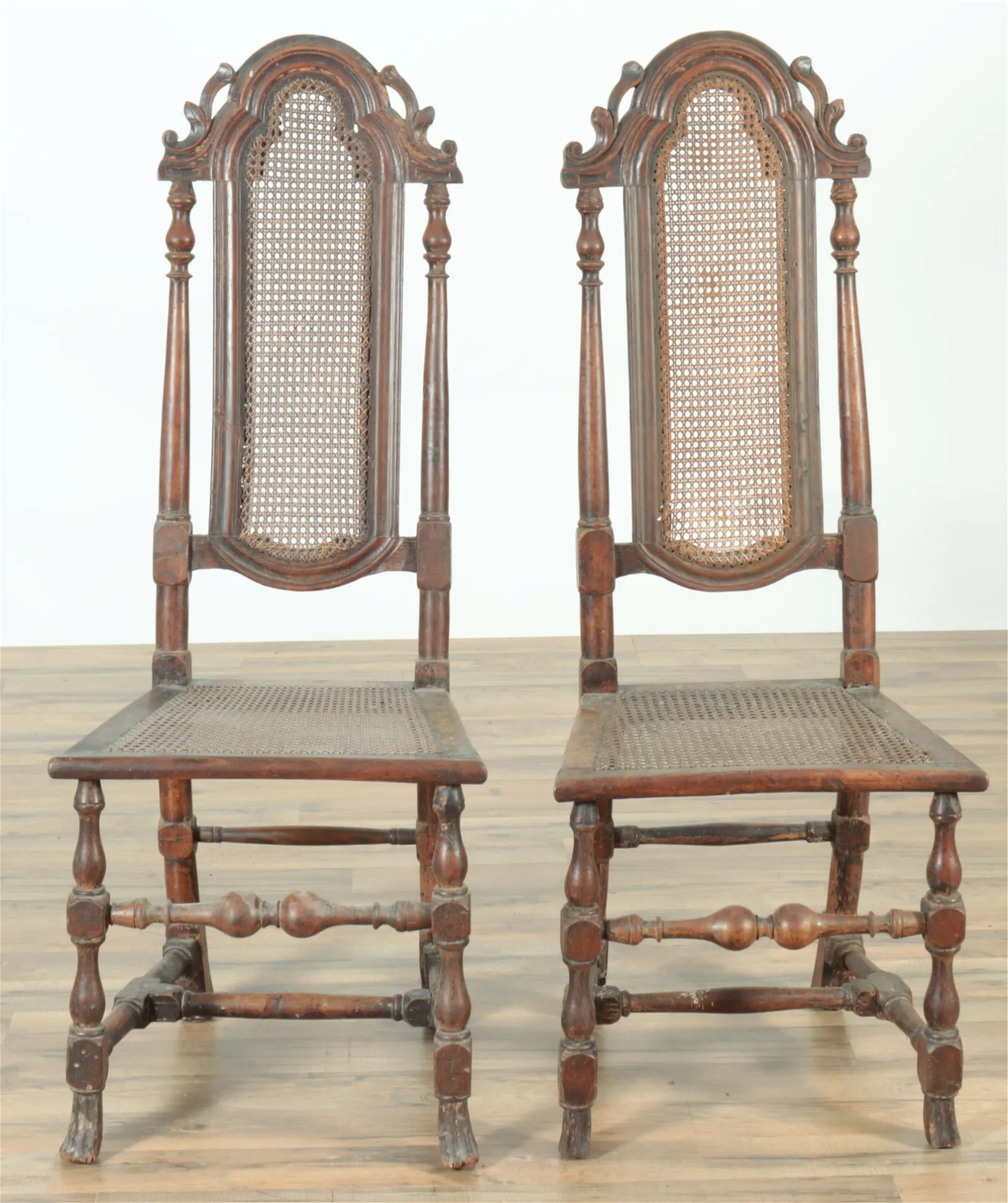
A matched pair of tall, high-back side chairs with arched and scrolled cresting, narrow caned back panels, and caned seats. Block-and-baluster turned front legs with an urn/bulbous front stretcher, side and rear stretchers, and square-block joints typical of Iberian work. Rich oxidized surface with scattered worming, old repairs, and replaced cane.
Curator Questions
Curated by Jade
Assessment:
These are good decorative examples of the Portuguese Baroque look, with tall caned backs and the characteristic bulbous front stretcher. The uniformity of the turning, overall symmetry, and general construction suggest late 19th–early 20th century revival manufacture rather than 1700s period chairs. Cane appears replaced and there are typical age-related repairs and worming to the walnut. A word about fakes.. Iberian Baroque chairs are widely reproduced; period examples show hand-turned asymmetries, more irregular carving, and earlier pegs or wedges; be cautious of overly uniform turning and fresh cane.
Individual Images:
none
Provenance:
Not provided
Condition:
Fair to Good (replaced cane with breaks, surface wear, scattered wormholes, old repairs and looseness to joints)
Identification Score: 85%
High confidence in the Iberian/Portuguese Baroque type based on the scrolled crest, tall narrow caned back, bulbous front stretcher, and block-and-baluster legs. Exact dating cannot be certain from the photos, but features align with revival production.
Authenticity Score: 30%
Low likelihood of being early 18th-century period pieces: the pair is closely matched with highly uniform turnings, consistent proportions, and later caning; overall suggests c. 1880–1910 revival manufacture. A word about fakes.. this category is heavily reproduced, often using distressed finishes and added worming—look for hand-cut asymmetry, early tool marks, and period pegs to confirm true 1700s examples.
Image Memory Note
None
None
Keywords
Portuguese Baroque Style, Iberian, caned chair, walnut, high-back chair, Dom João V style, 19th century revival, Portugal
The report was edited after initial Artmink draft. Original AI draft preserved in Artmink audit history.

Share: