American Classical / Empire Style Carved Mahogany Pedestal Card Table
LANGUAGE UNLOCK
Glossary Roundup
Original Presentation Script
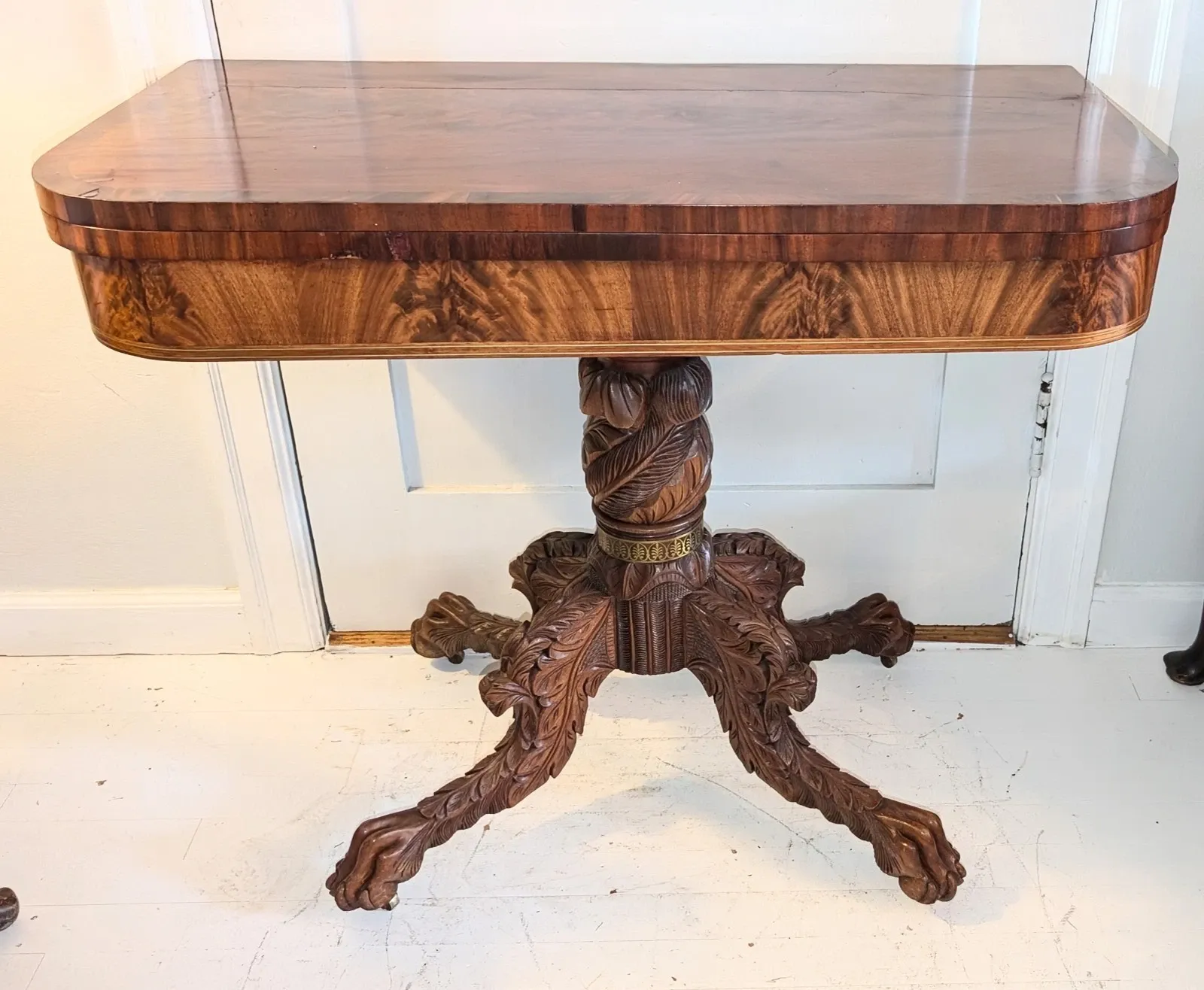
Let’s talk about this American Classical / Empire Style Carved Mahogany Pedestal Card Table — a wonderfully theatrical little stage for cards, tea, or display.
At first glance, it could have waltzed out of an 1830s New York parlor: rich mahogany veneer, a fold-over top, and that exuberant pedestal wrapped in leaves and rope, stomping the floor on four muscular paw feet.
Historically, this language is pure American Classical — the young republic translating ancient Rome into furniture. Collectors prize such forms as emblems of early 19th‑century ambition.
But the details tell a subtler story. The carving is very crisp and regular, the brass collar is clearly machine-made, and the underside joinery lacks the tool marks and hand-cut irregularities of the 1820s–30s shops. This is a later homage, likely 1880–1910, when Americans nostalgically revived the Empire look.
Condition is honest: veneer checking and light sun-fade to the top, age cracks in the carved base, some wear at the casters — all consistent with a century-plus of use, but not two.
On authenticity, I’d place this at about 25% for being true Classical period, and 75% likely Empire Revival. As such, its auction value would reasonably fall in the $600–$1,200 range, versus several thousand for a documented 1830s example.
Still, it offers big style for the money — a little burst of American grandeur that doesn’t require a Gilded Age budget.
Used for this report's TTS and avatar presentation.
Item Report
American Classical / Empire Style Carved Mahogany Pedestal Card Table
Materials:Mahogany veneer and solid mahogany with secondary softwood; brass inlaid decorative band; metal casters
Age:Circa 1880–1910 (late 19th to early 20th century, Empire Revival rather than early 19th-century period)
Condition:Good (surface wear, veneer shrinkage and checking to top, age cracks to carved base, but generally stable and presentable)
Value:If authentic early Classical period c. 1825–1840: $2,500–$4,500 at auction. As a late 19th/early 20th century Empire Revival table (most likely): $600–$1,200 at auction.
Maker's Marks / Writing:No maker’s mark or inscription visible in the provided images.
Date:2025-12-07 04:56:50.931300
Description:
Single-pedestal fold-over card table with rectangular rounded-corner top in figured mahogany veneer over a secondary wood core. The base features an elaborate carved pedestal wrapped with foliage and rope motifs, resting on four heavily carved acanthus and paw feet on small casters. A brass inlaid decorative collar encircles the pedestal. The top swings and folds open to form a larger playing surface.
Curator Questions
Curated by Jade
Assessment:
This is a richly carved American Classical / Empire Revival pedestal card table, drawing inspiration from high-style New York and Philadelphia Classical examples of the 1825–1840 period. The vigorous acanthus and paw-foot carving, rope-twist pedestal, and brass-inlaid collar echo the exuberant taste of the American Empire aesthetic. Construction details, however—machine-cut regularity to the carving, the look of the brass band, and the underside joinery and secondary woods—point to a later 19th- or very early 20th-century revival rather than a true Classical-period piece. The top shows honest wear, veneer shrinkage and checking, and the base exhibits age cracks but no obvious recent fabrication tricks. As a decorative Empire Revival table, it’s handsome and usable, though not a museum-grade early Classical example. A word about fakes.. Empire and Classical furniture have been heavily reproduced since the Centennial era, so one must always separate true 1820s work from later homages; this piece, while well made, sits firmly in the latter camp. I put my John Hancock on this opinion!
Individual Images:
none
Provenance:
Not provided.
Condition:
Good (surface wear, veneer shrinkage and checking to top, age cracks to carved base, but generally stable and presentable)
Identification Score: 92%
Form, folding mechanism, and carving vocabulary clearly identify it as an American Classical/Empire-type card table on a single carved pedestal; only the exact maker and workshop remain uncertain.
Authenticity Score: 25%
While the design is modeled closely on authentic 1825–1840 American Classical card tables, the machining, highly regular carving, and construction under the top suggest a later Empire Revival manufacture (c. 1880–1910) rather than a period piece; thus I assume reproduction until proven otherwise.
Image Memory Note
None
None
Keywords
American Classical, Empire Revival, card table, pedestal table, mahogany, 19th century, United States, antique furniture
The report was edited after initial Artmink draft. Original AI draft preserved in Artmink audit history.

Share: