English Late Restoration Period Walnut and Caned High-Back Chairs (Pair)
LANGUAGE UNLOCK
Glossary Roundup
Original Presentation Script
I am pleased to present a pair of English Late Restoration Period Walnut and Caned High-Back Chairs — a sophisticated relic from a bygone era, evoking the grandeur of late 17th-century England. These chairs stand as timeless sentinels of taste, with their commanding high backs and intricate caned artistry sparking a dance of silhouettes and shadows in any refined setting.
Originating between 1680 and 1700, these chairs bear witness to the stylistic transition from the opulent Restoration period to the more restrained William & Mary era. Their dramatic crest rails and turned elements echo the boldness of Restoration style, capturing the essence of an era marked by artistic revival and cultural reconnection.
The use of solid walnut, coupled with meticulous hand-caned panels, reveals the mastery of their unknown craftsman. The material choice is as much about endurance as it is about aesthetic indulgence, with the walnut's rich patina telling tales of time passed, while the caning, woven by hand, celebrates the artisan's touch in every reed.
Close examination reveals the ravages of time — visible on the block-form feet and the hand-caned seats, showing wear and considered restorations. The caning's losses speak to the chairs' authentic journey through the centuries, adding a layer of character rather than diminishing their worth.
With an authenticity score of 90%, these chairs are genuine period examples, untouched by modern mimicry. Their auction value is estimated between $1,800 and $3,200, a worthy sum for collectors and connoisseurs alike. In the realm of antiques, such estimations serve not just as a monetary marker but as a testament to their enduring allure in an ever-evolving marketplace. Indeed, these chairs quietly assert their place as storytellers of history, embodying the grace and resilience of the era they represent.
Used for this report's TTS and avatar presentation.
Item Report
English Late Restoration Period Walnut and Caned High-Back Chairs (Pair)
By:Unknown
Style:Restoration / William & Mary
Origin:England
Materials:Walnut wood, hand-caned reed
Age:Circa 1680-1700
Condition:Fair to Good (heavy wear, losses to caning, old repairs)
Value:$1,800–$3,200 (pair, at auction)
Maker's Marks / Writing:No visible maker's marks or inscriptions apparent.
Date:2025-07-10 12:15:09.160761
Description:
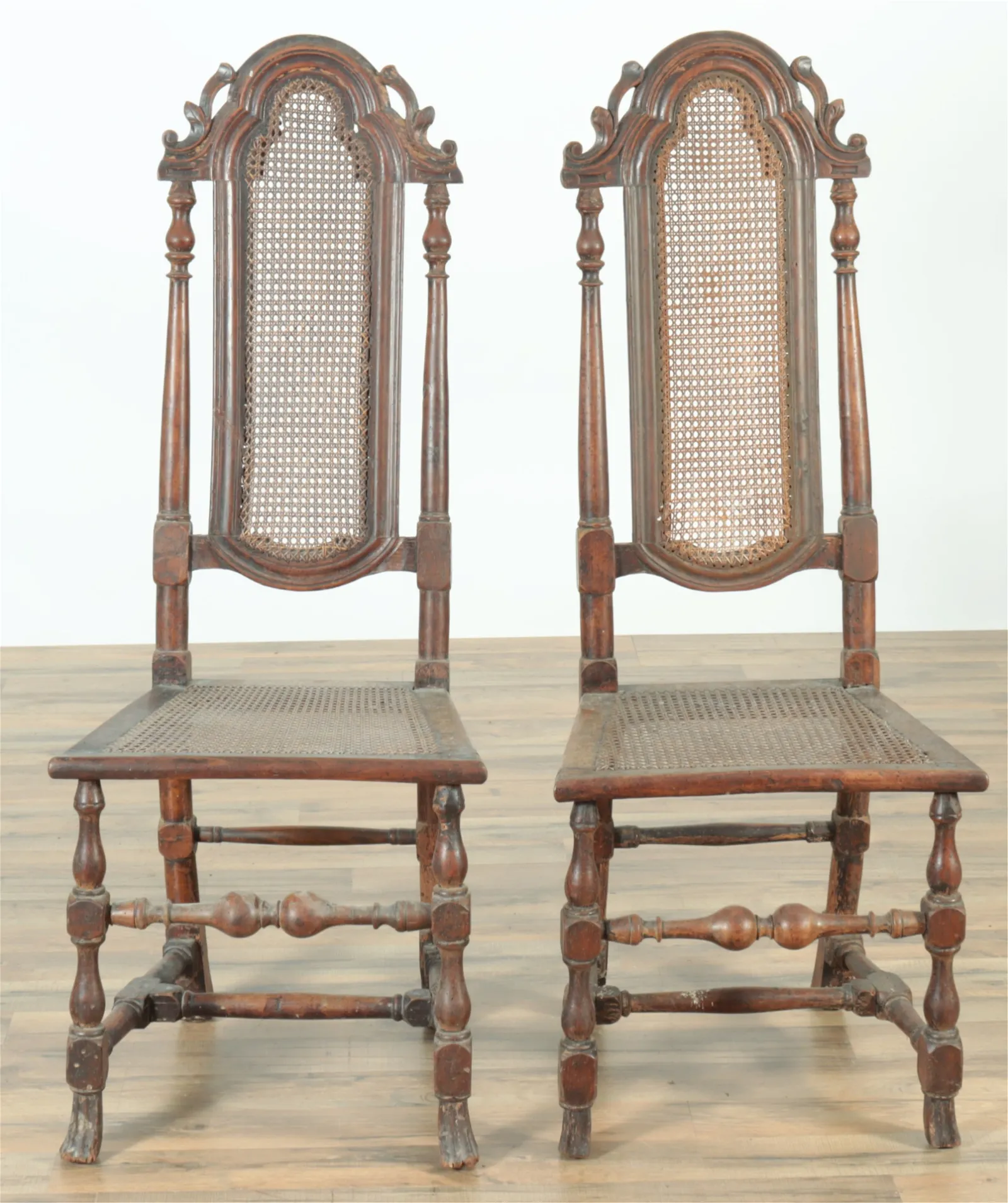
A matched pair of high-back side chairs dating to the late English Restoration period, circa 1680-1700. Each chair is constructed from solid walnut with turned legs, stretchers, and finial uprights. The high arched backs and seats feature hand-caned panels. The crest rails are dramatically arched and scrolled, a signature of the Restoration style. Feet are block-form, showing heavy wear consistent with great age. Some losses to the caning and age-appropriate repairs are noted.
Curator Questions
Curated by Jade
Assessment:
A highly characteristic pair of English high-back side chairs from the late 17th century. The forms, turned elements, and hand-caned backs confirm the period. Surface wear, patina, and evidence of hand construction attest to authentic age. Early caned chairs of this form remain highly desirable among collectors and decorators.
Individual Images:
There are no additional images provided beyond the main image. Notable details in the main image include: caning losses in both seat and back panels
turned front stretchers with heavy wear
and color variation due to age and use. Feet and stretchers (especially the right chair) show some unevenness and possible past repairs.
Provenance:
No provenance documentation is provided.
Condition:
Fair to Good (heavy wear, losses to caning, old repairs)
Identification Score: 98%
The style, construction method, and wear clearly identify these as late Restoration or early William & Mary English caned chairs. The proportion, turned stretchers, and arched crest rails are distinctive features of the period.
Authenticity Score: 90%
The deep patina on the walnut, hand-tied caning (with losses and age-wear), turned elements, and overall wear support the conclusion that these are genuine period examples. No clear signs of modern reproduction are apparent, though minor old repairs to the caning and frame are visible.
Image Memory Note
The image shows a matched pair of high-back side chairs constructed of dark walnut. Each chair has an arched, scrolled crest rail with finial forms, and double columnar stiles leading to a hand-caned back panel framed within an arched molding. Chair seats are also caned, showing visible wear and some broken areas (particularly on the right chair). Both seats and backs are caned in a typical period pattern. Legs are turned and connected by four stretchers, with the front stretchers being bulbous. Feet are block shaped, with some abrasion and color loss at the contact points. No visible writing, labels, or makers' marks. Both show age-appropriate surface patina and some evidence of old repairs at joints and caned areas.
Keywords
Restoration, William & Mary, English, antique chairs, 17th century, walnut, caned furniture, high-back, period, England
The report was edited after initial Artmink draft. Original AI draft preserved in Artmink audit history.

Share: