William & Mary Style Walnut Caned High-Back Side Chairs (Pair)
LANGUAGE UNLOCK
Glossary Roundup
Original Presentation Script
No narration for this appraisal report
Used for this report's TTS and avatar presentation.
Item Report
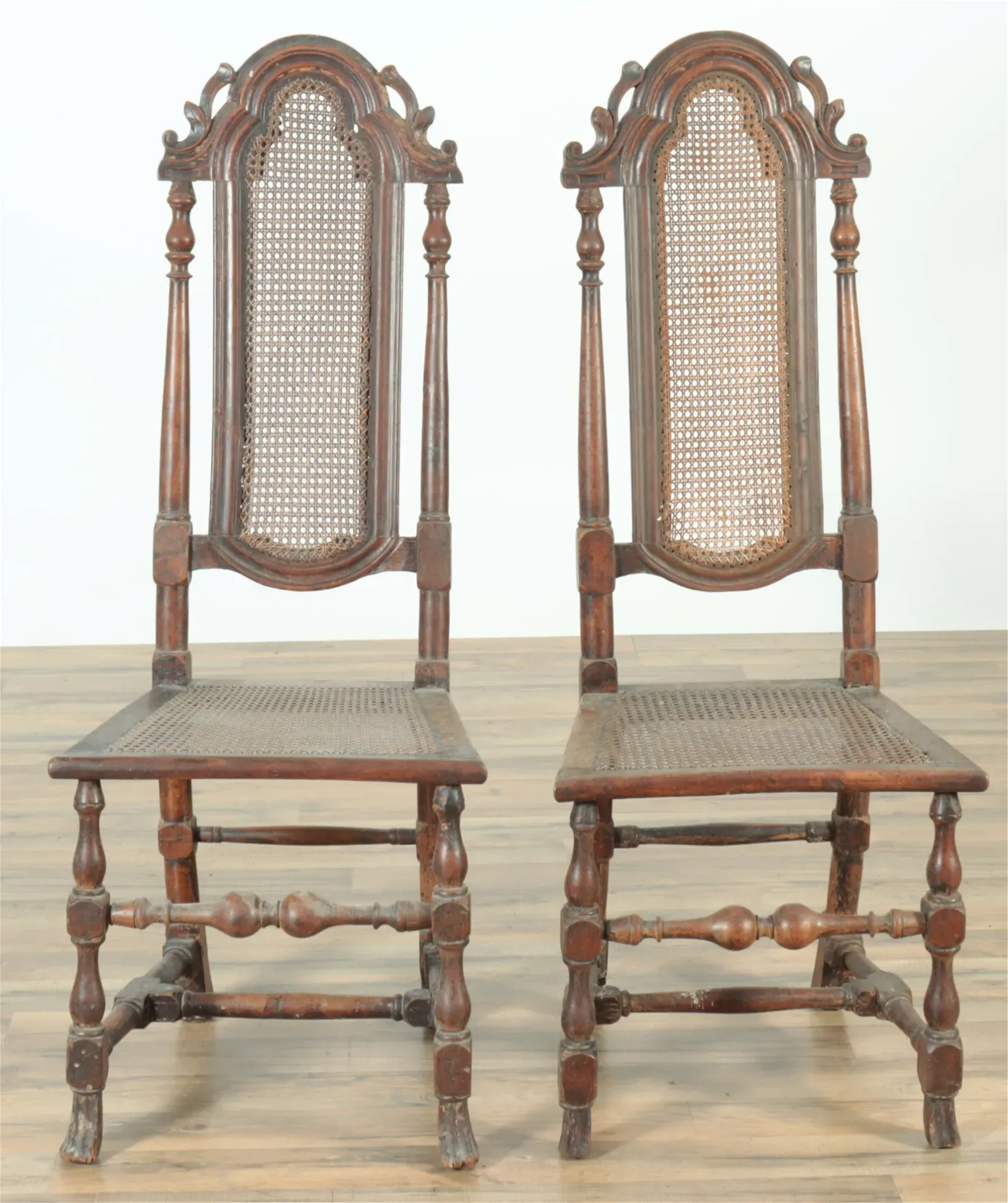
William & Mary Style Walnut Caned High-Back Side Chairs (Pair)
By:Unknown cabinetmaker
Style:Baroque / William & Mary revival, seating furniture
Origin:England or the Low Countries (Anglo‑Dutch tradition)
Materials:Walnut (frames), rattan cane (seat and back), iron/brass repair plates and slotted screws
Age:Circa late 19th century (1870–1900) in the William & Mary style; could incorporate earlier elements
Condition:Fair (extensive wear and worming, damaged/collapsed caning, cracked seat rails, losses to turnings, later metal repair plates and screws)
Value:$400–$1,200 (pair, auction estimate reflecting condition and style vs. period uncertainty)
Maker's Marks / Writing:No maker’s marks observed.
Date:2025-10-18 00:53:56.706099
Description:
A matched pair of high-back side chairs in the Anglo‑Dutch William & Mary taste, each with an arched and scrolled cresting rail, tall caned back panel, caned seat, baluster-turned front legs and stretchers with a pronounced bulb to the front stretcher, and Spanish feet. Old reddish-brown surface with heavy wear and scattered worming; later repairs noted.
Curator Questions
Curated by Jade
Assessment:
These are convincing William & Mary style caned side chairs with many 17th‑century design cues: tall arched backs with scrolled ears, baluster turnings, H-stretchers and Spanish feet. Surface oxidation, shrinkage, losses and pervasive worming suggest genuine age, but later screws, repair plates, and likely replaced cane point to significant restoration and/or later manufacture in the 19th‑century revival period. A word about fakes.. Cane-back Baroque chairs are often reproduced; judge authenticity by tool marks, oxidation, irregular hand-turnings, and old worming versus artificially made holes.
Individual Images:
none
Provenance:
Not provided.
Condition:
Fair (extensive wear and worming, damaged/collapsed caning, cracked seat rails, losses to turnings, later metal repair plates and screws)
Identification Score: 90%
Form, cresting profile, caned back/seat, baluster legs, H-stretcher with bulbous front element, and Spanish feet align closely with Anglo‑Dutch William & Mary caned chairs. High confidence on the type, lower on the exact period.
Authenticity Score: 55%
Heavy patina, oxidation, and old worming support age, but the presence of later screws/plates and replaced cane suggest a 19th‑century revival pair rather than pure period c.1690. Without underside joinery and tool-mark inspection, I remain conservative. A word about fakes.. This category is frequently copied; artificially aged wormholes and uniform machine turnings are red flags.
Image Memory Note
None
None
Keywords
William & Mary style, Baroque, caned chair, Spanish foot, Anglo-Dutch, walnut, England, Low Countries, 19th-century revival, pair of side chairs
The report was edited after initial Artmink draft. Original AI draft preserved in Artmink audit history.

Share: