
George : English Fine and Decorative Arts
George Presents

Original Presentation Script
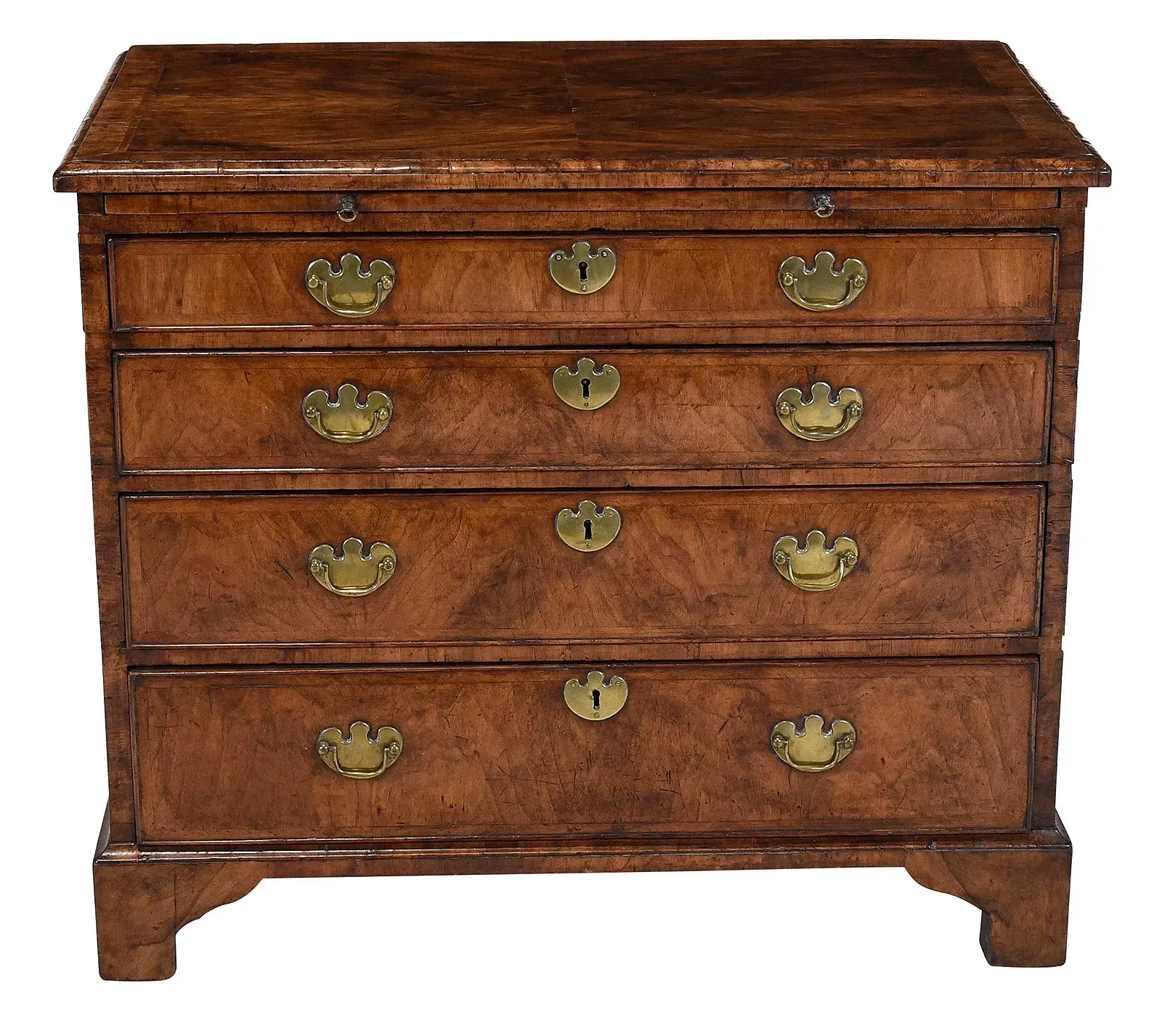
Here we have a handsome English George II Period Walnut Bachelor's Chest, a compact and deeply practical form made for refined 18th-century domestic life. Its neat scale, brushing slide, and four graduated drawers announce a piece designed for both storage and daily use. This chest sits comfortably in the Georgian tradition, likely around 1730 to 1750. The proportions are right, the quarter-veneered top is classic, and the bracket feet give it that sober, architectural poise collectors love. These small walnut chests have long been desirable because they marry elegance with utility. The materials and craftsmanship are particularly telling. The figured walnut veneers, featherbanded drawer fronts, and hand-cut dovetails visible at the drawer side all point toward genuine 18th-century work rather than a later revival copy. The brushing slide is another strong period feature. Brass batwing handles and escutcheons are appropriate, though they may be later replacements or at least later polished. Condition is honest and pleasing: surface scratches, veneer shrinkage, edge wear, and a mellow patina all suggest real age. The back appears darkened and plain, as one would expect, and there may have been light restoration over the years, which is normal rather than alarming. A word about copies.. Georgian walnut chests are heavily reproduced, so caution is essential. Still, this example passes the fakery check rather well. Authenticity score: 82%. Conservative auction estimate: $2,500 to $5,500 if authentic; perhaps $400 to $1,000 if later. A fine, quietly authoritative survivor... Charles here, signing off: Let the Mink have a Think!
Used for this report's TTS and avatar presentation.
Item Report
English George II Period Walnut Bachelor's Chest
By: Unknown
Style: George II period English furniture
Origin: England
Materials: walnut veneers on oak and secondary woods, brass hardware
Age: circa 1730-1750
Condition: Good (honest age wear, likely minor restoration, hardware possibly replaced, no major structural failure visible)
Value: Auction estimate if authentic: $2,500-$5,500 USD; if a later reproduction: $400-$1,000 USD
Peer-Reviewed Market Values
- Dating Range
- Pending structured dating
- Auction Liquidation
- Pending structured market values
- Fair Market Value
- Pending structured market values
- Replacement Value
- Pending structured market values
- Comparables Used
- No saved comparables yet
- Research Confidence
- Not Run
Peer review completed, but this run did not return structured market value ranges.
Maker's Marks / Writing: Chalk or inventory number visible on back, appears to read '2043'; no maker's label seen.
Date: 2026-03-14 21:35:08.832620
Description:
A small English walnut bachelor's chest with four long graduated drawers, a brushing slide above the top drawer, brass batwing handles and escutcheons, quarter-veneered top, featherbanding, and bracket feet. The sides are veneered in figured walnut, and the overall surface shows honest age, wear, and patina consistent with an 18th-century case piece.
Curator Questions
Curated by Jade
Assessment:
This appears to be an authentic English George II period bachelor's chest rather than a modern reproduction. The form, proportions, veneering, bracket feet, brushing slide, and especially the visible drawer dovetails and accumulated wear all support 18th-century origin. The brass handles and escutcheons may be replacements or later polished, but they are appropriate in type. The dark-stained backboard and some expected minor restoration or refinishing do not negate age. A word about copies.. English walnut chests of early Georgian type have been widely reproduced, especially in the late 19th and 20th centuries, so one must be strict; here, however, the construction and worn veneer edges read convincingly old. Fakery check: the top does not look artificially distressed, the side veneers show genuine shrinkage and abrasions, and the drawer joinery appears hand-cut rather than machine-perfect.
Individual Images:
- front chest
- whole chest three-quarter view
- detail of drawer dovetails
- top with brushing slide open
- back chest three-quarter view
- side view of chest
- whole chest three-quarter view
- whole chest three-quarter view
- detail of side wear
- detail of brass batwing handles
- detail of bracket foot
- detail of bracket foot
Provenance:
No documentary provenance provided in the images.
Condition:
Good (honest age wear, likely minor restoration, hardware possibly replaced, no major structural failure visible)
Identification Score: 95%
The chest is readily identifiable from its classic bachelor's chest form: compact proportions, brushing slide, four long drawers, bracket feet, and walnut veneering typical of George II English furniture.
Authenticity Score: 82%
The score is fairly strong because the visible hand-cut dovetails, surface wear, veneer cracking and shrinkage, side construction, and overall mellow patina support period authenticity. I stop short of a higher score because the hardware may not all be original and only exterior views are provided, without underside or interior case details.
Image Memory Note
None None
Keywords
English, George II period, walnut bachelor's chest, Georgian chest, brushing slide, bracket feet, featherbanding, brass batwing handles
Peer Review Summary
Peer Review
Key Visible Evidence
1) Supported by Visible EvidenceThe images strongly support the claims regarding the chest's form, proportions, and features, including the compact bachelor's chest design, four graduated drawers, and the presence of a brushing slide (Image 4). The walnut veneers, including the quarter-veneered top and featherbanding, are clearly visible. Evidence of honest age, wear, and patina, such as surface scratches, veneer shrinkage, and edge wear, is apparent across multiple images (e.g., Image 9, Image 3). Crucially, Image 3 provides a clear view of hand-cut dovetails on the drawer side, directly supporting the claim of 18th-century construction and refuting machine-cut joinery. The bracket feet are consistent with the George II style (Images 11, 12). The dark-stained backboard with a chalk mark '2043' is visible in Image 5.2) Supported by Grounded SourcesThe comparables found (all George II walnut bachelor's chests, mid-18th century, circa 1740) provide robust external validation for the appraiser's dating of circa 1730-1750 and the overall style attribution. The consistent features across these documented examples, such as the brushing slide, bracket feet, and quarter-veneered tops, reinforce the authenticity assessment of the subject item. The realized prices of the comparables, ranging from approximately $1,989 to $4,875 USD, fall squarely within the appraiser's estimated range of $2,500-$5,500 USD for an authentic piece, lending strong support to the value estimate.3) Uncertain / Needs Dealer VerificationThe report's assessment that the brass batwing handles and escutcheons "may be replacements or later polished" is a reasonable observation. While the hardware is appropriate in type (Image 10), the images alone do not provide definitive evidence to confirm originality or the extent of any later polishing or replacement. A physical inspection would be necessary to examine for ghosting, original pinholes, or differences in patination. Similarly, the extent and nature of any "minor restoration or refinishing" mentioned in the report cannot be fully ascertained from the provided images. The absence of detailed underside or interior case views, as noted by the appraiser, limits a complete assessment of all construction elements and secondary woods.4) Auditor Take (Dealer as Final Judge)The appraiser's report is comprehensive and well-reasoned. The claims regarding the chest's George II period, walnut materials, bachelor's chest form, and key construction details like hand-cut dovetails are strongly supported by both the visible image evidence and the provided grounded comparables. The assessment of honest age and wear is consistent with the visual evidence. The value estimate for an authentic piece is well-corroborated by recent auction results for highly similar items. The authenticity score of 82% is appropriate, reflecting strong indicators of age and construction while acknowledging the limitations of image-based assessment for hardware originality and full interior details. The identification score of 95% is fully justified. The report provides a solid foundation for understanding this piece.
Comparables (Similar Items)
No archived comparables matched this report yet.
Share: