Jade : Chinese Fine and Decorative Arts
Jade Presents

Original Presentation Script
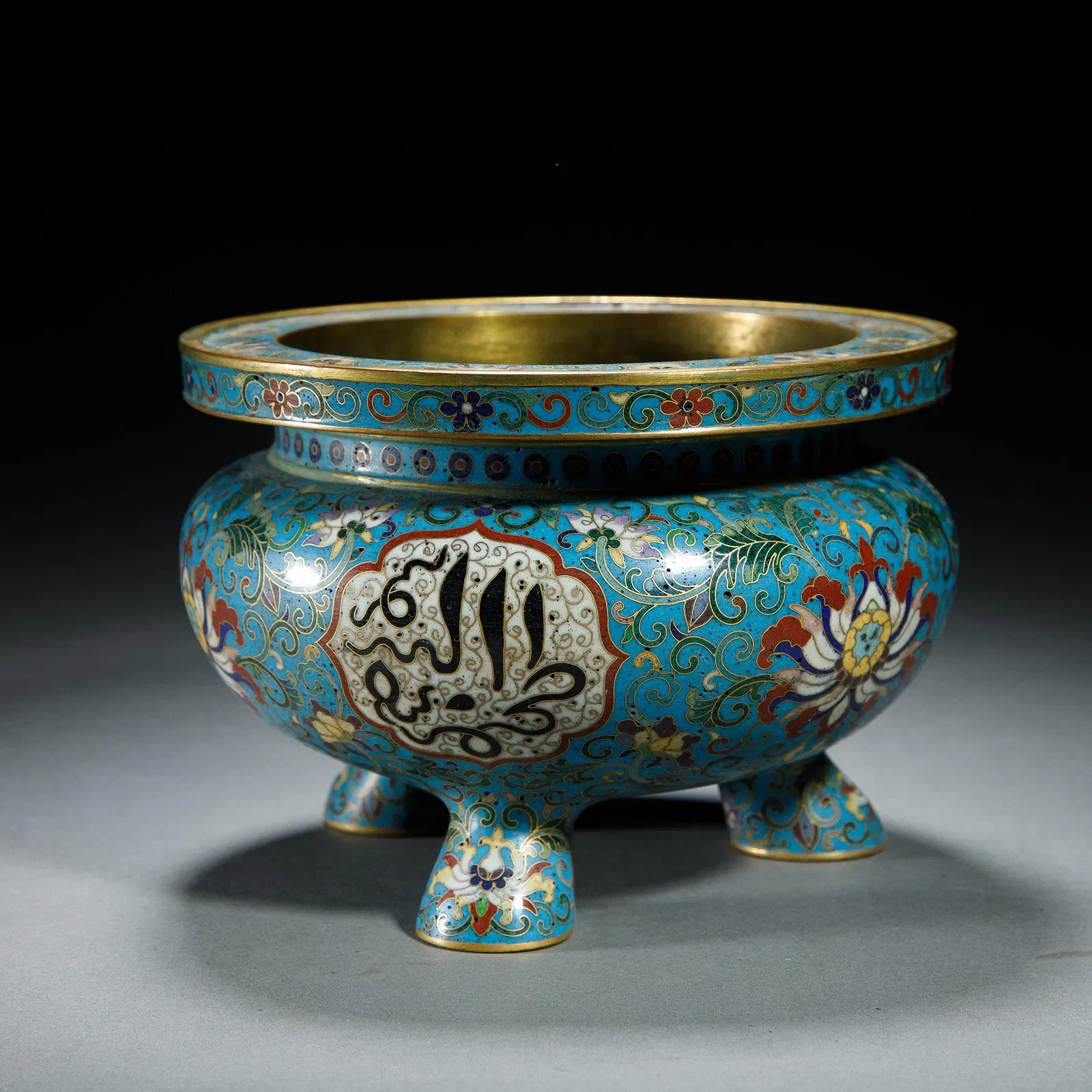
Here we have a Chinese Qing Style cloisonné enamel tripod censer — a handsome, jewel-like object that sits somewhere between ritual vessel and decorative tour de force. Its rounded body, flared mouth, and three stout feet follow the long Chinese incense-burner tradition, while the turquoise ground and scrolling florals give it immediate visual sparkle. What makes it especially interesting are the white reserve panels with stylized Arabic script, a nod to the Islamic taste that influenced certain Chinese export and courtly decorative arts. That cross-cultural flair is real enough as a design language, and collectors do respond to it. The body appears to be brass or copper alloy, overlaid with cloisonné wires and filled with colored enamels. The workmanship is competent and attractive, though not quite at the sublime level one expects from truly early imperial masterpieces. The foot pads, rim treatment, and enamel regularity all suggest a later production. Condition looks generally solid, with expected surface wear and some minor age-related rubbing. I do not see obvious catastrophic losses from these photos, though the images are not close enough to exclude small restorations. Now, the important part: the base bears a Xuande mark — and that is precisely where caution begins. Xuande-marked cloisonné is one of the most heavily copied areas in Chinese art. In my view, this is not Xuande period, and the mark is apocryphal. Authenticity score: 32% as a Xuande-period claim, though it may still be a legitimate later decorative piece. Conservative auction estimate: about $800 to $2,500 as seen; if it were truly period imperial, the value would leap into the tens or hundreds of thousands. A beautiful object — just not one to trust blindly because of the mark.
Used for this report's TTS and avatar presentation.
Item Report
Chinese Qing Style Cloisonné Enamel Three-Foot Censer
中国清式掐丝珐琅三足香炉
By: Unknown
Style: Chinese cloisonné enamel, Qing Style, Islamic market taste
Origin: China
Materials: brass or copper alloy body, cloisonné enamel, gilt metal rims and foot pads
Age: late 19th to mid-20th century, most likely early 20th century
Condition: Very Good (visible surface wear and minor enamel age-related wear; not enough detail to rule out restorations)
Value: Auction estimate: if an authentic early Qing imperial or Xuande-period related example, potentially $80,000-$300,000+; as the more likely later Qing/Republic or 20th-century decorative cloisonné piece seen here, approximately $800-$2,500.
Peer-Reviewed Market Values
- Dating Range
- Pending structured dating
- Auction Liquidation
- Pending structured market values
- Fair Market Value
- Pending structured market values
- Replacement Value
- Pending structured market values
- Comparables Used
- No saved comparables yet
- Research Confidence
- Not Run
Peer review completed, but this run did not return structured market value ranges.
Maker's Marks / Writing: Square four-character mark reading 宣德年製 / 宣德年制 ('Made in the Xuande reign'). The surrounding white cartouches appear to contain stylized Arabic calligraphy, but the exact text is not fully legible from the provided images.
Date: 2026-03-27 00:26:35.060877
Description:
A globular brass-bodied cloisonné censer with everted rim and three short splayed feet, decorated with turquoise-blue ground, scrolling lotus and floral sprays, and white cartouches bearing stylized Arabic calligraphy in an Islamic-inspired taste. The base carries an apocryphal four-character Xuande mark. 一件铜胎掐丝珐琅香炉,器身鼓腹,侈口,三只短外撇足。通体以松石蓝地为饰,满布缠枝莲与花卉纹,并饰白地开光,内有伊斯兰风格的阿拉伯文书法。底部见一方框四字“宣德年制”寄托款。
Curator Questions
Curated by Jade
Assessment:
This appears to be a Chinese cloisonné censer made in the style of earlier Ming and Qing court wares, with Islamic-inspired decorative panels likely intended for export or for a taste influenced by Sino-Islamic design. The form is credible as a censer, and the workmanship is competent, but the base mark should not be taken at face value. The four-character Xuande mark is almost certainly apocryphal, as Xuande-marked cloisonné is among the most copied categories in Chinese decorative arts. The even, bright enamel palette, regularity of the wirework, and overall surface character suggest a later example rather than a true Ming imperial piece. A word about copies.. cloisonné censers bearing famous reign marks, especially Xuande, are reproduced in enormous numbers, and authentic early examples are vastly rarer and more valuable than decorative later versions. Fakery check: the mark is a major red flag, but the object itself may still be an older decorative piece rather than a brand-new fake. 此器应为中国掐丝珐琅香炉,仿明清宫廷器风格,并融入伊斯兰审美趣味,白地开光内的阿拉伯文装饰尤其说明这一点。器形作为香炉是合理的,工艺也较为工整,但底部款识不应按真款理解。所见“宣德年制”四字几乎可以肯定为寄托款,因为带宣德款的掐丝珐琅器在中国工艺品中属于最常被仿制的门类之一。其珐琅色泽鲜艳均匀、掐丝规整、整体表面状态较新,更像晚期作品,而非真正的明代宣德御制器。A word about copies.. 掐丝珐琅香炉,尤其带有“宣德”名款者,复制品与后仿品极多;真正早期精品极为稀少,价值与普通装饰性后仿器之间往往相差数百倍以上。仿伪检查:底款本身是重要警讯,但器物整体未必是全新的假货,更可能是一件较晚的装饰性旧作。
Individual Images:
- whole censer three-quarter view
- front censer
- side view of censer
- whole censer three-quarter view
- top of censer
- underside censer
- detail of apocryphal mark
Provenance:
No provenance documentation provided.
Condition:
Very Good (visible surface wear and minor enamel age-related wear; not enough detail to rule out restorations)
Identification Score: 94%
The form, enamel technique, tripod construction, Islamic-style cartouches, and visible apocryphal mark all strongly support identification as a Chinese cloisonné censer. 从器形、掐丝珐琅工艺、三足结构、伊斯兰风格开光以及可见的寄托款来看,将其认定为中国掐丝珐琅香炉的把握很高。
Authenticity Score: 32%
Assuming reproduction until proven otherwise, I do not believe this is of Xuande period despite the mark. The mark is almost certainly spurious. The piece may still be a legitimate late Qing to Republic or later decorative cloisonné, but not an imperial Ming original. Limited photos prevent a firmer dating, yet the surface, color balance, and mark all argue for caution. 按照“先视为后仿,除非证据充分”的原则,我不认为此器为宣德时期真品,尽管带有该款。此款几乎肯定是伪托款。器物本身仍可能是晚清、民国或更晚时期的真实装饰性掐丝珐琅器,但绝非明代御制原作。由于图片有限,年代不能断得过死;不过其表面状态、色彩组合和底款都提示应保持高度谨慎。
Image Memory Note
None None
Keywords
Chinese cloisonne censer, Qing Style, tripod incense burner, turquoise enamel, Islamic taste, Arabic calligraphy, Xuande mark, apocryphal mark, brass, China 中国掐丝珐琅香炉, 清式, 三足香炉, 松石蓝珐琅, 伊斯兰风格, 阿拉伯文装饰, 宣德款, 寄托款, 铜胎, 中国
Peer Review Summary
Peer Review
Key Visible Evidence
The object is a globular, tripod cloisonné censer with an everted rim, consistent with the report's description (Images 1-4). The primary ground color is turquoise-blue, decorated with scrolling lotus and floral sprays. Four white cartouches on the body contain stylized black script, which the report identifies as Arabic calligraphy (Images 1-4). The base features a square gilt metal plaque with a four-character seal script mark (Image 6, close-up Image 7). The mark, read from top right to bottom left, is 宣德年製 (Xuande Nian Zhi), meaning 'Made in the Xuande reign.' This confirms the report's transcription. The overall appearance, including the bright, even enamel colors and regular wirework, suggests a later production rather than a Ming dynasty piece. The gilt metal elements appear relatively fresh.
Market and Source Support
Grounded sources and market comparables (e.g., LiveAuctioneers, Invaluable) frequently show similar Chinese cloisonné censers with apocryphal Xuande marks, often dated to the late 19th or 20th century. These comparables confirm the market presence and valuation range for such later decorative pieces. The report's assessment that the Xuande mark is apocryphal is strongly supported by the visual characteristics of the piece, which align with later Qing Dynasty or Republic period cloisonné production rather than authentic Ming imperial examples. True Ming Xuande cloisonné exhibits different enamel characteristics, wirework finesse, and patination. The presence of stylized Arabic calligraphy on Chinese decorative arts is a known phenomenon, reflecting cross-cultural influences, particularly for export markets or specific tastes within China, and is consistent with later Qing and Republic period production.
Needs Verification
The exact content and translation of the stylized Arabic calligraphy within the white cartouches (Images 1-4) remain uncertain due to the stylized nature and resolution of the provided images. Higher-resolution, direct-angle close-ups would be needed for a definitive reading. While the report notes 'visible surface wear and minor enamel age-related wear,' the provided images are not sufficiently detailed to definitively rule out minor restorations, hairline cracks, or small enamel losses. Macro-photography under various lighting conditions (e.g., UV light) would be required for a comprehensive condition assessment. Confirmation of the base metal (brass or copper alloy) would require non-destructive testing, as visual inspection alone cannot definitively distinguish between these alloys.
Audit Conclusion
The report accurately identifies the object as a Chinese cloisonné enamel tripod censer with Islamic-inspired decoration. The transcription of the four-character Xuande reign mark on the base is correct. The report's critical assessment that the Xuande mark is apocryphal and that the piece likely dates to the late 19th or early 20th century is well-grounded in visible evidence and consistent with market comparables for similar later cloisonné. The bright palette and regular workmanship are characteristic of later production. The value estimate provided by the report for a later decorative piece ($800-$2,500) is consistent with the prices realized for comparable items in recent auctions. Further verification is needed for the precise translation of the Arabic script and a more granular assessment of condition, but these do not fundamentally alter the core dating and authenticity conclusions.
Comparables (Similar Items)
No archived comparables matched this report yet.
Share: