George : English Fine and Decorative Arts
George Presents

Original Presentation Script
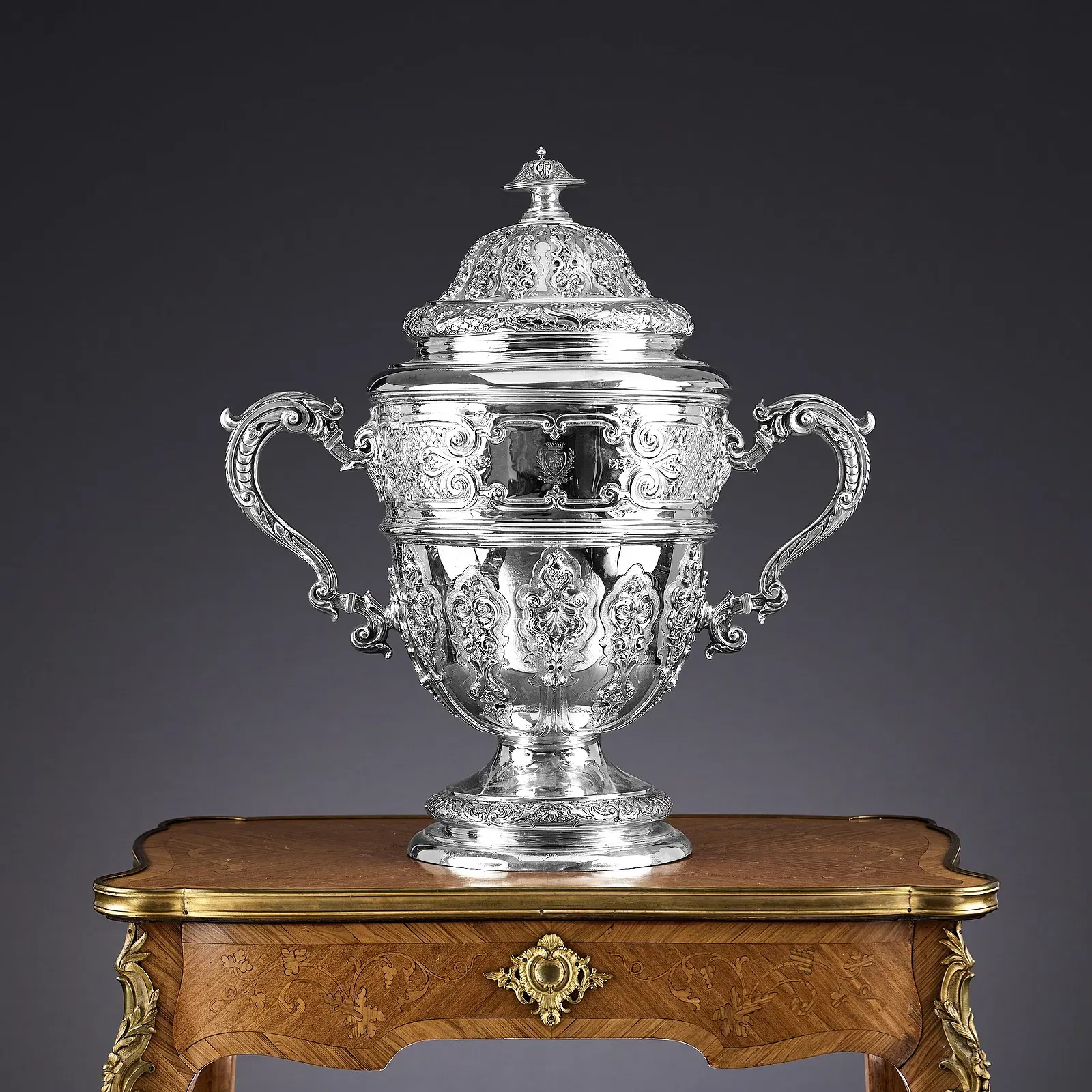
Here we have a splendid Victorian Rococo Revival silver plate two-handled covered cooler—one of those gloriously theatrical dining-room pieces that blurs the line between utility and pure table spectacle. With its pierced domed lid, scrolling handles, bulbous body, and embossed ornament, it was made to impress as much as to serve. The style is emphatically 19th century, not Georgian: all that exuberant foliate scrollwork and rich surface chasing belongs to the great Victorian appetite for revival design. Pieces like this were often used as ice pails, wine coolers, or ceremonial serving vessels in ambitious households. The detail shots help greatly. We can see commercial stamped marks including 'M&W' and hallmark-like devices, which suggest plated ware rather than solid sterling silver. The body also has the bright, reflective look and slightly rubbed high spots typical of antique silverplate. The engraved armorial crest adds dignity, though it may be decorative rather than evidence of noble provenance. Condition appears very decent overall, with honest wear, some rubbing, and the sort of use marks one hopes to see on a real 19th-century table piece. That wear actually helps the case for age. No glaring signs of a crude modern fake jump out. So: authenticity score, 72%. I believe it is likely a genuine Victorian period silver-plated object, circa 1860 to 1890. At auction, I would place it conservatively around $300 to $700 if period and correctly catalogued; if later, the value drops sharply to roughly $75 to $200. Handsome, decorative, and very much of its age... Charles here, signing off: Let the Mink have a Think!
Used for this report's TTS and avatar presentation.
Item Report
Victorian Rococo Revival Silver Plate Two-Handled Covered Ice Pail or Wine Cooler
By: Uncertain maker; marked 'M&W' with additional pseudo-hallmarks
Style: Victorian Rococo Revival silverplate
Origin: Probably England
Materials: Silver-plated metal, likely over Britannia metal or copper alloy
Age: Circa 1860-1890
Condition: Very Good (visible polish wear and minor surface rubbing, not laboratory tested)
Value: Auction estimate if authentic period piece: $300-$700. If later reproduction or decorative copy: $75-$200.
Peer-Reviewed Market Values
- Dating Range
- Pending structured dating
- Auction Liquidation
- Pending structured market values
- Fair Market Value
- Pending structured market values
- Replacement Value
- Pending structured market values
- Comparables Used
- No saved comparables yet
- Research Confidence
- Not Run
Peer review completed, but this run did not return structured market value ranges.
Maker's Marks / Writing: Stamped marks include 'M&W' and several pseudo-hallmark devices; engraved crest with coronet above shield and motto ribbon reading approximately 'NICEA CIVITAS' or similar.
Date: 2026-03-19 09:42:54.711591
Description:
A richly embossed and chased two-handled covered vessel in high Victorian Rococo Revival taste, likely intended as an ice pail, wine cooler, or presentation-form table vessel. It has scrolling foliate handles, a pierced domed cover, cartouche reserves, and a footed base. Detail images show silverplate rather than solid silver, with stamped marks including 'M&W' and pseudo-hallmark devices.
Curator Questions
Curated by Jade
Assessment:
This appears to be a 19th-century Victorian silver-plated covered cooler or ice pail in the Rococo Revival manner, rather than an 18th-century silver tureen. The exuberant scrollwork, pierced cover, and cast handles are consistent with mid-to-late Victorian electroplate. The close mark image reading 'M&W' and the lion/date-letter style punches suggest a British plated wares maker using commercial marks rather than sterling hallmarks. The engraved armorial-style device and motto appear decorative or commemorative. Surface wear and rubbing visible in the closeups support age and use. A word about copies.. silverplate in historic revival styles is a field full of reproductions and later decorative copies, so one must be cautious not to confuse a Victorian revival object with an earlier Georgian original.
Individual Images:
- whole cooler catalog view
- whole cooler front view
- whole cooler with lid off
- detail of engraved crest
- detail of underside marks
- detail of marks closeup
Provenance:
No provenance documentation shown in the images.
Condition:
Very Good (visible polish wear and minor surface rubbing, not laboratory tested)
Identification Score: 90%
The form, removable pierced lid, and heavy two-handled cooler shape strongly indicate a covered ice pail or wine cooler rather than a soup tureen. The decorative language is clearly Victorian Rococo Revival, and the underside marks support plated tableware identification.
Authenticity Score: 72%
Likely authentic as a 19th-century period silver-plated vessel, but not likely an 18th-century piece or solid silver example. Fakery check: the decoration is convincing for Victorian electroplate, the wear is plausible, and the marks appear commercially struck rather than recently fabricated; however, only limited views of the base and construction prevent a higher score. Because reproductions are common in revival silver, I remain conservative.
Image Memory Note
None None
Keywords
Victorian Rococo Revival silver plate covered ice pail, wine cooler, two-handled urn, covered vessel, electroplate, England, M&W
Peer Review Summary
Peer Review
Key Visible Evidence
The subject item (Images 1, 2, 3) presents as a highly ornate, two-handled, covered vessel, consistent with the Victorian Rococo Revival aesthetic. The engraved crest (Image 4) features a coronet above a shield and a motto ribbon, which appears decorative or commemorative. Crucially, the marks on the underside (Images 5, 6) clearly display 'M&W' within a rectangular punch, accompanied by several pseudo-hallmarks: a lion passant (facing left), a head (likely a sovereign's head duty mark), and a letter 'h' within a shield. The overall condition, as observed in the images, appears to be good, with minor surface rubbing and polish wear visible in the close-up of the marks (Image 5, 6), which is consistent with an object of its purported age and use. No significant structural damage or obvious repairs are discernible.
Market and Source Support
The 'M&W' mark, in conjunction with the pseudo-hallmarks (lion passant, head, and date letter), is strongly associated with Mappin & Webb, a prominent British manufacturer of electroplated wares during the Victorian era. The Rococo Revival style was a dominant trend in Victorian decorative arts, and Mappin & Webb actively produced items in this ornate aesthetic. The presence of a lion passant (introduced post-1822) and a potential sovereign's head duty mark (in use between 1784 and 1890) further supports a 19th-century dating for British electroplate. The practice of major electroplate manufacturers, including Mappin & Webb, to implement voluntary date letter systems for their silver plate aligns with the Victorian period attribution.
Needs Verification
While the letter 'h' is visible in the pseudo-hallmarks (Image 6), a definitive assignment of a specific year requires access to Mappin & Webb's proprietary electroplate date letter registers for the relevant period. Additional research into these specific registers would be necessary for a precise dating. The report's assertion that the base metal is 'likely over Britannia metal or copper alloy' is plausible for electroplate, but direct visual evidence of the substrate is not available. Definitive confirmation would require more intrusive examination, such as XRF analysis, or clear visual evidence of plating wear exposing the base metal. The functional identification as an 'ice pail or wine cooler' is consistent with the form, but the presence or absence of an original removable internal liner, often characteristic of such items, is not explicitly visible or discussed. Confirmation of an original liner would strengthen this functional attribution. The specific significance of the engraved armorial crest (Image 4) as 'decorative or commemorative' remains an inference without further provenance documentation or detailed heraldic research.
Audit Conclusion
The report's identification of the object as a Victorian Rococo Revival silver-plated two-handled covered ice pail or wine cooler, circa 1860-1890, and its attribution to Mappin & Webb (or a related Mappin entity), is largely well-supported by both visible image evidence and grounded historical sources. The ornate style, the object's form, and the specific 'M&W' maker's mark with accompanying pseudo-hallmarks are consistent with British electroplate production during the mid-to-late Victorian era. The observed condition appears appropriate for an antique of this type and age. However, the report's auction value estimate of $300-$700 appears somewhat optimistic when critically compared against recent auction results for similar ornate Victorian silver-plated items. Auction comparables for highly decorative Victorian silver-plated urns and tureens have realized prices in the range of $100-$200. While dealer asking prices for comparable decorative pieces can be significantly higher, the stated 'auction estimate' should ideally reflect actual auction performance for closely analogous items. The specific level of ornamentation and the Mappin & Webb attribution of the subject item may indeed command a premium, but the available auction comparables suggest that a more conservative range might be a more realistic expectation in an auction setting. The authenticity score of 72% and identification score of 90% are considered reasonable given the inherent challenges in definitively authenticating and identifying such items without further intrusive examination, and acknowledging the prevalence of reproductions in revival silverplate. The report correctly distinguishes the marks as electroplate rather than solid sterling silver, which is a critical distinction.
Comparables (Similar Items)
No archived comparables matched this report yet.
Share: