Premium upgrade: Monique delivers your appraisal as a guided podium narration with synced visuals and voiceover.
Output is a narrated, animated slideshow with video intro and outro, sandwiching the autoplay voiceover sequence in actual video.
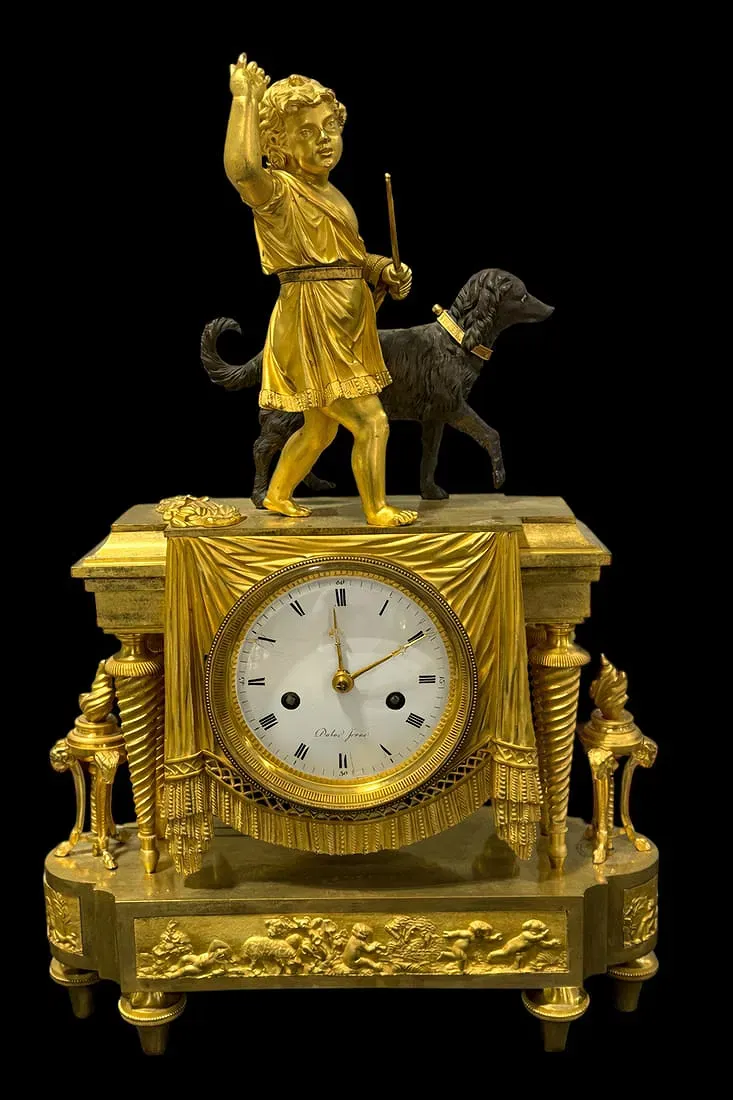
French Empire Period Ormolu and Patinated Bronze Figural Mantel Clock with Hunter and Dog
LANGUAGE UNLOCK
Glossary Roundup
Original Presentation Script
Ah, what a delightful embodiment of Napoleonic elegance — a French Empire Period ormolu and patinated bronze figural mantel clock, crowned with a young hunter and his loyal hound. At once theatrical and disciplined, it perfectly captures the Empire’s fascination with antiquity, virtue, and heroic youth.
Dating to roughly 1805 to 1820, this clock belongs to the golden age of Parisian bronze craftsmanship. The draped swags, spiral columns, and mythological frieze along the base all speak the visual language of Imperial France — ordered, classical, and just a touch propagandistic. The contrast between the luminous mercury-gilt bronze and the dark patinated dog is particularly telling; this interplay was a hallmark of fine Empire workshops.
The white enamel dial, signed “Dubuc Jeune,” suggests a Parisian retailer or clockmaker active during the period. The drum movement and bell structure visible from the rear are consistent with early 19th-century French production.
Condition is very good, with minor dial hairlines and expected wear to the gilding — precisely the sort of gentle aging we like to see. A word about copies.. Empire clocks have been widely reproduced since the late 19th century, and many decorative examples flood today’s market. Fortunately, the quality of casting and the subtle matte gilding here argue in favor of period authenticity.
With an authenticity confidence of 75%, I would place this at auction between $4,000 and $7,000. A charming and dignified survivor of Napoleon’s aesthetic revolution — and far more loyal than the average courtier.
Used for this report's TTS and avatar presentation.
Item Report
French Empire Period Ormolu and Patinated Bronze Figural Mantel Clock with Hunter and Dog
By:Dial signed Dubuc Jeune (clockmaker/retailer)
Style:Empire Period (early 19th century)
Origin:France
Materials:Fire-gilt bronze (ormolu), patinated bronze, white enamel dial, brass movement
Age:Circa 1805–1820
Condition:Very Good (minor dial hairline, surface wear to gilding, movement not tested)
Value:If authentic: $4,000–$7,000 at auction. If later reproduction (late 19th–20th century): $800–$1,500 at auction.
Maker's Marks / Writing:Dial signed 'Dubuc Jeune'; interior stamped numbers '10' and '87' (visible).
Date:2026-02-21 01:01:05.109506
Description:
A finely cast and fire-gilt bronze (ormolu) mantel clock surmounted by a classical child hunter holding a whip or switch, accompanied by a patinated bronze hound. The rectangular case is draped with gilt swags, flanked by spiral columns and mythological mounts, and raised on toupie feet. The white enamel dial with Roman numerals is signed 'Dubuc Jeune.'
Curator Questions
Curated by Jade
Assessment:
This clock strongly reflects authentic French Empire craftsmanship, with refined modeling, high-quality mercury gilding, and convincing patinated contrast between the figure and dog. The sculptural composition, classical drapery, and mythological frieze align with early 19th-century Parisian production. The dial signature 'Dubuc Jeune' appears appropriate to the period, though further archival verification is advised. The movement and interior construction are consistent with early 19th-century French drum movements. Overall, the piece presents as a genuine Empire Period mantel clock.
Individual Images:
whole clock front view
front with dial door open
side view right
back showing movement
side view left
upper half figural group
detail of surface wear top
detail of dial hairline crack
detail of dial signature Dubuc Jeune
detail of right front mount
interior movement drum
detail of stamped number inside
Provenance:
No documentation provided.
Condition:
Very Good (minor dial hairline, surface wear to gilding, movement not tested)
Identification Score: 95%
The form, iconography, dial style, movement structure, and gilding technique clearly correspond to documented French Empire figural clocks of the early 19th century.
Authenticity Score: 75%
Surface wear, matte mercury gilding, minor age-related oxidation, and appropriate interior movement construction support early 19th-century authenticity. However, without inspecting the movement in person and confirming the maker, caution remains warranted given the prevalence of later Empire-style reproductions.
Image Memory Note
None
None
Keywords
French Empire Period, ormolu mantel clock, figural clock, patinated bronze dog, Dubuc Jeune, early 19th century, France
The report was edited after initial Artmink draft. Original AI draft preserved in Artmink audit history.

Share: