George : English Fine and Decorative Arts
George Presents

Original Presentation Script
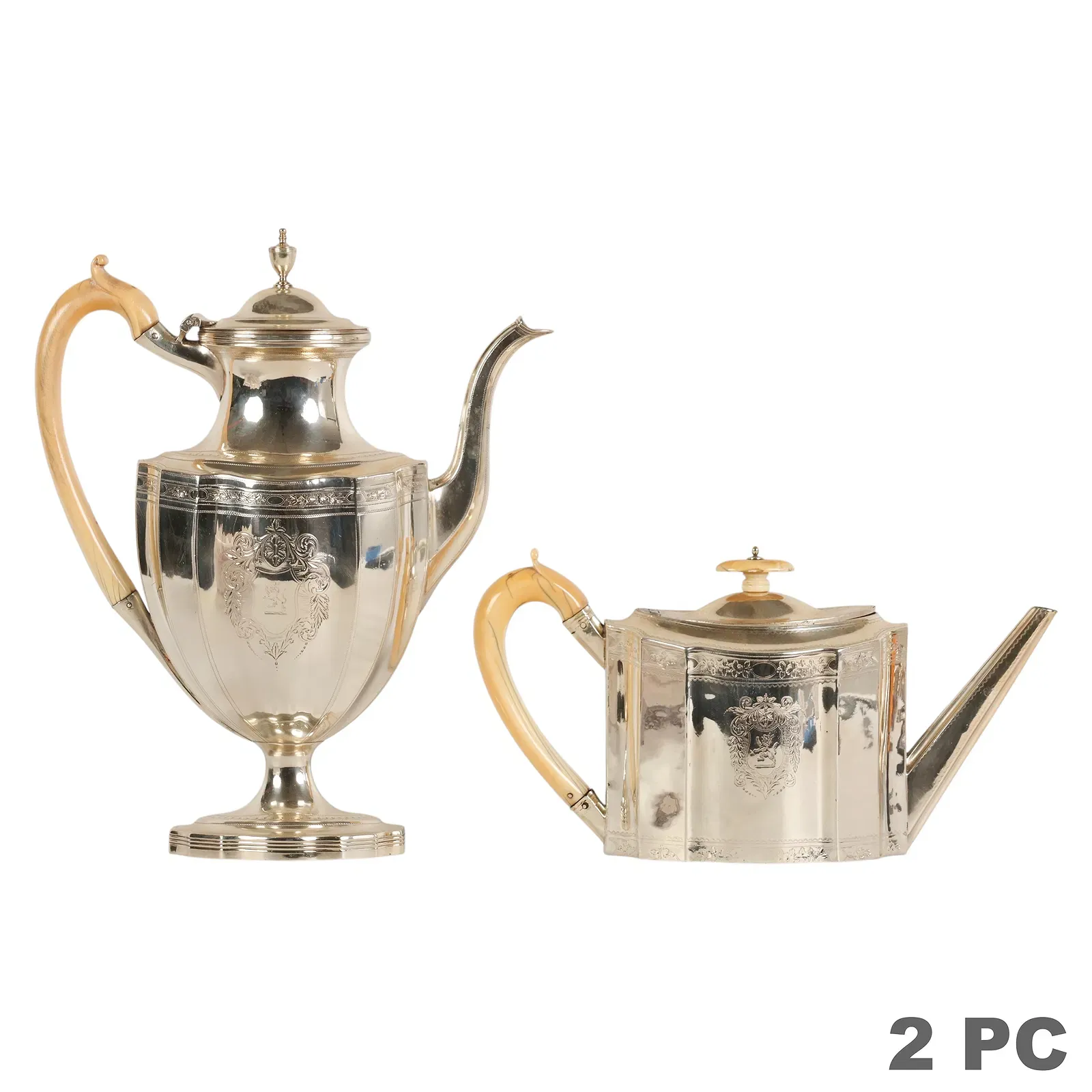
Here we have a handsome English Edwardian sterling silver coffee pot and teapot, a refined two-piece service that speaks the language of early 20th-century dining elegance. The tall urn-form coffee pot and lower angular teapot balance practicality with poise, while the ivory handles were not merely decorative—they insulated the hand from heat. Stylistically, this set belongs to the Edwardian era, when silversmiths favored crisp neoclassical lines, restrained engraving, and polished surfaces over the heavier exuberance of high Victorian wares. The faceted bodies, engraved borders, and shield cartouches fit that moment very well. The most encouraging evidence lies inside: struck English hallmarks are visible, and they appear properly die-struck rather than modern fantasy marks. That matters enormously. Construction and wear also look believable, with gentle surface scratching and slight irregularities from use and polishing over time. Condition appears very good overall. I do see ordinary signs of age—light rubbing, some minor waviness or small dings, and the expected softness from repeated polishing. Those do not hurt authenticity; if anything, they support it. A word about copies.. silver services are full of plated imitations and later revival examples, so hallmarks are the great truth-tellers here. On balance, I’d give this set an authenticity score of 82%. Conservative auction estimate: $600 to $1,200 if authentic sterling as it appears; if later plated or otherwise misdescribed, more like $75 to $200. A charming and useful survivor of Edwardian table culture... Charles here, signing off: Let the Mink have a Think!
Used for this report's TTS and avatar presentation.
Item Report
English Edwardian Sterling Silver and Ivory-Handled Coffee Pot and Teapot
By: English maker, initials appearing as R.H. or similar; exact attribution uncertain from photo alone
Style: Edwardian
Origin: England
Materials: sterling silver, ivory handle insulators and finial details
Age: circa 1900-1910
Condition: Very Good (light age wear, polish marks, minor surface irregularities; not professionally condition graded)
Value: Auction estimate: if fully authentic Edwardian sterling silver set, approximately $600-$1,200; if later silver-plated or misrepresented reproduction, approximately $75-$200.
Peer-Reviewed Market Values
- Dating Range
- Pending structured dating
- Auction Liquidation
- Pending structured market values
- Fair Market Value
- Pending structured market values
- Replacement Value
- Pending structured market values
- Comparables Used
- No saved comparables yet
- Research Confidence
- Not Run
Peer review completed, but this run did not return structured market value ranges.
Maker's Marks / Writing: Interior hallmark group visible, including sterling lion passant-type mark, date/town-style punches, and maker's mark reading R.H. or similar; engraved cartouches appear largely vacant or lightly monogrammed.
Date: 2026-03-15 23:18:38.155157
Description:
A matched two-piece silver service comprising a tall coffee pot and a low teapot, both of faceted, tapering form with engraved neoclassical borders, vacant cartouches, and curved ivory handles and finials. The visible hallmarks indicate English sterling silver, and the overall design is consistent with the Edwardian period.
Curator Questions
Curated by Jade
Assessment:
This appears to be a genuine early 20th-century English sterling silver coffee pot and teapot set in Edwardian taste, rather than a modern reproduction. The proportions, engraved ornament, period form, and especially the interior hallmarks support authenticity. The ivory handles are typical heat-resistant fittings for the period. Condition appears generally good with light surface wear, minor denting or waviness, and polishing consistent with age. A word about copies.. silver services are a category where later plated wares and revival pieces are extremely common, so one must rely heavily on hallmarks, construction, and honest wear rather than style alone. Fakery check: the hallmarks look properly struck rather than laser-clean, the surfaces show believable age and use, and the engraved decoration is modest and period-appropriate rather than overdone.
Individual Images:
- whole silver set front view
- whole silver set with scale bottle
- back of coffee pot and teapot
- open lids front view
- back of coffee pot and teapot
- detail of sterling hallmarks
Provenance:
No provenance documentation shown in the images.
Condition:
Very Good (light age wear, polish marks, minor surface irregularities; not professionally condition graded)
Identification Score: 94%
The object type is clear from the forms: one tall coffee pot and one lower teapot, both from an English silver tea or coffee service. The hallmarks and period styling make the identification highly confident, though the precise maker's name cannot be fully resolved from the provided mark image.
Authenticity Score: 82%
I believe this is likely an authentic Edwardian English sterling silver pair. The best evidence is the presence of multiple struck hallmarks inside the vessel, including lion passant-type sterling mark, town/date-style punches, and a maker's mark. The ivory insulators, restrained engraving, and slightly softened wear all support age. The score is held below absolute certainty because the date letter and maker are not fully legible from the single detail image, and there are no closeups of seams, bases, or full hallmark sets for both pieces.
Image Memory Note
None None
Keywords
English sterling silver, Edwardian, coffee pot, teapot, ivory handle, silver service, hallmarked silver, England
Peer Review Summary
Peer Review
Key Visible Evidence
Visible evidence in Image 6 shows five distinct hallmarks. From left to right: 1) A lion passant in an irregular shield, indicating sterling silver. 2) A crowned leopard's head in a shield, identifying the London Assay Office. The presence of a crown on the leopard's head is critical. 3) An uppercase Roman letter 'A' in a rectangular punch with cut corners, serving as the date letter. 4) A profile head facing right in a circular punch, which is a Duty Mark. 5) A maker's mark, appearing as 'R' over 'D' or 'P' in a rectangular punch. The overall form of the coffee pot and teapot, with their faceted bodies, neoclassical engraved borders, and ivory-colored handles and finials, is consistent with late 18th to early 19th-century design.
Market and Source Support
Based on established English sterling silver hallmark guides: The presence of a Duty Mark (Image 6, Punch 4) restricts the dating to between 1784 and 1890. The crowned leopard's head (Image 6, Punch 2) further restricts the dating to before 1821/1822. Combining these, the item must date between 1784 and 1821/1822. Consulting London date letter cycles for this period, an uppercase Roman 'A' in a rectangular punch with cut corners corresponds to the year 1796-1797. This dating is consistent with the presence of a King George III duty mark. The maker's mark 'R' over 'D/P' is partially legible; 'RH' (Robert Hennell I or II) is a plausible interpretation given their activity during this period in London, though the second letter is not definitively 'H'.
Needs Verification
The report's claim of 'Edwardian' (circa 1900-1910) for the age and style is directly contradicted by the visible hallmarks. The presence of a Duty Mark and a crowned leopard's head definitively places the manufacturing date between 1784 and 1821/1822, specifically identified as 1796-1797. The stylistic elements, such as the faceted form and neoclassical engraving, are consistent with the late Georgian/Regency period, not Edwardian. A clearer, higher-resolution image of the maker's mark (Image 6, Punch 5) would be needed to definitively confirm the second letter and attribute the maker. Additionally, confirmation that both the coffee pot and teapot bear identical hallmarks is needed, as Image 6 only shows hallmarks from one piece.
Audit Conclusion
The report's primary claim regarding the age and style as 'Edwardian' (circa 1900-1910) is incorrect and directly contradicted by the visible hallmarks. The hallmarks clearly indicate a late Georgian period dating to 1796-1797. The material (sterling silver) and the authenticity of the hallmarks themselves appear correct, but the period identification is fundamentally flawed. The value estimate, being predicated on an 'Edwardian' dating, would therefore need to be re-evaluated based on the correct late Georgian period.
Comparables (Similar Items)
No archived comparables matched this report yet.
Share: