Materials:Walnut (primary), rattan cane, iron/brass repair plates and screws
Age:Circa late 17th–early 18th century design; this pair likely 18th–19th century with later recaning and repairs
Condition:Fair (heavy wear and worming, losses and cracks to seat rails, later sheet-caning with breaks/sagging, metal plate repairs; structurally tired)
Value:US $400–1,000 (pair, auction/liquidation estimate given condition and authenticity uncertainty)
Maker's Marks / Writing:No maker’s marks observed.
Date:2025-10-18 01:23:26.359613
Description:
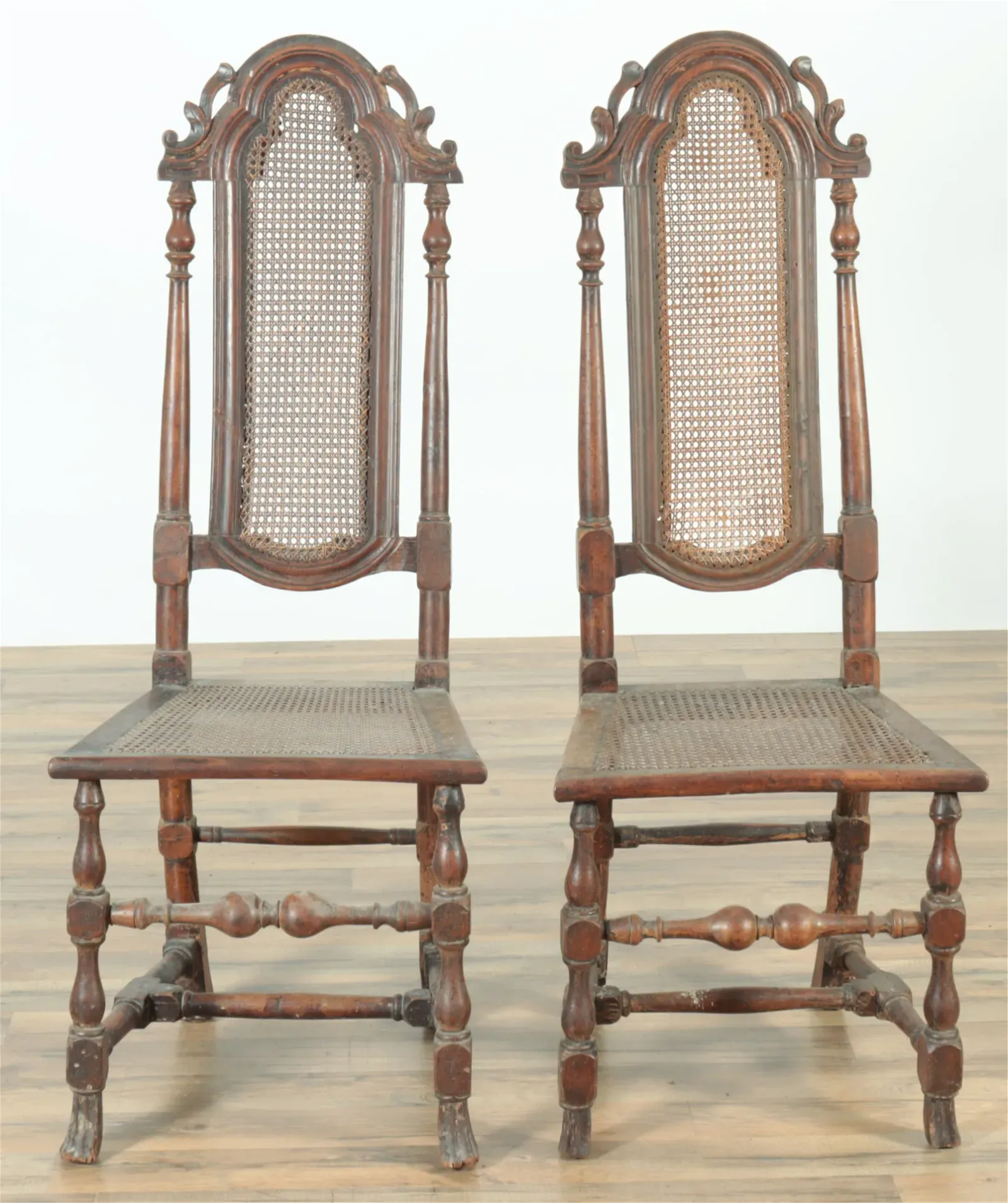
A matched pair of tall side chairs with arched, scrolled crest rails and cane panels to the backs and seats. Block-and-baluster turned legs on H-stretchers with a pronounced bulbous front stretcher and flared ‘Spanish’ feet. Surfaces show an old reddish-brown finish with heavy wear, scattered wormholes, and later structural repairs.
Curator Questions
Curated by Jade
Assessment:
These are classic Iberian high-back caned side chairs with features associated with late Baroque seating from Spain/Portugal: the tall arched and molded back with scrolled ‘ears,’ block-and-baluster legs joined by an H-stretcher with a large center turning, and flared ‘Spanish’ feet. The wood appears to be walnut (numerous worm holes and grain), with substantial age-related wear. The sheet caning on seats and backs looks to be later replacements, and there are obvious structural repairs, including a brass plate at the back frame and patched seat rails. A word about fakes.. Iberian Baroque chairs are widely reproduced (19th–20th century), often with artificial worming and new machine-woven cane; caution is warranted. These examples show convincing age, oxidation, shrinkage, and irregular hand turning, but later hardware and recaning lower certainty. Priced as decorative antiques rather than museum-period masterpieces.
Individual Images:
none
Provenance:
None provided.
Condition:
Fair (heavy wear and worming, losses and cracks to seat rails, later sheet-caning with breaks/sagging, metal plate repairs; structurally tired)
Identification Score: 80%
Form and details (arched scrolled crest, caned panels, block-and-baluster legs, H-stretcher with large bulb) strongly indicate Spanish/Portuguese Baroque-type side chairs; minor regional variations considered.
Authenticity Score: 55%
Considerable surface age, worming, oxidation and hand-turned asymmetry suggest real age; however, the sheet cane appears later, and the brass repair plate with slotted screws plus generalized 19th-c. Iberian revival production keep certainty moderate.
Image Memory Note
None
None
Keywords
Iberian Baroque style, Spanish chair, Portuguese chair, walnut, caned seat, high-back, H-stretcher, Spanish foot, 17th-18th century design, Spain, Portugal
The report was edited after initial Artmink draft. Original AI draft preserved in Artmink audit history.

Share: