Premium upgrade: Thomas delivers your appraisal as a guided podium narration with synced visuals and voiceover.
Output is a narrated, animated slideshow with video intro and outro, sandwiching the autoplay voiceover sequence in actual video.
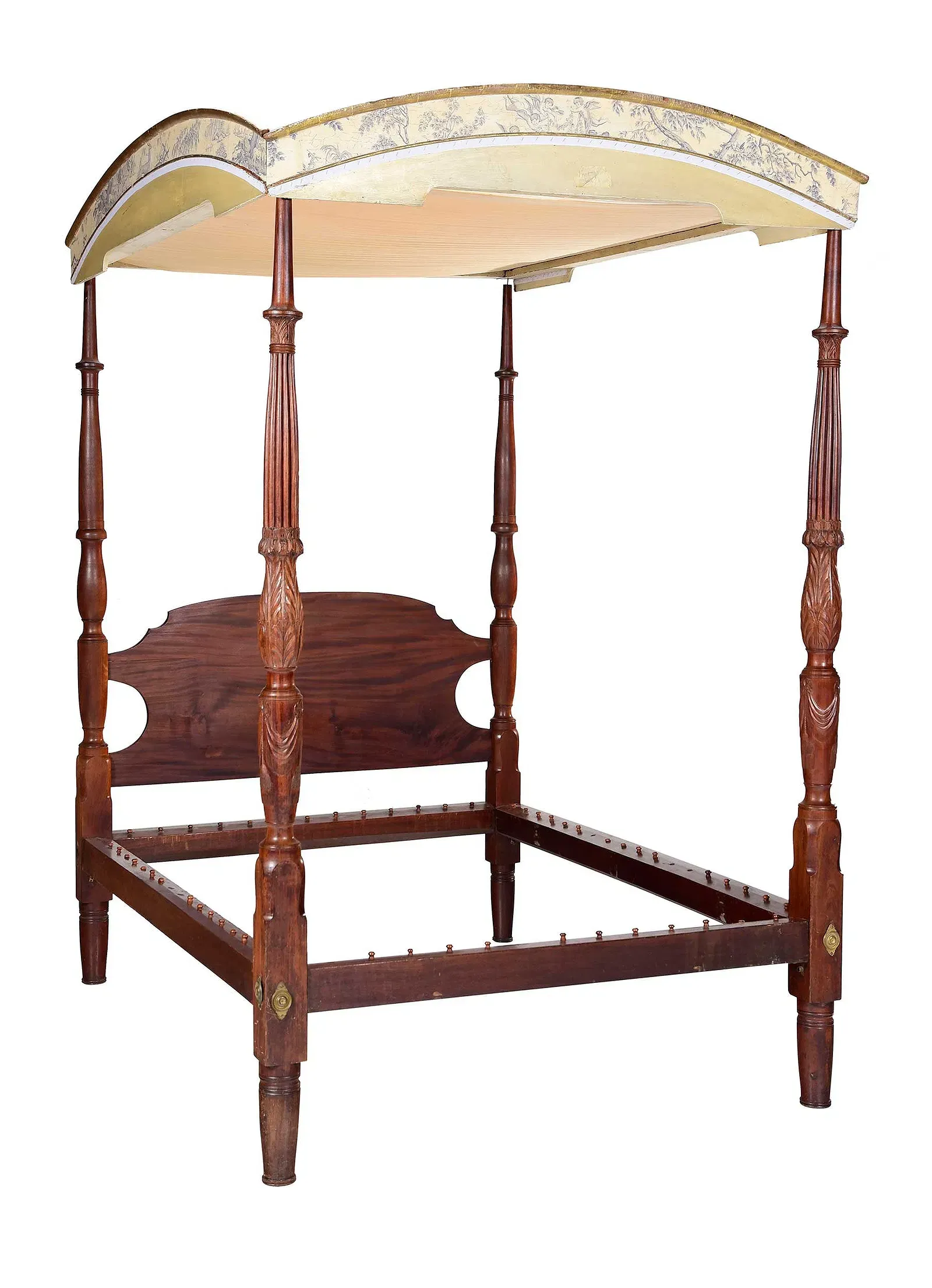
American Federal Revival Mahogany Canopy Bed美式联邦复兴风格桃花心木四柱罩床
LANGUAGE UNLOCK
Glossary Roundup
Original Presentation Script
This American Federal Revival mahogany canopy bed, dating to the late 19th or early 20th century (circa 1880–1915), captures the elegance of early American neoclassicism while reflecting the production methods of its own era. The slender turned posts with carved leaf collars, shaped headboard, and arched canopy frame create a stately silhouette firmly rooted in the Federal tradition.
Closer inspection, however, places the piece within the revival movement rather than the original Federal period of 1780–1820. The carving displays a notable uniformity, and the canopy’s decorative printed trim is more consistent with later decorative practices than with hand-finished period textiles. Bed-bolt construction and overall finish further support a dating in the late 19th to early 20th century.
The primary wood appears to be mahogany, exhibiting a deep tone and grain appropriate to the species. Surface wear, scuffing, and finish age are visible and consistent with over a century of use. While not an 18th-century original, it remains an attractive and well-proportioned example of Federal Revival furniture, suitable for decorative use and valued accordingly in today’s market.
Used for this report's TTS and avatar presentation.
Materials:Mahogany (primary wood), decorative printed trim (likely paper or fabric), metal bed bolts and fasteners
Age:Late 19th to early 20th century (circa 1880–1915)
Condition:Very good (visible surface wear, minor scratches and scuffs consistent with age; later decorative canopy trim present)
Value:Authentic period example: $2,500–$6,000; Federal Revival example as shown: $500–$1,500
Peer-Reviewed Market Values
Dating Range
Pending structured dating
Auction Liquidation
Pending structured market values
Fair Market Value
Pending structured market values
Replacement Value
Pending structured market values
Comparables Used
4 comparables
Research Confidence
Complete
Peer review completed, but this run did not return structured market value ranges.
Maker's Marks / Writing:None
Date:2026-06-20 12:24:43.528365
Description:
Four-poster canopy (tester) bed in the American Federal Revival manner, featuring turned and carved posts with leafy collars, a shaped and molded headboard, bed bolts, and an arched canopy frame fitted with decorative printed trim. The primary wood appears to be mahogany, with a dark, even tone and grain consistent with that species. Construction details and the character of the carving indicate a late 19th- to early 20th-century revival interpretation rather than an 18th-century Federal-period original.
美式联邦复兴风格四柱罩床,带有车木与雕刻立柱(饰叶形圈饰)、造型模压床头板、床栓结构,以及拱形罩架并配有装饰性印花边饰。主体木材外观为桃花心木,色泽深沉均匀,纹理特征相符。整体结构与雕刻风格显示其为19世纪晚期至20世纪早期的复兴作品,而非18世纪联邦时期原作。
Curator Questions
Curated by Jade
Assessment:
A handsome and decorative American Federal Revival canopy bed, confidently dated to the late 19th or early 20th century. The neoclassical vocabulary—slender turned posts, carved leaf ornament, shaped headboard, and arched canopy—is stylistically consistent, while the uniformity of carving and the presence of printed canopy trim firmly place it within the revival tradition rather than the Federal period itself (1780–1820). It represents a well-made decorative piece with genuine age and wear, but not an 18th-century original.
这是一件造型优雅、装饰性强的美式联邦复兴风格罩床,可较有把握地断代为19世纪晚期至20世纪早期。其新古典主义语言——纤细车木立柱、叶饰雕刻、造型床头板与拱形罩架——风格统一;而雕刻的规整一致性与印花罩檐边饰则清楚表明其为复兴时期作品,而非1780–1820年间的联邦时期原作。整体为做工良好的装饰性古董家具,具有一定年代使用痕迹,但并非18世纪原件。
Individual Images:
Whole bed (front and side views); three-quarter view; carved post detail; headboard profile; canopy frame and underside; close-up of decorative trim; hardware and bed-bolt detail; joinery at rail connections.
Provenance:
Unknown
Condition:
Very good (visible surface wear, minor scratches and scuffs consistent with age; later decorative canopy trim present)
Identification Score: 92%
The four-poster canopy form and Federal-style detailing are clearly expressed and visually consistent. Turned posts, carved leafy collars, shaped headboard, canopy frame, and bed-bolt construction all support identification as an American Federal Revival bed. While exact workshop attribution is not possible from images alone, the object type and stylistic category are identified with high confidence.
四柱罩床结构与联邦风格细节特征清晰明确,包括车木立柱、叶形雕饰、造型床头板、罩架及床栓结构等,均支持其为美式联邦复兴风格罩床。虽无法仅凭图像确定具体工坊,但器型与风格类别判断具有较高把握。
Authenticity Score: 45%
Visible surface wear and patina indicate genuine age, and the materials appear consistent with late 19th- to early 20th-century production. However, the regularity of the carved ornament and the decorative printed canopy trim are characteristic of revival-era manufacture rather than hand-finished Federal-period work. The piece is best understood as an authentic Federal Revival bed, not a misrepresented fake, but also not an original from the late 18th century.
表面磨损与包浆显示其具有真实年代,材料亦符合19世纪晚期至20世纪早期制作特征。然而,雕刻装饰的规整一致性及印花罩檐边饰更符合复兴时期工业化生产特征,而非18世纪联邦时期的手工精制作品。因此,此床应被视为真实的联邦复兴风格家具,而非仿冒品,但也不是18世纪原作。
Image Memory Note
Assessment based on provided overall and detail images of the bed, including posts, canopy, trim, and hardware.
评估基于所提供的整床及细节图像,包括立柱、罩架、边饰与五金结构。
Fair Market Value
Pending structured market values
Replacement Value
Pending structured market values
Archived Matches
No archive matches yet
Research Confidence
Complete
Peer Review
Key Visible Evidence
The bed exhibits a four-poster form with turned and carved posts, a shaped headboard, and a canopy frame, consistent with a Federal style aesthetic (Image 1, 4, 5, 6). The wood appears to be mahogany, displaying a characteristic dark tone and grain. Visible carving on the posts (Image 6) shows a degree of uniformity, suggesting later production methods. The canopy features a decorative border with what appears to be printed trim (Image 1). Bed bolts are visible, indicating a common construction method for period and revival beds.
Market and Source Support
The report's classification of the bed as 'American Federal Revival / Federal Style' is consistent with historical descriptions of Federal Revival furniture, which often emulated earlier Federal forms but with later execution. Period Federal furniture (1780-1820) is characterized by lighter proportions, refined lines, and often intricate hand-carved details, veneers, and inlays, with ornamentation typically simple, flat, and contained. The emergence of four-poster beds in the United States in the mid-to-late 1800s further supports the reported dating for a revival piece. The presence of printed canopy trim, as noted in the report, aligns with a later dating, as period Federal pieces typically featured more refined or hand-finished textile work, or painted canopies.
Needs Verification
["The claim of 'secondary hardwoods' cannot be verified without access to unseen areas of the construction, such as the interior of rails or the underside of the headboard.", 'A macro close-up of the canopy trim (Image 1) would be beneficial to definitively confirm if it is printed paper or fabric, and to assess its manufacturing technique.', 'Detailed images of joinery (e.g., rail attachments, headboard panel insertion) are needed to further support dating and construction methods.']
Audit Conclusion
The report accurately identifies the bed as an American Federal Revival piece, with the visible neoclassical style, uniform carving, and printed canopy trim strongly supporting a late 19th to early 20th-century dating. The primary material, mahogany, is visually consistent. While the overall assessment is sound, further physical inspection of internal construction and materials would provide more definitive evidence for certain claims.


Share: