
Monique : French Fine and Decorative Arts
Monique Presents

Original Presentation Script
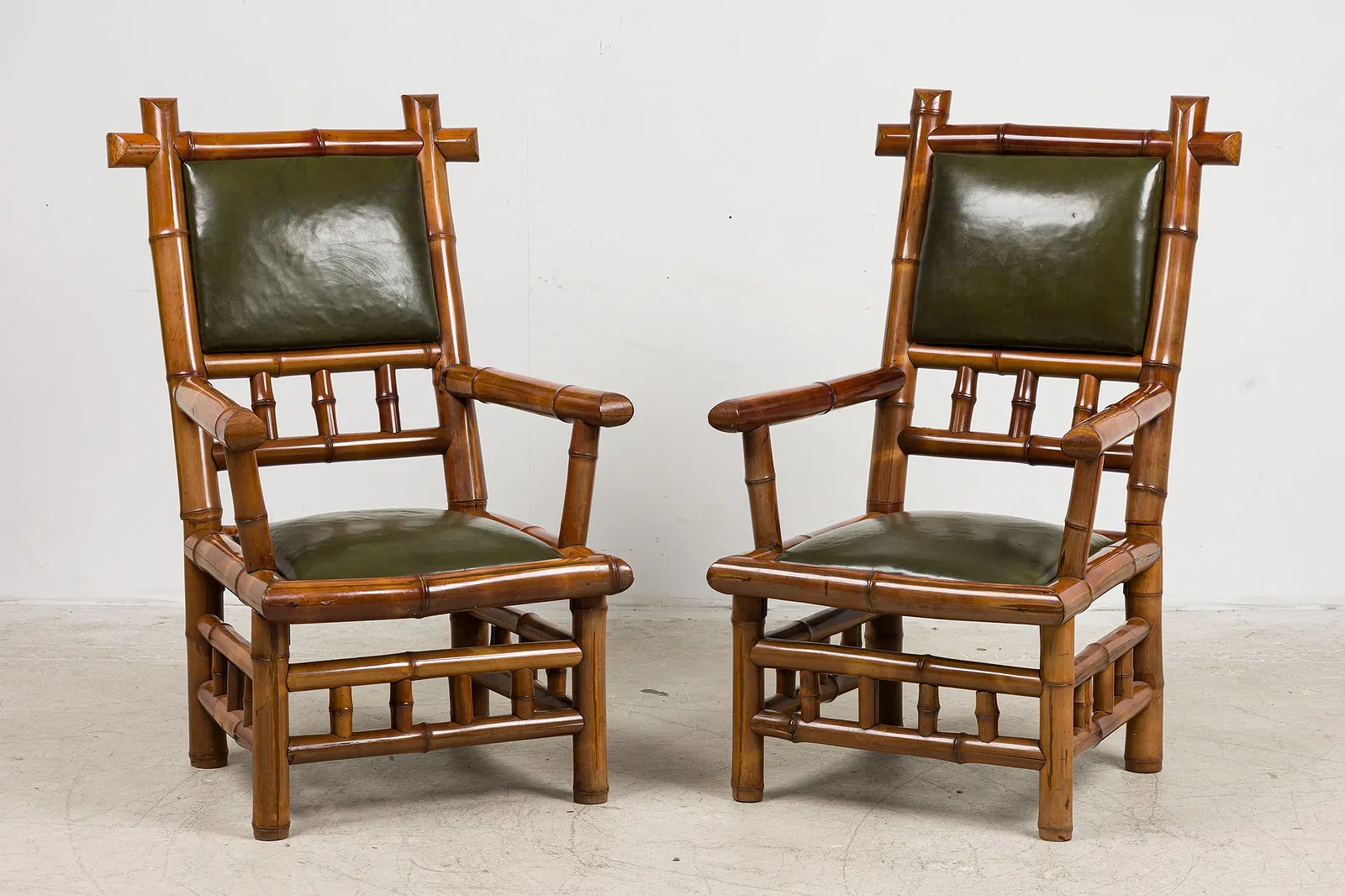
What we have here is a charming and highly characteristic pair of French Japonisme armchairs by Perret & Vibert of Paris, dating to circa 1884–1900—the firm’s mature period of Japanese-inspired production. Perret & Vibert, established in 1872 and located at 33 Rue du 4 Septembre, became widely known for bamboo and Japanese-style furnishings. From the mid-1880s onward, they produced carved wooden furniture that convincingly simulated bamboo, answering Parisian demand for exotic, artistic interiors. The oval brass plaque on these chairs ties them directly to that address and period. The frames are carved hardwood, expertly turned and shaped to imitate bamboo culms and nodes. Visible wood grain and the precision of the carved joints confirm the intentional faux-bamboo construction. The geometric structure—uprights, cross-stretchers, and disciplined lines beneath the decorative surface—anchors them firmly in the Aesthetic Movement. The dark green leather upholstery shows creasing and honest wear, complementing the warm brown finish of the frames. Rubbing at the edges, minor finish losses at the feet, and subtle shrinkage lines at the simulated joints are entirely consistent with late 19th-century age. The brass label displays oxidation and patina appropriate to its era. Bamboo-style furniture is a category frequently revisited in later decades, and caution is always prudent. Here, however, the labeled attribution, construction quality, and coherent aging together present a persuasive case for period manufacture. At auction, a conservative estimate for the pair would be $1,200 to $2,500. They remain distinctly Parisian in spirit—elegant, slightly exotic, and unmistakably products of the late 19th century’s fascination with Japan.
Used for this report's TTS and avatar presentation.
Item Report
French Japonisme Simulated Bamboo and Leather Armchairs, Pair
法国仿竹风格皮革扶手椅(一对)
Merge Reports: Yes (reconciled). Approval remains manual.
By: Perret & Vibert, Paris
Style: Japonisme / Aesthetic Movement
Origin: France
Materials: carved and turned hardwood (simulated bamboo), leather upholstery, brass label
Age: circa 1884–1900
Condition: Very Good (period wear, surface rubbing and finish loss consistent with age; upholstery worn but serviceable; not examined in hand)
Value: Auction estimate: $1,200–$2,500 for the pair.
Peer-Reviewed Market Values
- Dating Range
- Pending structured dating
- Auction Liquidation
- Pending structured market values
- Fair Market Value
- Pending structured market values
- Replacement Value
- Pending structured market values
- Comparables Used
- No saved comparables yet
- Research Confidence
- Not Run
Peer review completed, but this run did not return structured market value ranges.
Maker's Marks / Writing: Oval brass label reading: "PERRET & VIBERT / FABRICANTS / 33, Rue du 4 Septembre / PARIS".
Date: 2026-03-24 01:46:42.989011
Description:
A pair of late 19th-century French armchairs in carved and turned hardwood skillfully fashioned to simulate bamboo, upholstered in dark green leather, and bearing an oval brass maker's label for Perret & Vibert, 33 Rue du 4 Septembre, Paris. The design reflects the fashionable Japonisme and Aesthetic Movement taste of the period, with geometric framing, cross-stretchers, and carefully articulated faux-bamboo nodes. 一对19世纪晚期法国扶手椅,以精细雕刻与车制的硬木仿制竹材效果,配深绿色皮革坐面与靠背,并附有“PERRET & VIBERT / 33 Rue du 4 Septembre / Paris”椭圆形黄铜厂牌。整体设计体现了当时流行的日本主义与唯美主义风格,结构几何感强,并以仿竹节细节装饰。
Curator Questions
Curated by Jade
Assessment:
This pair represents a confident example of late 19th-century French Japonisme furniture by Perret & Vibert of Paris, a firm established in 1872 and celebrated for its bamboo and Japanese-style furnishings. From approximately 1884 onward, the company specialized in carved wooden pieces designed to evoke Far Eastern forms, often referred to as 'faux-bambou.' The present chairs, with their carved hardwood frames convincingly simulating bamboo and their intact Paris label, align closely with that production period. The frames are executed in wood rather than natural bamboo, with visible grain, carved nodes, and neatly formed joints demonstrating deliberate simulation. The warm brown finish shows consistent age-related rubbing at edges and feet, minor shrinkage lines at the simulated joints, and small areas of finish loss—all coherent with late 19th-century manufacture. The oval brass label displays oxidation and patination appropriate to age. The dark green leather upholstery exhibits creasing and surface wear consistent with long use. While it harmonizes well with the frames, confirmation of whether it is original or an early replacement would require examination of the underside and internal upholstery techniques. Bamboo-style seating has been widely reproduced in the 20th century, making attribution an area that rewards caution. In this instance, however, the clearly legible Perret & Vibert label with the Rue du 4 Septembre address, the quality of carving, and the natural wear patterns together support a period example dating to the firm’s mature Japonisme phase, circa 1884–1900. 这对扶手椅为19世纪晚期法国日本主义风格家具的优秀实例,出自1872年创立的巴黎著名家具商Perret & Vibert。自约1884年起,该公司专门生产受远东风格启发的“仿竹”(faux-bambou)雕刻木家具。本对椅子以硬木精细雕刻仿竹效果,并保留完整巴黎地址厂牌,与其成熟时期的作品特征高度吻合。 椅架为木质而非天然竹材,可见木纹与人工雕刻竹节细节,结构严谨。表面呈温润棕色包浆,在边角与足端可见自然磨损,仿竹节点处可见轻微木材收缩纹理,均符合19世纪晚期家具的自然老化特征。黄铜厂牌氧化自然。 深绿色皮革坐面与靠背有长期使用形成的褶皱与磨痕。是否为原装或早期更换版本,需通过座面底部与内部结构进一步检视确认。 仿竹家具在20世纪曾大量仿制,鉴定需谨慎。然而,本例凭借清晰可读的Perret & Vibert巴黎地址厂牌、精良雕工及自然磨损状态,支持其为约1884–1900年间的原时期作品。
Individual Images:
- Front and three-quarter views of both armchairs; close-ups of carved simulated bamboo joints and stretchers; detail of oval brass maker's label; images of leather seat wear and edge rubbing; rear and side structural views.
Provenance:
No documentary provenance beyond the original Perret & Vibert maker's label visible on the frame.
Condition:
Very Good (period wear, surface rubbing and finish loss consistent with age; upholstery worn but serviceable; not examined in hand)
Identification Score: 96%
The maker's label, specific Paris address, documented specialization of Perret & Vibert in simulated bamboo Japonisme furniture after circa 1884, and strong stylistic alignment make the identification highly secure. 根据清晰可见的厂牌与巴黎地址,以及Perret & Vibert自约1884年起专门生产仿竹日本主义家具的历史记载,加之风格高度一致,因此本品的身份认定非常可靠。
Authenticity Score: 85%
The oxidized brass label, coherent late 19th-century construction in simulated hardwood, visible age-related shrinkage and finish wear, and stylistic consistency with documented Perret & Vibert production support authenticity. A higher score would require in-hand inspection of joinery, underside construction, and upholstery details. 氧化自然的黄铜厂牌、符合19世纪晚期特征的仿竹木质结构、可见的木材收缩与表面磨损,以及与Perret & Vibert已知作品风格一致性,均支持其真实性。如能进一步检视榫卯结构、底部与内衬细节,可信度可进一步提升。
Image Memory Note
Frames constructed of carved hardwood simulating bamboo rather than natural bamboo; label clearly present. 椅架为雕刻硬木仿竹结构,而非天然竹材;厂牌清晰可见。
Keywords
Perret & Vibert, Paris, faux bamboo, simulated bamboo, Japonisme, Aesthetic Movement, French 19th century, leather armchairs, pair Perret & Vibert,巴黎,仿竹,日本主义,唯美主义,19世纪法国,皮革扶手椅,一对
Peer Review Summary
Peer Review
Key Visible Evidence
The subject chairs are constructed from wood, meticulously carved and turned to simulate bamboo, as evidenced by visible wood grain, mitered joints, and the artificial formation of 'nodes' (Images 1, 2, 3, 5, 7). The upholstery consists of dark green leather, exhibiting creasing and surface wear consistent with prolonged use and age (Images 1, 8). An oval brass label, clearly legible as 'PERRET & VIBERT / FABRICANTS / 33, Rue du 4 Septembre / PARIS,' is affixed to a horizontal frame member (Image 4). This label displays oxidation and patination typical of aged brass. The overall finish is a warm, glossy brown, with areas of rubbing and loss, particularly at edges, feet, and joints (Images 3, 5, 8). Minor shrinkage lines and cracking are discernible in the simulated bamboo joints and members, indicating the age of the wood (Images 2, 3). The design features a geometric frame and cross-stretchers, aligning with the Japonisme and Aesthetic Movement styles.
Market and Source Support
Grounded research confirms that Perret & Vibert was a prominent Parisian firm, established in 1872 by Alfred Perret and Ernest Vibert, and located at 33 Rue du 4 Septembre. The company was renowned for its 'natural bamboo furniture and cane seats' and, from approximately 1884, for its 'Japanese style furniture,' specializing in carved wooden furniture of Far Eastern inspiration, often referred to as 'faux-bambou' or simulated bamboo. The firm's operational period and address are consistent with the report's dating of 'circa 1880-1900' and the stylistic attribution to Japonisme/Aesthetic Movement. Perret & Vibert gained recognition at the Universal Exhibitions in Paris (1889, 1900), where they received awards for their exotic and Japonisme-inspired furniture. The practice of using simulated bamboo in wood was common in France during this period, driven by demand for the popular aesthetic and the cost/suitability limitations of genuine bamboo.
Needs Verification
While visual evidence strongly indicates the chairs are crafted from simulated hardwood (Images 2, 3, 7), the report's phrasing 'bamboo and/or bamboo-simulated hardwood' introduces a slight ambiguity. A definitive material identification would require in-hand examination, including analysis of wood grain, joinery details (e.g., dowels, mortise and tenon), and potentially microscopic wood analysis. The report states 'Upholstery may be replaced or refreshed.' Photographic evidence alone cannot conclusively determine if the leather is original to the period or a later replacement. Examination of the underside of the seat, upholstery tacking methods, and internal stuffing would be necessary for a more definitive assessment. The report mentions 'ebonized joint accents imitating natural bamboo nodes.' However, the provided images (Images 2, 3, 5, 7) show the carved joints finished in a consistent brown tone with the rest of the frame, without clear evidence of ebonization. Further high-resolution, close-up images under varied lighting conditions would be required to confirm or refute this detail. The authenticity score of 82% is justified by the report's acknowledgment of photographic limitations. To achieve a higher confidence level, additional evidence such as UV/blacklight examination for repairs or refinishing, and detailed images of internal construction, would be beneficial.
Audit Conclusion
The report's identification of the chairs as a pair of French Japonisme armchairs by Perret & Vibert, circa 1880-1900, is robustly supported by the visible maker's label and corroborated by extensive grounded sources detailing the firm's history, location, and specialization in this specific style and period. The visible wear, oxidation of the label, and shrinkage lines in the wood are consistent with the stated age. However, the material is more accurately and predominantly identified as skillfully simulated bamboo hardwood rather than actual bamboo, a distinction that, while acknowledged by the report, could be more definitively stated based on visual evidence. The claim of 'ebonized joint accents' is not clearly substantiated by the provided images. While the overall authenticity and identification are well-supported, further in-hand examination of construction details, upholstery originality, and potential refinishing would enhance the certainty of the condition and originality claims.
Comparables (Similar Items)
No archived comparables matched this report yet.
Share: