Premium upgrade: Jade delivers your appraisal as a guided podium narration with synced visuals and voiceover.
Output is a narrated, animated slideshow with video intro and outro, sandwiching the autoplay voiceover sequence in actual video.
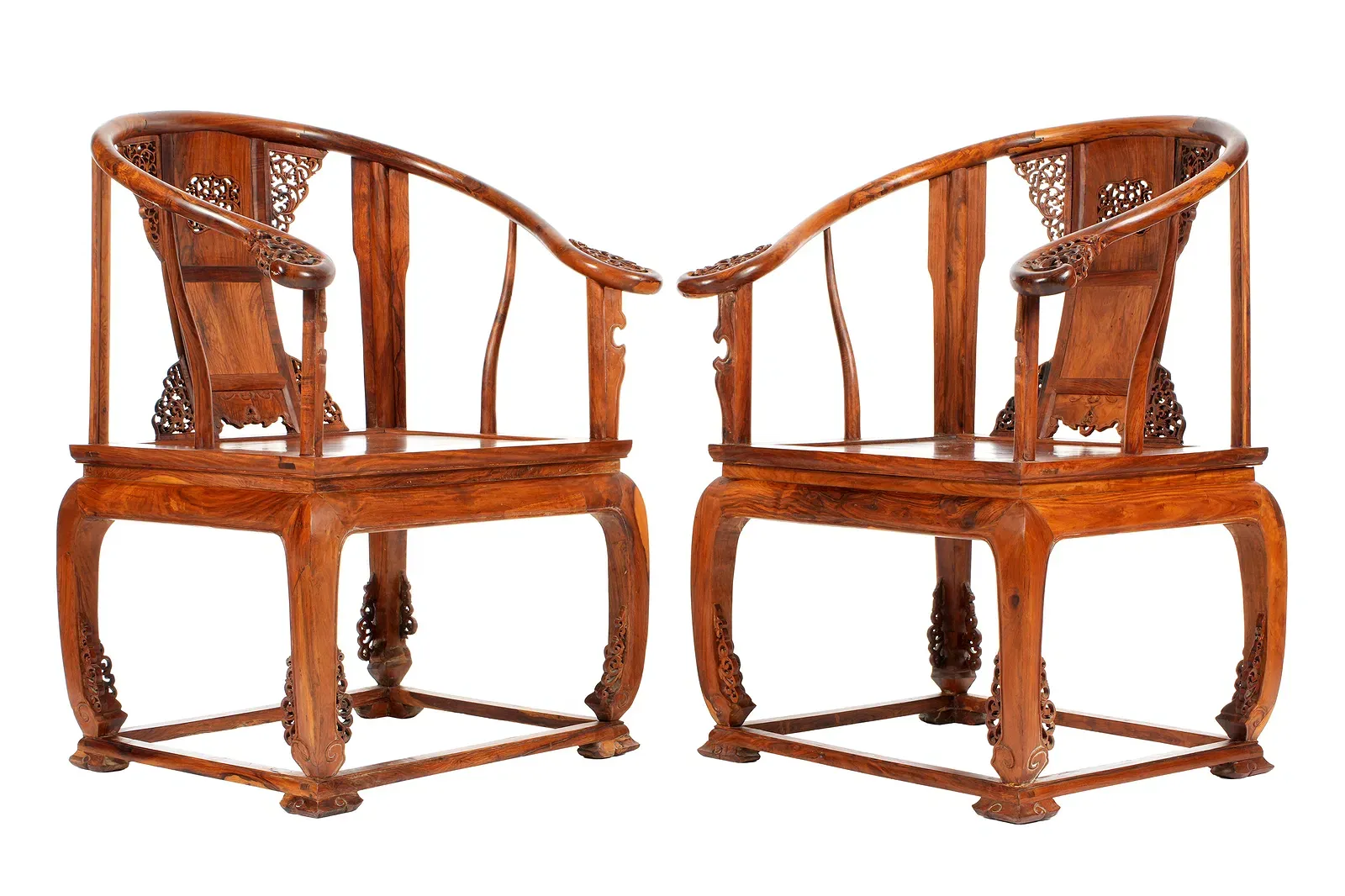
Chinese Qing Style Huanghuali Horseshoe-Back Armchairs (Pair)清式黄花梨圈椅一对(仿古)
LANGUAGE UNLOCK
Glossary Roundup
Original Presentation Script
Let’s take a closer look at this handsome pair of Chinese Qing-style horseshoe-back armchairs — a form long associated with scholars, connoisseurs, and cultivated domestic life.
The sweeping crest rails, elegant open arms, and pierced corner spandrels all echo furniture made during the height of Qing taste, when proportion and restraint mattered more than excess ornament. Chairs like these once anchored studios and reception rooms, framing the sitter with dignity.
They are crafted from a richly grained hardwood marketed as huanghuali or a close substitute. The wood is attractive and carefully selected, and the joinery is precise — but it is precisely this perfection that raises an eyebrow. The carving is sharp and confident, yet uniform. The surfaces are glossy and consistent, without the softened edges, shrinkage, and layered patina earned over centuries.
Condition is excellent, almost too excellent. There are no meaningful repairs, no old damage, and little evidence of long-term use. That tells us these chairs were made to evoke the past, not to survive it.
Authenticity, then, lands around 25 percent. These are not Qing dynasty survivors, but late 20th- or early 21st-century revival works. At auction, they would likely bring $2,000 to $4,000 as decorative furnishings. A genuine Qing period pair, by contrast, would command well into six figures.
Elegant, confident, and persuasive — but ultimately, a modern homage dressed in antique robes.
Used for this report's TTS and avatar presentation.
Item Report
Chinese Qing Style Huanghuali Horseshoe-Back Armchairs (Pair)
清式黄花梨圈椅一对(仿古)
By:Unknown
Style:Qing Style Chinese Furniture
Origin:China
Materials:Hardwood, likely huanghuali or huanghuali-type substitute
Age:Late 20th to early 21st century (circa 1980–2015)
Condition:Excellent (modern piece with minimal wear, not antique)
Value:If authentic Qing period examples: auction estimate USD $120,000–200,000 for the pair. As later Qing-style reproductions: auction estimate USD $2,000–4,000 for the pair.
Maker's Marks / Writing:None observed
Date:2025-12-30 02:36:25.788370
Description:
A matched pair of Chinese horseshoe-back armchairs with continuous rounded crest rails, openwork carved spandrels, and square-section legs joined by stretchers. The overall form closely follows classical Qing dynasty scholar’s chairs, with elegant proportions and decorative pierced carving panels beneath the back splat and along the legs. The wood shows attractive grain but retains a relatively uniform surface finish.
一对中式圈椅,配连续弯曲的搭脑、透雕角牙与方材腿足,并以横枨加固。整体造型仿自清代文人家具,比例端正,背板与腿部设有装饰性镂空雕刻。木纹清晰美观,但表面包浆较为一致。
Curator Questions
Curated by Jade
Assessment:
These chairs are well-executed Qing-style horseshoe-back armchairs, clearly inspired by 18th-century elite furniture forms. However, several factors argue strongly against period authenticity: the carving is extremely crisp and repetitive, the finish is even and glossy with limited variation, and the overall condition is remarkably intact with minimal age-related wear. The wood grain is attractive but lacks the deep oxidation and complex surface patina expected of genuine Qing huanghuali. Joinery appears precise and standardized, consistent with modern workshop production rather than individual handcraft from the imperial era.
A word about copies.. Chinese horseshoe-back armchairs are among the most frequently reproduced forms in the furniture market. From the late 20th century onward, countless high-quality revival pieces were produced specifically to satisfy international demand for ‘scholar furniture,’ often using convincing hardwood substitutes. These chairs fit squarely within that tradition.
While decorative and respectable in quality, they should be appreciated as modern reproductions rather than antique relics. {chavatar_catchphrase}
这对圈椅在造型与比例上准确借鉴了清代经典文人家具,制作水准不俗。然而,多项关键特征明确排除了其为清代原作的可能性:雕刻线条过于锋利且模式化,整体表面光泽均一,几乎未见自然老化痕迹;木材虽具观赏性,但缺乏真正清代黄花梨应有的深层氧化色与复杂包浆。榫卯工整而标准化,更符合现代作坊式生产特征。
关于仿品需特别提醒:圈椅是中国家具中复制率最高的器型之一,自20世纪末以来大量仿古作品流入市场,专为迎合收藏需求而制。此对椅子正属这一范畴。
因此,它们应被视为装饰性良好的现代仿作,而非历史遗存。{chavatar_catchphrase}
Individual Images:
whole chairs three-quarter view
front view of chairs
overhead view of seats
side view of chairs
back view of chairs
opposite side view
detail of carved back splat
detail of carved back splat reverse
Provenance:
No documentation provided
Condition:
Excellent (modern piece with minimal wear, not antique)
Identification Score: 95%
The horseshoe-back form, construction, and decorative vocabulary are unmistakably Chinese Qing-style armchairs.
圈椅的器型、结构与装饰语言明确指向清式中式家具,辨识度极高。
Authenticity Score: 25%
Surface finish, carving sharpness, uniform condition, and lack of aged patina strongly indicate a modern reproduction rather than a Qing period original.
表面处理、雕刻锋利度、整体状态过于一致,以及缺乏自然老化包浆,均显示其为现代仿制品而非清代原作。
Image Memory Note
None
None
Keywords
Chinese furniture, Qing Style, horseshoe-back chair, huanghuali, armchair, pair, China
中国家具, 清式, 圈椅, 黄花梨, 扶手椅, 成对, 中国
The report was edited after initial Artmink draft. Original AI draft preserved in Artmink audit history.

Share: