Premium upgrade: Monique delivers your appraisal as a guided podium narration with synced visuals and voiceover.
Output is a narrated, animated slideshow with video intro and outro, sandwiching the autoplay voiceover sequence in actual video.
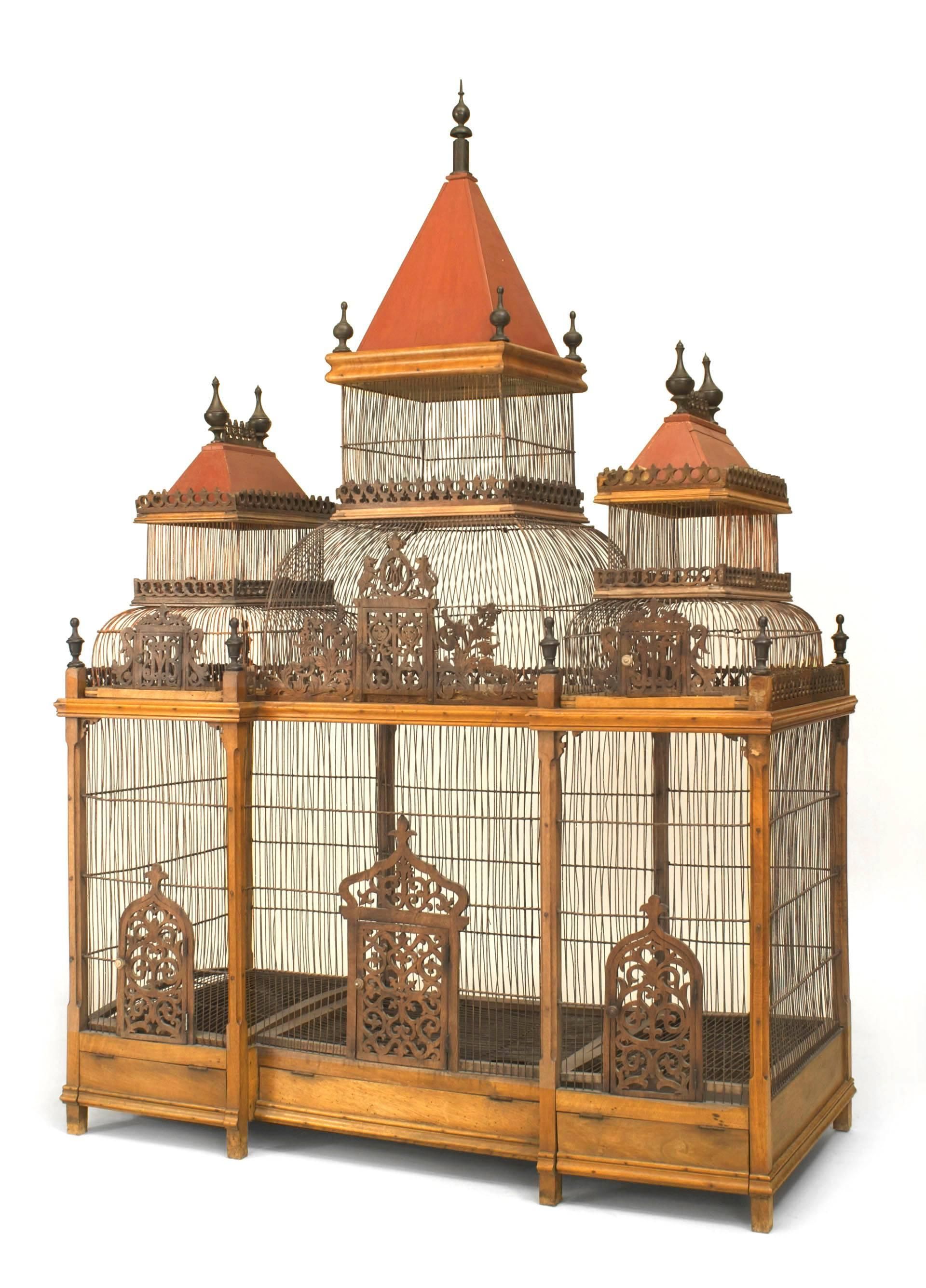
Victorian Period Carved Walnut Architectural Birdcage Aviary
LANGUAGE UNLOCK
Glossary Roundup
Original Presentation Script
Let me introduce a true showstopper: a Victorian Period carved walnut architectural birdcage aviary, designed not merely to house birds, but to command a room.
In the late 19th century, the keeping of exotic birds was a fashionable pursuit among the English upper classes, and this extraordinary cage reflects that world perfectly. With its triple-tower silhouette and almost cathedral-like presence, it blurs the line between furniture, sculpture, and fantasy architecture.
Crafted primarily from walnut, the cage features finely pierced Gothic panels, heraldic beasts, and a crowned monogram—details cut by hand, not machine. The vertical iron wires show gentle oxidation and irregularity, exactly what one expects from pre-industrial fabrication rather than modern factory output.
Condition is very good for an object of this ambition and age. There is honest wear to the wood, mellow patina throughout, and oxidation to the wire—signs of time, not neglect. Importantly, I see no alarming signs of artificial distress or overly fresh surfaces.
So, is it real? With an authenticity score of around 65%, I believe this is very likely a genuine late Victorian aviary, though prudence always applies in a category rife with later copies. At auction, an authentic example could reasonably achieve $25,000 to $45,000, while a reproduction would fall dramatically lower.
In short: a rare survival from an era when even birdcages were built like palaces.
Used for this report's TTS and avatar presentation.
Item Report
Victorian Period Carved Walnut Architectural Birdcage Aviary
By:Unknown English workshop
Style:Victorian Period
Origin:England (likely)
Materials:Walnut wood, wrought and drawn iron wire, possibly brass finials
Age:circa 1870–1890
Condition:Very Good (structurally sound, consistent wear, oxidation to wire, minor age-related losses)
Value:If authentic: auction estimate $25,000–45,000. If a later reproduction: $3,000–6,000.
Maker's Marks / Writing:No visible maker’s mark or inscription observed.
Date:2026-01-31 19:31:54.955391
Description:
A monumental Victorian-era birdcage or indoor aviary of architectural form, featuring three pagoda-like towers, fine vertical wire bars, and richly carved walnut panels with Gothic and heraldic motifs. The central crest displays a crowned monogram flanked by heraldic animals, above pierced foliate doors. Designed as a statement decorative object as much as a functional aviary, this piece reflects the 19th-century fascination with exotic pets and interior spectacle.
Curator Questions
Curated by Jade
Assessment:
This is an exceptionally ambitious and decorative Victorian birdcage, conceived architecturally with cathedral- or pavilion-like massing. The quality of carving, the complexity of the wirework, and the evident age-related patina strongly suggest a genuine late 19th-century origin rather than a modern decorative copy. Such pieces were luxury items, often custom-made for conservatories or grand townhouses. A word about copies.. Large-scale Victorian birdcages have been widely reproduced since the late 20th century, but most reproductions lack the depth of carving, subtle asymmetry, oxidation of wire, and mellow walnut patina seen here.
Individual Images:
whole birdcage three-quarter view
front view of birdcage
detail of carved door and crest
Provenance:
No provenance documentation provided.
Condition:
Very Good (structurally sound, consistent wear, oxidation to wire, minor age-related losses)
Identification Score: 95%
The form, function, and decorative vocabulary clearly identify this as a Victorian architectural birdcage or aviary, with strong comparables in 19th-century English examples.
Authenticity Score: 65%
While the scale, wear, patina, and hand-cut pierced carving argue for a 19th-century origin, the absence of maker’s marks and limited detail of construction joints prevent a higher score. It is far more convincing than most modern reproductions, but caution remains prudent.
Image Memory Note
None
None
Keywords
Victorian birdcage, architectural aviary, carved walnut, 19th century, English decorative arts, iron wire cage, England
The report was edited after initial Artmink draft. Original AI draft preserved in Artmink audit history.


Share: