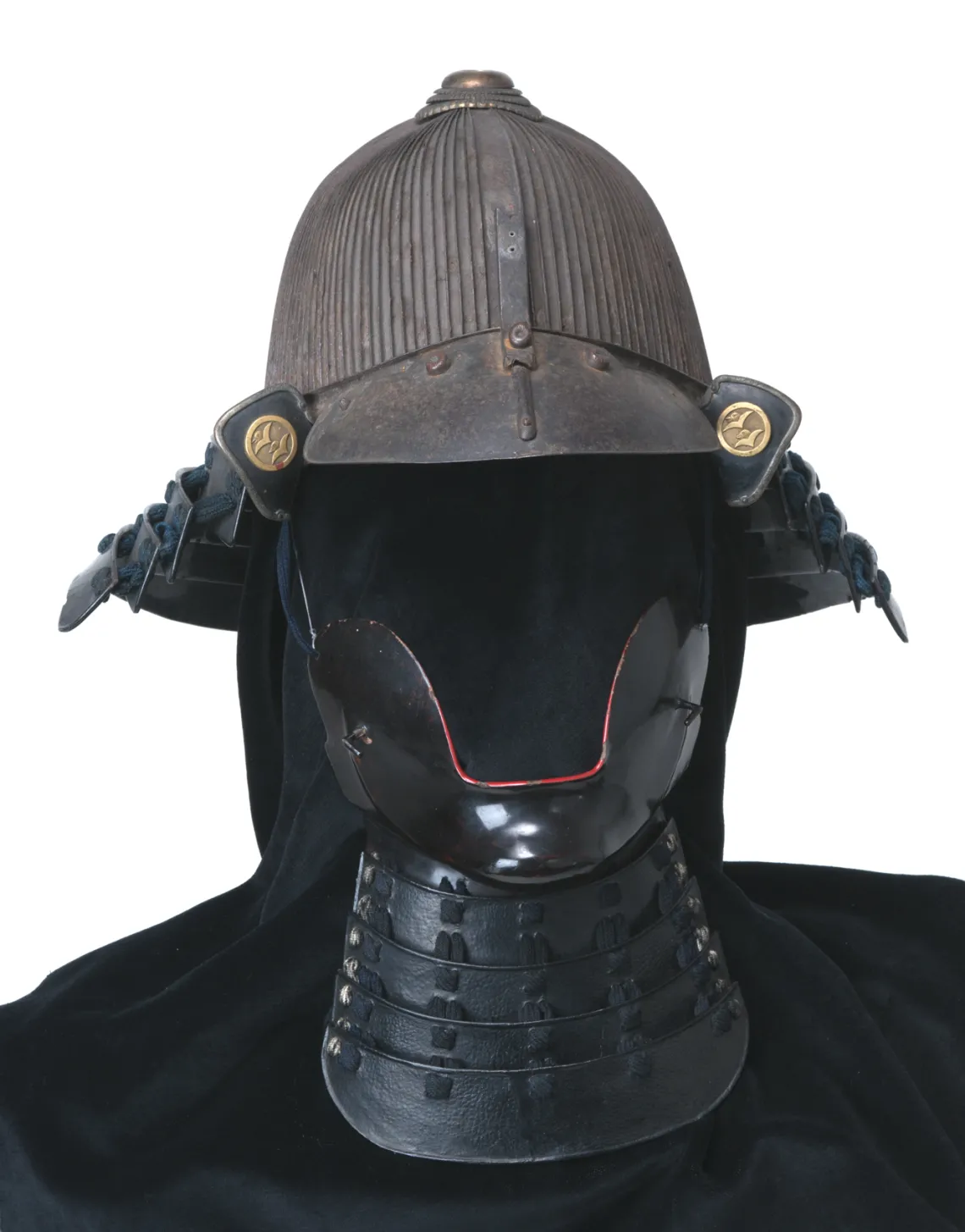
Introducing an impressive relic of samurai heritage: the Edo Period Iron Kawari Kabuto Helmet with Mempo. Gracefully formed and steeped in storied tradition, this ensemble of helmet and facial mask once adorned a warrior of stature in feudal Japan. The melding of iron and lacquer, accentuated with silk braidings, speaks of its crafted elegance and the era's martial splendor.
Hailing from the Edo Period, a time when samurai culture profoundly shaped Japan, this ceremonial armor has witnessed the passage of history itself. With the crest of a venerable family inscribed upon its fukigaeshi, it tells a tale of clan allegiance and the code of Bushido.
Forged of robust iron, the kabuto’s distinctive suji-bachi construction is a testament to traditional craftsmanship, with each rivet symphony-like in its placement. Bound by navy silk lacing, the yodare-kake grants both protection and majesty, while the menpo’s stark lacquer finish lends a fearsome visage, its red inner edge a striking highlight.
This piece stands in very good condition, graced only by age-appropriate wear. The original patina, skilfully applied lacquer, and mostly intact silk underscores its untouched authenticity. Such preservation enhances its allure, avoiding the pitfalls of overzealous restoration, where history sometimes yields to unsympathetic hands.
With an authenticity score of 80%, this matched set affirms its genuine Edo origins, despite the pervasive market of imitations. Assessed at a distinguished $6,000 to $12,000, it holds the potential to enrich both collector and curator alike. We are reminded: amidst echoes of samurai valor, the past whispers its stories, if only we listen.
Used for this report's TTS and avatar presentation.
Item Report
Edo Period Iron Kawari Kabuto Helmet with Mempo
By:Unknown (typically samurai armors were made by armorers, not signed)
Age:circa 18th–early 19th century (Edo Period, Japan)
Condition:Very Good (minor expected wear, silk lacing and lacquer mostly intact, original patina; not officially graded)
Value:$6,000–$12,000 (auction estimate for authentic Edo period kabuto and menpo pair in very good condition)
Maker's Marks / Writing:Two round gilt clan crests (family mon) are visible on the fukigaeshi. No signature (mei) is visible on the helmet bowl or menpo in this view.
Date:2025-07-06 22:43:31.615384
Description:
This is a Japanese kabuto (helmet) and menpo (facial armor) ensemble, commonly worn by samurai during the Edo Period (1603–1868). The rounded, riveted iron helmet bowl features ribbing (suji-bachi) typical of Edo period kabuto construction, flanked by large fukigaeshi (projecting ear guards) decorated with family crests (mon). The menpo is crafted from lacquered iron, with a black laced throat guard (yodare-kake) of lamellar plates. Such armor pieces were both functional and status symbols, with the design and decoration reflecting the rank and affiliation of the wearer.
Curator Questions
Curated by Jade
Assessment:
A well-preserved example of Edo period samurai armor, showing traditional craft techniques and with distinct clan mon on the fukigaeshi. The condition is notably good, with original patination, lacquer, and silk lacing mostly intact. The helmet and menpo appear to be a matching set, increasing its historical and collector value. A word about fakes..: The market for samurai armor is rife with reproductions, often of much more recent manufacture, but this example appears consistent with genuine Edo work in both form and aging.
Individual Images:
Although only a single general image appears to be submitted
it shows key details: the ribbed suji-bachi helmet bowl
gilt clan crest [mon] on the fukigaeshi
intact menpo with visible red lacquered inner edge
and lamellar neck guard plates (shikoro) with blue silk lacing. No major visible splits
cracks
or restoration patches are observed. The surface shows appropriate aging and minor abrasions indicative of original use.
Provenance:
No provenance documentation is visible or referenced in the supplied image.
Condition:
Very Good (minor expected wear, silk lacing and lacquer mostly intact, original patina; not officially graded)
Identification Score: 97%
The distinctive shape, construction methods (rivet lines, lamellar plates, lacquer-work, and mon emblems), and aging are all highly consistent with an Edo period kabuto and menpo. Only minor uncertainty remains regarding the exact dating within the period and possible later restorations.
Authenticity Score: 80%
The patina, wear on metal and lacquer, plus silk deterioration, all support Edo period origins rather than modern reproduction. There is still some margin for caution, as some restorations or skillful old replicas exist, but the overall impression is of authenticity.
Image Memory Note
The object is a traditional Japanese samurai helmet (kabuto) with facial armor (menpo). The helmet features vertical ribbing (suji), a rounded bowl, and prominent side flaps (fukigaeshi) with circular, gilt mon crests depicting a stylized leaf (appears to be a common Edo period mon). The menpo is black lacquered with a sharply defined nose and cheek, highlighted by a red inner edge. The throat guard (yodare-kake) consists of multiple lacquered lamellar plates laced with navy blue silk knots. Surface exhibits even brownish-grey patina; the lacquer and silk show minor wear typical of age but no obvious restoration. No inscriptions or written marks are noted aside from the gilt family crests on the fukigaeshi. No major cracks or significant losses visible.
Keywords
Edo period, Japanese armor, kabuto, menpo, samurai, helmet, Japan, antique, suji-bachi, fukigaeshi, clan mon
The report was edited after initial Artmink draft. Original AI draft preserved in Artmink audit history.

Share: