Pair of Mid‑20th Century Yoruba Style Carved Narrative Wooden Door Panels
LANGUAGE UNLOCK
Glossary Roundup
Original Presentation Script
Let’s spend a moment with this commanding pair of Yoruba Style Carved Narrative Wooden Door Panels from Nigeria.
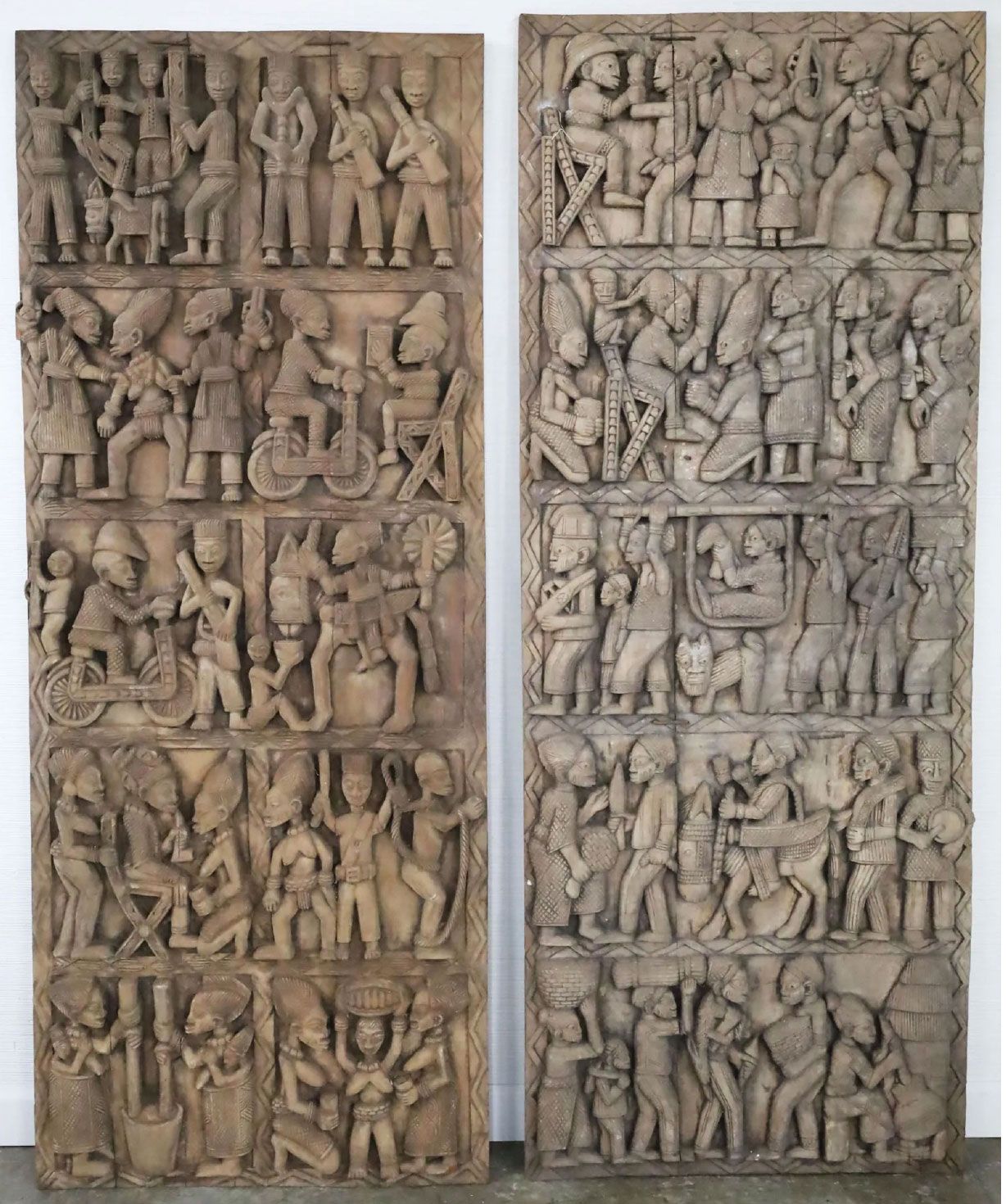
At first glance they read like graphic novels in wood: tier upon tier of figures—musicians, officials, porters, riders on horses and bicycles—telling the story of a bustling Yoruba town. These weren’t casual wall hangings in origin; they echo the great carved doors that once fronted palaces and shrines in southwestern Nigeria, proclaiming status and history to anyone who entered.
Here, the history is mid‑20th century. The colonial caps, bicycles and scooters all place the scenes after European contact, in that lively era when Yoruba carvers folded new imagery into very old visual grammar. Wide almond eyes, elaborate coiffures and cross‑hatched textiles are classic Yoruba, but the narrative has modern twists.
Technically, they’re impressive: solid hardwood planks, deeply carved in high relief, stabilized with butterfly keys on the reverse. Tool marks, slight asymmetries and honest shrinkage cracks confirm handwork rather than CNC fakery.
Condition is very good—age cracks and small edge losses, but no disastrous splits—and the surface has matured to a quiet, natural patina rather than a glossy tourist-shop stain.
In terms of authenticity, I’d place them around 65 out of 100: genuine Yoruba workshop carvings from about 1950–1975, but made for decorative or export use rather than for a 19th‑century palace. On today’s auction block, a conservative estimate would be in the $1,500 to $2,500 range for the pair. A lot of story, quite literally, for the wall space they command.
Used for this report's TTS and avatar presentation.
Item Report
Pair of Mid‑20th Century Yoruba Style Carved Narrative Wooden Door Panels
By:Unknown Yoruba workshop carver
Style:Yoruba style carved architectural panel / palace door (Nigeria, mid‑20th century tourist and commissioned art)
Origin:Nigeria (Yoruba peoples, West Africa)
Materials:Carved hardwood (likely iroko or similar West African hardwood), natural patina, no visible pigment
Age:Circa 1920–1950
Condition:Very good (age cracks, minor chips and edge wear, stable overall with attractive natural patina)
Value:$1,500–$2,500 (pair, auction estimate)
Maker's Marks / Writing:No visible signatures or inscriptions.
Date:2025-11-24 17:34:17.586949
Description:
Tall rectangular wood panels deeply carved in high relief with stacked narrative scenes of Yoruba life and ceremony. Each panel is divided into horizontal registers populated by standing, kneeling, and mounted figures, musicians, porters and processions, some with colonial-era elements such as bicycles and caps. The figures have typical Yoruba features: large almond eyes, pointed chins, patterned clothing and elaborate coiffures. Carved from thick single planks joined by butterfly keys and framed with a simple geometric border. The backs are flat, tool-marked and unfinished.
Curator Questions
Curated by Jade
Assessment:
These are impressive large-scale Yoruba-style narrative door panels, almost certainly made in early-to-mid-20th century Nigeria. The iconography—courtly scenes, drummers, processions, and colonial references such as bicycles and Western-style caps—fits well with Colonial Yoruba carving traditions that blended traditional subjects with imported motifs. The carving is vigorous and consistent, with repeated figure types and patterned clothing, typical of workshop production. The backs and butterfly keys suggest genuine handwork in solid hardwood, with age-related shrinkage cracks but no attempt at artificial distressing. They are authentic African carvings of good decorative and ethnographic interest and desirable to collectors of African traditional sculpture or interior designers needing strong statement pieces.
Individual Images:
none
Provenance:
Not provided.
Condition:
Very good (age cracks, minor chips and edge wear, stable overall with attractive natural patina)
Identification Score: 88%
The figural style, subject matter, and construction closely match known Yoruba carved doors and panels from southwestern Nigeria. Some uncertainty remains regarding the specific carver and exact dating, hence not 100%.
Authenticity Score: 85%
They appear to be genuine hand-carved Yoruba-style panels from mid-20th century rather than recent machine-made reproductions: tool marks, uneven depths, natural shrinkage and patina support age.
Image Memory Note
None
None
Keywords
Yoruba style carved wooden door panels, Nigerian art, African tribal carving, narrative relief sculpture, West Africa, mid-20th century, architectural panel
The report was edited after initial Artmink draft. Original AI draft preserved in Artmink audit history.

Share: