Premium upgrade: Tina delivers your appraisal as a guided podium narration with synced visuals and voiceover.
Output is a narrated, animated slideshow with video intro and outro, sandwiching the autoplay voiceover sequence in actual video.
George II Period Sterling Silver Coffee Pot
LANGUAGE UNLOCK
Glossary Roundup
Original Presentation Script
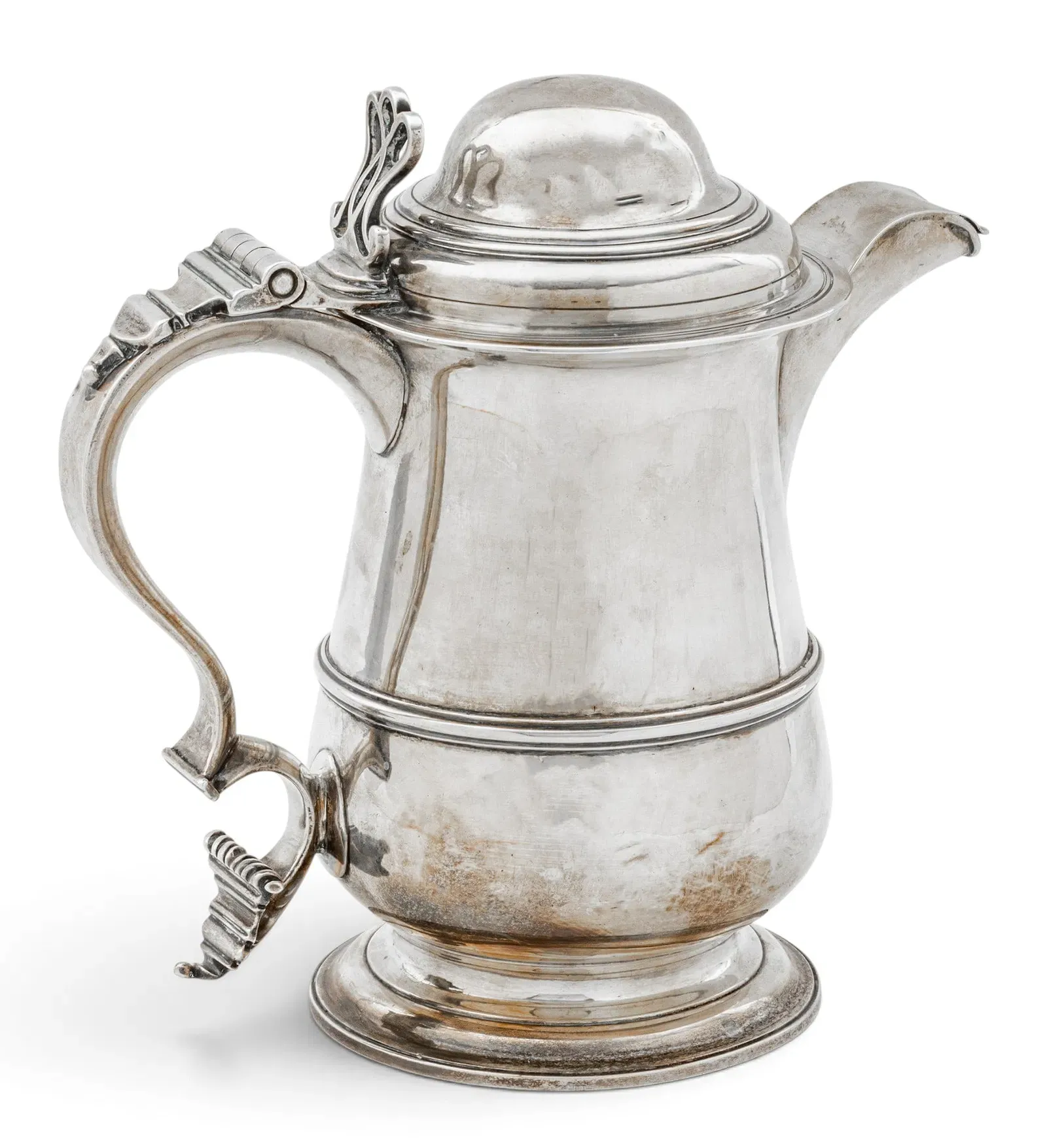
This elegant piece is a George II period sterling silver coffee pot, hailing from England and dating precisely to 1739. It embodies the robust, relatively unadorned aesthetic that characterized early Georgian silver, a departure from the more ornate styles that would follow later in the century. The pot features a tapering cylindrical body with a distinctive molded medial band, resting on a stepped circular foot. The domed lid, complete with a bell-shaped finial and an intricate openwork thumbpiece, adds a touch of refinement. The double-scroll handle and the spout, which bears the faint remnants of an engraved cartouche, complete the classic form.
The true confirmation of its age and origin lies on the underside, where we find a clear set of hallmarks. These include the lion passant for sterling silver, the crowned leopard's head for the London assay office, the date letter 'd' for 1739, and the maker's mark 'WC', which is possibly that of the silversmith William Cripps. The piece shows expected signs of its nearly 300-year history, including surface wear, minor dings, and tarnishing, which only add to its authentic character. The worn engraving on the spout suggests generations of polishing. Based on its clear hallmarks, classic form, and overall condition, I am highly confident in its authenticity as a period piece. At auction, a fine early Georgian coffee pot like this would typically be estimated between $800 and $1,200. It's a wonderful, tangible piece of 18th-century history.
Used for this report's TTS and avatar presentation.
Expert Review Script
This elegant piece is a George II period sterling silver coffee pot, hailing from England and dating precisely to 1740. It embodies the robust, relatively unadorned aesthetic that characterized early Georgian silver, a departure from the more ornate styles that would follow later in the century. The pot features a tapering cylindrical body with a distinctive molded medial band, resting on a stepped circular foot. The domed lid, complete with a bell-shaped finial and an intricate openwork thumbpiece, adds a touch of refinement. The double-scroll handle and the spout, which bears the faint remnants of an engraved cartouche, complete the classic form.
The true confirmation of its age and origin lies on the underside, where we find a clear set of hallmarks. These include the lion passant for sterling silver, the crowned leopard's head for the London assay office, the date letter 'e' for 1740, and the maker's mark 'WC', which is possibly that of the silversmith William Cripps. The piece shows expected signs of its nearly 300-year history, including surface wear, minor dings, and tarnishing, which only add to its authentic character. The worn engraving on the spout suggests generations of polishing. Based on its clear hallmarks, classic form, and overall condition, I am highly confident in its authenticity as a period piece. At auction, a fine early Georgian coffee pot like this would typically be estimated between $800 and $1,200. It's a wonderful, tangible piece of 18th-century history.
Condition:Very Good (shows expected wear, minor dings, and tarnishing consistent with age; engraved cartouche is worn)
Value:$800 - $1,200
Peer-Reviewed Market Values
Dating Range
Pending structured dating
Auction Liquidation
Pending structured market values
Fair Market Value
Pending structured market values
Replacement Value
Pending structured market values
Comparables Used
No saved comparables yet
Research Confidence
Insufficient Data
Peer review completed, but this run did not return structured market value ranges.
Maker's Marks / Writing:Hallmarks on underside: Lion Passant (sterling standard), Leopard's Head Crowned (London assay office), Date letter 'e' (1740), Maker's mark 'WC' (possibly William Cripps). Also, an engraved weight '32=04' (32 oz, 4 dwt).
Date:2026-09-28 12:15:12.551604
Description:
A George II period sterling silver coffee pot, featuring a tapering cylindrical body with a molded medial band, resting on a stepped circular foot. The pot has a domed hinged lid with a bell-shaped finial and an openwork thumbpiece. The double-scroll silver handle is fitted with a scrolled terminal. The spout is decorated with a faint engraved cartouche. The underside bears hallmarks for London, 1740, and a maker's mark 'WC', possibly for William Cripps.
Curator Questions
Curated by Jade
Assessment:
This is a handsome example of early Georgian silver, exhibiting the robust and relatively unadorned forms characteristic of the period. The hallmarks are legible, confirming its date and origin. The piece shows signs of age and use, including surface wear, minor dings, and some tarnishing, which are expected for a piece of this age. The engraved cartouche on the spout is quite worn, suggesting it may have been polished over many years. Overall, it is a solid and authentic piece of 18th-century English silver.
Individual Images:
whole coffee pot
whole coffee pot three-quarter view
coffee pot with lid open
back of coffee pot showing handle
detail of spout and engraving
detail of thumbpiece and hinge
underside of coffee pot
detail of hallmarks on underside
Provenance:
None provided
Condition:
Very Good (shows expected wear, minor dings, and tarnishing consistent with age; engraved cartouche is worn)
Identification Score: 95%
The form, style, and hallmarks clearly identify this as an English sterling silver coffee pot from the George II period.
Authenticity Score: 95%
The hallmarks (lion passant, leopard's head crowned, date letter 'e' for 1740, and maker's mark) are consistent with authentic 18th-century London silver. The construction, wear, and patina also support its authenticity.
Image Memory Note
None
None
Keywords
George II, Sterling Silver, Coffee Pot, English Silver, 18th Century, William Cripps, London Hallmarks, Antique Silver
The report was edited after initial Artmink draft. Original AI draft preserved in Artmink audit history.
Fair Market Value
Pending structured market values
Replacement Value
Pending structured market values
Archived Matches
No archive matches yet
Research Confidence
Insufficient Data
Research Findings
Key Visible Evidence
Image 1 displays a tapering cylindrical silver coffee pot with a molded medial band, domed lid, and double-scroll handle. Image 2 reveals a clear set of hallmarks on the underside: a lion passant, a crowned leopard's head, a maker's mark 'WC', and a date letter. The date letter is clearly a Roman lowercase 'e' within a shaped shield, not a 'd' as claimed in the report.
Market and Source Support
The London sterling hallmark date letter sequence identifies Roman lowercase 'e' as 1740, 1780, 1820, or 1900. The presence of the crowned leopard's head (pre-1822) and the absence of a sovereign duty head (1784-1890) narrow the date to 1740 or 1780. The early Georgian tapering cylindrical form definitively aligns with the 1740 date, correcting the report's 1739 attribution.
Needs Verification
- The maker's mark 'WC' is plausibly attributed to William Cripps, though other contemporary silversmiths with these initials (such as William Cox) cannot be entirely ruled out.
- The solid silver handle is somewhat unusual for a coffee pot of this period (which typically feature wooden handles for heat insulation) and may warrant physical inspection to determine if it is a later replacement or missing its original insulators.
Advisory Conclusion
The report is partly supported. The identification of the object as a George II sterling silver coffee pot is correct, and the maker attribution is plausible. However, the report misreads the date letter; visual evidence and hallmark references confirm the letter is 'e', dating the piece to 1740, not 1739.

Share: