Early 20th-Century Continental School Sepia Ink-and-Wash Village Street Scene on Paper
LANGUAGE UNLOCK
Glossary Roundup
Original Presentation Script
No narration for this appraisal report
Used for this report's TTS and avatar presentation.
Item Report
Early 20th-Century Continental School Sepia Ink-and-Wash Village Street Scene on Paper
By:Unknown (indistinct signature or initials at lower left, illegible in photo)
Style:Continental School Realist (Architectural/Topographical)
Origin:Italy (probable, Alpine/Lombard region)
Materials:Sepia ink and wash (possibly watercolor) on wove paper; matted and framed under glass
Age:circa 1920–1940
Condition:Very Good (even overall toning; no obvious tears or losses; assessment limited by glass reflections and matting)
Value:$80–$200 (auction, conservative)
Maker's Marks / Writing:Lower left appears to show an indistinct signature or initials (unreadable in the photo); no legible date or title visible.
Date:2025-10-05 14:11:11.582591
Description:
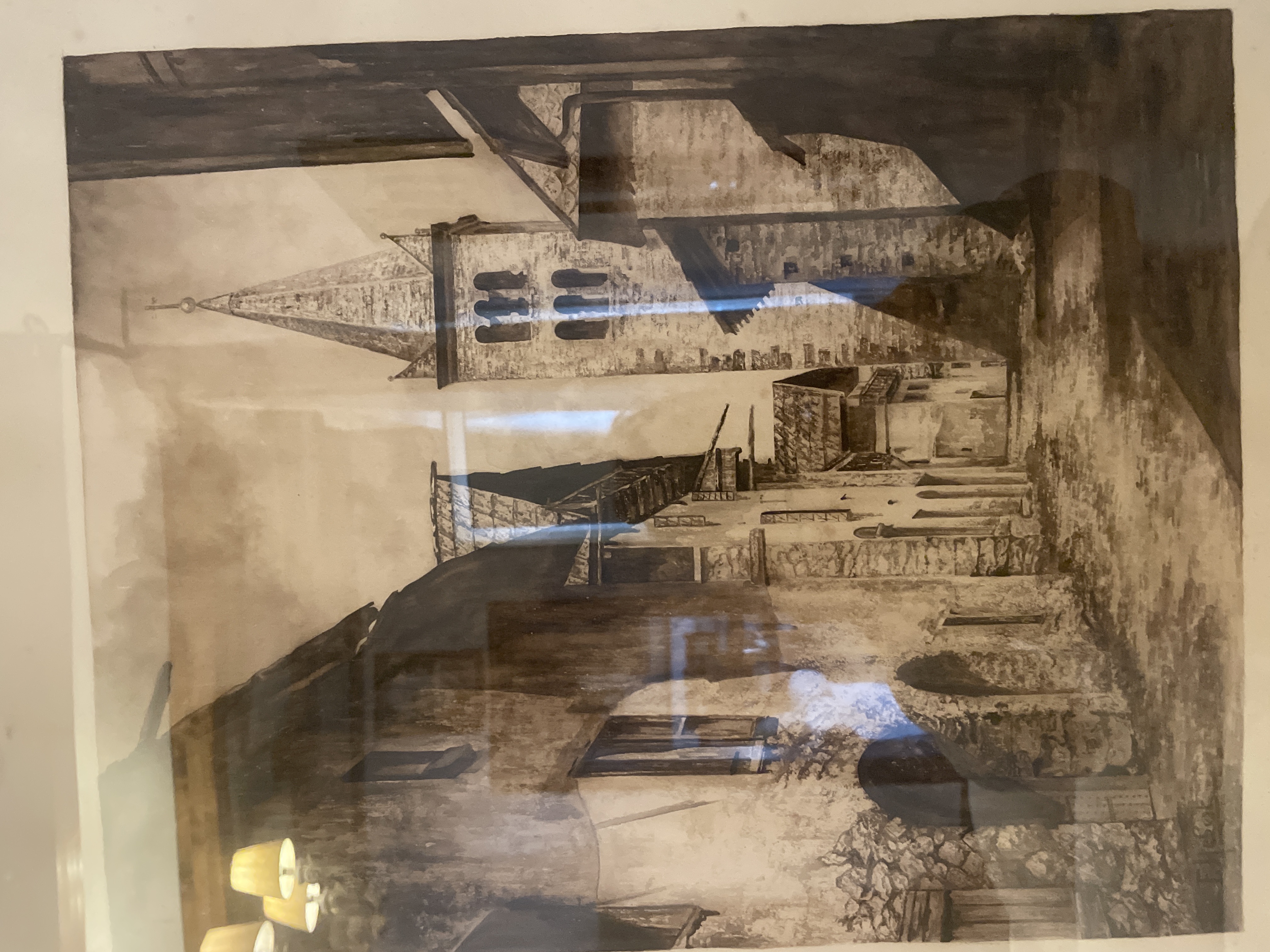
Framed monochrome ink-and-wash (sepia) depiction of a narrow European village street culminating in a Romanesque church tower with paired arched belfry openings and a tall spire with cross finial. The scene shows rough stone and stucco facades, timber eaves, arched doorways, and cobbled paving. Tonal washes create atmospheric depth; line work defines architectural textures. Likely an original work on paper rather than a color print, though this cannot be confirmed from the photo alone.
Curator Questions
Curated by Jade
Assessment:
This appears to be an early-to-mid 20th-century European architectural street scene, likely Italian based on the Romanesque campanile with paired belfry openings and steep spire. The handling of wash and texture suggests a competent draughtsman working in a realist, topographical manner aimed at picturesque travel or study subjects. Framing and mat look later but not brand new. Without inspection outside the frame, I cannot rule out a photomechanical reproduction (e.g., photogravure) with hand-applied wash; close examination for plate marks, dot patterns, or uniform surface gloss would clarify. A word about fakes.. works on paper of European street scenes are frequently reproduced as photogravures, collotypes, or modern giclée prints; verify under magnification for continuous tone versus dot patterns and check paper age and margins before assigning higher value.
Individual Images:
whole item
Provenance:
No provenance documents shown.
Condition:
Very Good (even overall toning; no obvious tears or losses; assessment limited by glass reflections and matting)
Identification Score: 70%
High confidence that this is a Continental (European) realist architectural village scene in sepia ink-and-wash from the early 20th century; specific locality and artist remain uncertain due to indistinct signature.
Authenticity Score: 45%
From the photo it looks like hand-applied wash and line, but reflections from glazing and lack of margin/plate-mark view prevent ruling out a period photomechanical print or modern reproduction. Closer in-person inspection of paper surface, margins, and under magnification is needed.
Image Memory Note
Vertical framed artwork behind glass with cream/off-white mat; sepia-toned depiction of a narrow cobbled lane flanked by stone and stucco buildings with overhanging eaves and small windows. Dominant feature is a Romanesque church bell tower to the right of center with two levels of paired arched openings (biforas) and a tall pyramidal spire topped by a cross with ball finial. Perspective leads to a vanishing point down the lane; small distant figure possibly present but not distinct. Texture rendering on stonework is detailed with stipple and hatch; sky is light wash. Lower left within the image area there is a faint, illegible inscription or signature—looks like several capital letters or a cursive surname, but cannot be read from the photo. No visible title or edition number; no visible plate mark due to mat covering margins. The paper shows even age toning; no apparent foxing or tears evident. Strong reflections from two lamp shades and room environment are visible on the glazing, especially left quadrant and center, partially obscuring details. No other stamps or labels visible.
Keywords
Continental School, European village street, ink and wash, sepia, architectural drawing, Romanesque tower, Italy, early 20th century, framed artwork, topographical art
The report was edited after initial Artmink draft. Original AI draft preserved in Artmink audit history.


Share: