Japanese Edo-Style Lacquered-Iron Samurai Armor (Tosei Gusoku)
LANGUAGE UNLOCK
Glossary Roundup
Original Presentation Script
No narration for this appraisal report
Used for this report's TTS and avatar presentation.
Item Report
Japanese Edo-Style Lacquered-Iron Samurai Armor (Tosei Gusoku)
By:Unknown armorer/workshop (components likely from different periods)
Style:Japanese arms and armor – Edo-style tosei gusoku
Origin:Japan
Materials:Lacquered iron/steel plates and lames, silk braid lacing (odoshi), leather and doeskin, gilt copper-alloy fittings, horsehair on mask, wood stand
Age:Circa 1900–1950 (composite assembly in Edo style; parts may include earlier elements)
Condition:Good (visible lacquer losses and surface wear; lacing appears later and intact; overall complete but not professionally authenticated)
Value:$3,000–$8,000 (auction, as a likely later/composite display set; if authenticated Edo-period throughout, potential $20,000–$40,000)
Maker's Marks / Writing:No clear maker’s mark visible; circular maedate mount on kabuto and a raised dragon medallion on cuirass noted.
Date:2025-10-31 16:38:43.659138
Description:
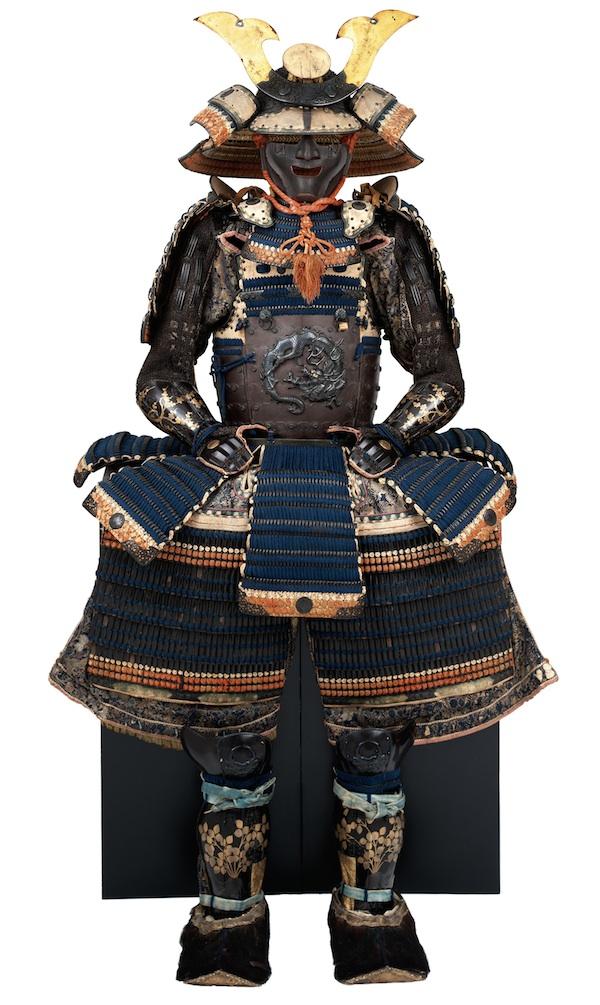
A complete suit of Japanese samurai armor comprising a multi-plate suji-bachi kabuto with gilt kuwagata crest, a lacquered iron menpo mask with moustache, large sode shoulder guards, a hotoke-do style cuirass bearing a raised dragon medallion, laced kusazuri skirt, kote sleeves, haidate thigh guards with stenciled leather, and suneate shin guards. Indigo/blue silk odoshi lacing with contrasting buff tones; gilt-copper alloy mounts and lacquered finishes.
Curator Questions
Curated by Jade
Assessment:
This is a well-presented tosei gusoku (modern-style) samurai armor with classic features: suji-bachi kabuto with kuwagata, ressei menpo, hotoke-do with dragon device, broad sode, and full leg defenses. The uniform, clean indigo lacing, vivid gilding and overall presentation suggest a composite or later assembly intended for display, very common from late Meiji through Showa eras. Lacquer losses and edge wear are visible, consistent with age and handling, but a definitive period judgment requires close inspection of plate construction, lacquer stratigraphy, and interior rivets. A word about fakes.. Japanese armor is frequently reproduced or reassembled from parts; many 20th-century sets emulate Edo-period styles. Without detailed interior photos and provenance, I treat this as a later/composite example and value it conservatively for auction.
Individual Images:
none
Provenance:
None provided.
Condition:
Good (visible lacquer losses and surface wear; lacing appears later and intact; overall complete but not professionally authenticated)
Identification Score: 95%
Distinctive samurai armor components are clearly present (kabuto with kuwagata, menpo, sode, do, kusazuri, haidate, suneate) and the construction/lacing are typical of Japanese tosei gusoku.
Authenticity Score: 45%
Single studio-style photo with no interior or hardware details; very even, bright re-lacing, crisp gilding, and display-oriented assembly are consistent with late Meiji–Showa composites. Could include older parts, but full Edo-period originality is unproven.
Image Memory Note
None
None
Keywords
Samurai armor, tosei gusoku, Edo style, kabuto, menpo, Japanese arms and armor, Japan, lacquered iron, kuwagata crest, odoshi lacing
The report was edited after initial Artmink draft. Original AI draft preserved in Artmink audit history.

Share: