American Late Victorian Walnut Estey Parlor Reed Organ
LANGUAGE UNLOCK
Glossary Roundup
Original Presentation Script
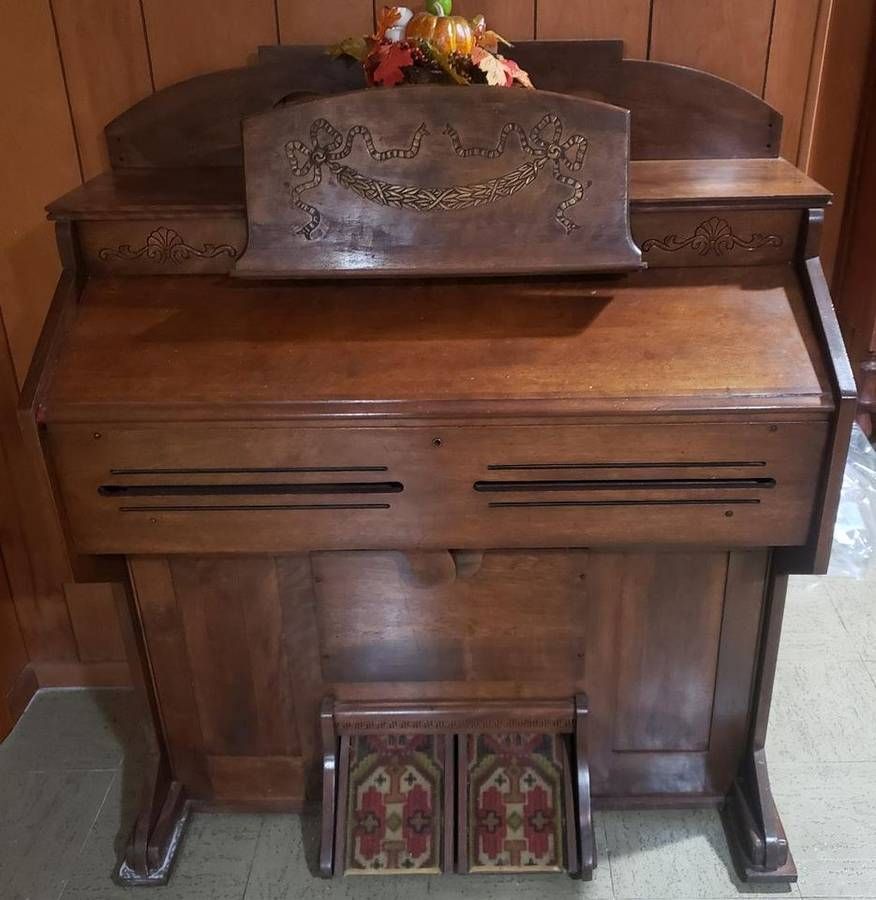
Let’s talk about this American Late Victorian Walnut Estey Parlor Reed Organ — essentially the home entertainment center of 1900. Compact, upright, with its folding lid and decorative crest, it’s the sort of instrument that anchored hymn-sings and parlour soirées across small-town America.
Built by the Estey Organ Company of Brattleboro, Vermont, this example likely dates from around 1890 to 1910, when reed organs were at their peak but just beginning to feel the pressure from the piano and, later, the phonograph. The incised ribbon swags and restrained carving are textbook late-Victorian design, toned down for respectable middle-class taste.
The case appears to be walnut or walnut-stained hardwood; the keytops are either early celluloid or late ivory, with ebonized sharps. Twin tapestry-covered treadles pump air through a set of metal reeds — a mass-produced yet still hand-fitted mechanism that gave Estey its reputation for reliability.
Condition looks honest: some surface wear, key discoloration, and age to the pedal fabric. The big unknown is internal: dried bellows leather and stuck reeds are common and can be costly to restore, but they don’t diminish its historical charm.
On authenticity, this piece scores high — the Estey nameboard, hardware, and style all align with known models, so I’d put it around 92 out of 100. In today’s market, where supply exceeds demand, a fair auction estimate is roughly $200 to $500, more if professionally restored and musically lively. A modest price for a roomful of vintage hymn power.
Used for this report's TTS and avatar presentation.
Item Report
American Late Victorian Walnut Estey Parlor Reed Organ
By:Estey Organ Company
Style:Late Victorian / Parlor Organ
Origin:United States (Brattleboro, Vermont)
Materials:Walnut (or walnut-stained hardwood) case, ivory or celluloid keytops, ebonized sharps, fabric-covered treadles, metal and leather internal mechanisms
Age:Circa 1890–1910
Condition:Good to very good (visible surface wear and key discoloration; mechanical condition not verified)
Value:$200–$500 USD at auction
Maker's Marks / Writing:Script on nameboard: “Estey Organ Co. Brattleboro, Vt. U.S.A.” plus labeled draw stops.
Date:2025-11-27 01:44:42.405360
Description:
Compact pump (reed) organ in a stained-walnut case with folding cover and decorative crest rail. The instrument features a single manual keyboard, multiple draw stops, and twin tapestry-covered foot treadles. The case is embellished with incised ribbon-and-swag motifs and low relief carving typical of late Victorian parlor furniture. Front horizontal slots act as sound vents. Marked on the nameboard “Estey Organ Co. Brattleboro, Vt. U.S.A.”
Curator Questions
Curated by Jade
Assessment:
This is a late Victorian/early 20th-century Estey parlor reed organ, built in Brattleboro, Vermont, a major American center for pump-organ manufacture. The simplified case, incised ribbon ornament, and relatively modest height suggest a later, more economical model rather than the earlier, highly ornate Gothic examples. Condition looks structurally sound, with expected finish wear, some discoloration to keys, and age to the treadle fabric; playability is unknown and strongly affects value, as many examples need bellows or action restoration. A word about fakes.. reed organs are not commonly forged, so the principal concern here is condition and completeness rather than fakery, and the clear Estey nameboard, hardware, and construction all align with authentic factory production of the period. In today’s market these are charming yet somewhat under-valued instruments: they appeal to niche collectors of musical Americana and for decorative use, but supply outstrips demand. Assuming intact mechanisms but no recent professional restoration, a conservative liquidation estimate would be in the $200–$500 range, with more possible if fully serviced and musically strong. Always keep documentation and any serial numbers, as they help tie this piece to Estey’s well-recorded production history. Antiquity meets parlour nostalgia. {chavatar_catchphrase}
Individual Images:
none
Provenance:
Not provided; presumed domestic use in a private home.
Condition:
Good to very good (visible surface wear and key discoloration; mechanical condition not verified)
Identification Score: 98%
The Estey Organ Co. nameboard is clearly visible, the pedal and stop layout match known Estey parlor reed organs, and the case style and construction are consistent with catalogued late 19th–early 20th century models.
Authenticity Score: 92%
Factory inscription, period-appropriate wear, hardware, and construction all point to an original Estey reed organ rather than a later reproduction; fakery in this category is rare, so remaining uncertainty mainly concerns later repairs or replaced parts rather than the organ’s period origin.
Image Memory Note
None
None
Keywords
American, Estey Organ Company, parlor reed organ, pump organ, late Victorian, Brattleboro Vermont, musical instrument, antique furniture
The report was edited after initial Artmink draft. Original AI draft preserved in Artmink audit history.

Share: