Premium upgrade: George delivers your appraisal as a guided podium narration with synced visuals and voiceover.
Output is a narrated, animated slideshow with video intro and outro, sandwiching the autoplay voiceover sequence in actual video.
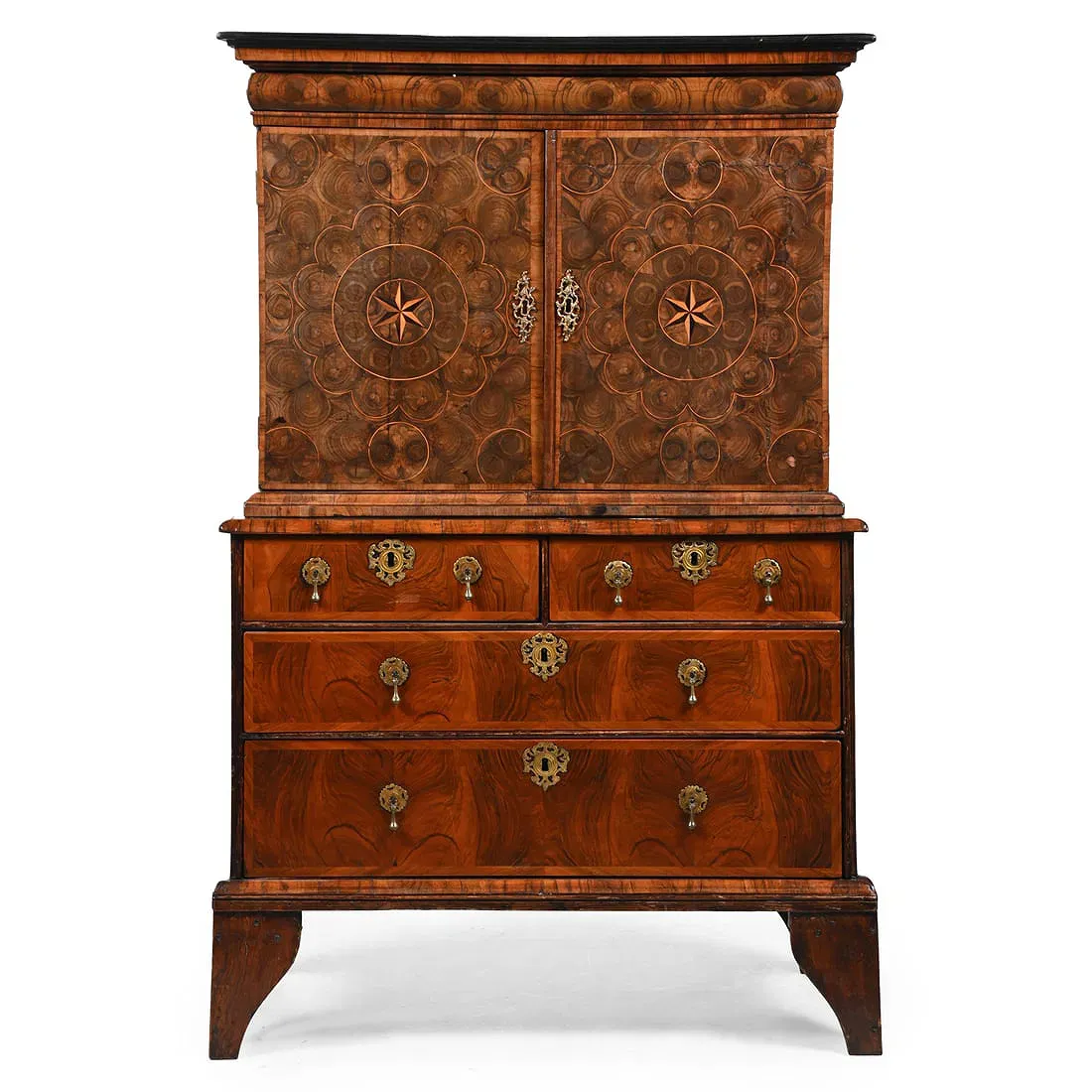
William and Mary Style Walnut and Oyster Veneer Cabinet on Chest (Composite)
LANGUAGE UNLOCK
Glossary Roundup
Original Presentation Script
Hello, collectors! Today we are examining a fascinating piece of English furniture history: a Walnut and Oyster Veneer Cabinet on Chest. This piece offers a great lesson in reading antique furniture.
The upper section features stunning 'oyster' veneer, a hallmark of the William and Mary period circa 1690. Cabinetmakers achieved this mesmerizing pattern by taking transverse slices of small walnut branches. Notice the intricate geometric stringing on the doors, forming elegant star and circular motifs.
However, when we look at the lower chest, the story changes. The drawers are faced with standard figured walnut, not oyster veneer, and the piece rests on splayed bracket feet—a style that didn't become popular until the late 18th century. This strongly suggests the piece is a 'marriage,' where an antique upper cabinet was later joined to a different lower chest. While an intact period example could bring $15,000 to $25,000 at auction, composite pieces like this are more accessible, though they still offer the beautiful craftsmanship of the era. It's a wonderful, decorative survivor that tells a complex historical story!
Used for this report's TTS and avatar presentation.
Item Report
William and Mary Style Walnut and Oyster Veneer Cabinet on Chest (Composite)
Peer review completed, but this run did not return structured market value ranges.
Maker's Marks / Writing:None visible
Date:2026-08-26 01:08:47.306502
Description:
A cabinet on chest featuring a William and Mary style upper section with two doors decorated in walnut oyster veneer and intricate geometric stringing forming star and circular motifs. The lower section, which appears to be a later addition or marriage, is a chest of two short over two long drawers veneered in figured walnut, raised on later splayed bracket feet. The piece retains brass drop handles and ornate escutcheons. Note: The interior is not visible in the provided images.
Curator Questions
Curated by Jade
Assessment:
While the upper section of this cabinet displays the spectacular oyster veneering and geometric stringing characteristic of late 17th-century English cabinetmaking, the piece as a whole appears to be a 'marriage' or composite. The lower chest is veneered in figured walnut rather than oyster veneer, creating a distinct visual break. Furthermore, the piece is raised on splayed bracket feet, a style typical of the late 18th century, rather than the bun feet or turned stands expected for circa 1690. The hardware, while stylistically appropriate for the William and Mary period, may be later replacements. Pending an inspection of the interior and secondary woods, this piece should be evaluated as a composite of period and later elements.
Individual Images:
whole cabinet front view closed
Provenance:
None provided
Condition:
Fair to Good (composite piece/marriage, later feet, typical wear and veneer repairs)
Identification Score: 80%
The upper section features classic William and Mary oyster veneer and stringing, but the lower section is a mismatched figured walnut chest on late 18th-century style splayed bracket feet.
Authenticity Score: 60%
The upper doors show convincing signs of period oyster veneering and stringing. However, the mismatched figured walnut veneer on the lower chest and the late 18th-century splayed bracket feet strongly indicate that the upper and lower sections were married at a later date. The score reflects this composite nature.
Image Memory Note
None
None
Keywords
William and Mary, oyster veneer, walnut, cabinet on chest, English antique, marriage, composite, stringing, splayed bracket feet
The report was edited after initial Artmink draft. Original AI draft preserved in Artmink audit history.
Peer Review Summary
Dating Range
Upper section circa 1690; lower section and feet 18th/19th century (Composite)
Fair Market Value
Pending structured market values
Replacement Value
Pending structured market values
Archived Matches
No archive matches yet
Research Confidence
Insufficient Data
Peer Review
Key Visible Evidence
The image shows a cabinet on chest, but contrary to the report's claim of 'oyster veneering throughout,' only the upper doors feature oyster veneer. The lower chest section is veneered in standard figured walnut, displaying broad sweeping grain rather than the small transverse branch slices seen on the top. Additionally, the piece is raised on splayed bracket feet (French bracket feet), a style that emerged in the late 18th century, which contradicts the circa 1690 dating for the base. Finally, the interior is not shown in the provided image, so the report's detailed description of a 'fully fitted interior' cannot be verified.
Market and Source Support
Authentic William and Mary (c. 1690) cabinets typically feature consistent veneering across the primary facade and rest on bun feet or turned stands. The presence of late 18th-century splayed bracket feet and mismatched veneer types strongly indicates a 'marriage' (two disparate antique sections joined later) or a later composite piece. Reference examples of period oyster veneer cabinets confirm that the intricate transverse cuts were usually applied uniformly to the front, unlike the distinct transition seen here.
Needs Verification
['Images of the interior to verify the presence and condition of the fitted drawers and central cupboard.', 'Close-up images of the secondary woods, drawer joinery (dovetails), and hardware mounts to determine the exact age of the lower chest.', 'Inspection of the backboards and the transition point between the upper and lower sections to confirm the extent of the marriage.']
Audit Conclusion
The report is partly supported regarding the style of the upper section, but contradicted regarding the lower section and overall cohesion. The visible mismatch in veneer types and the late 18th-century splayed bracket feet strongly suggest a marriage or later assemblage rather than an intact circa 1690 piece. The dating, description, and value framing must be adjusted to reflect a composite piece, and claims about the unseen interior must be removed.


Share: